
Claude Fable 5 Benchmarks Explained: Coding, Reasoning and Model Comparison (2026)
As AI coding models rapidly evolve, traditional chatbot evaluation is no longer sufficient.
Modern developers now care about real engineering performance, including:
- Repository-level reasoning
- Multi-file debugging
- AI agent workflows
- Long-context software understanding
Claude Fable 5 is designed for these tasks. To evaluate its real capability, we compare it with leading coding models such as the GLM series, Claude Opus, and Codex-style systems.
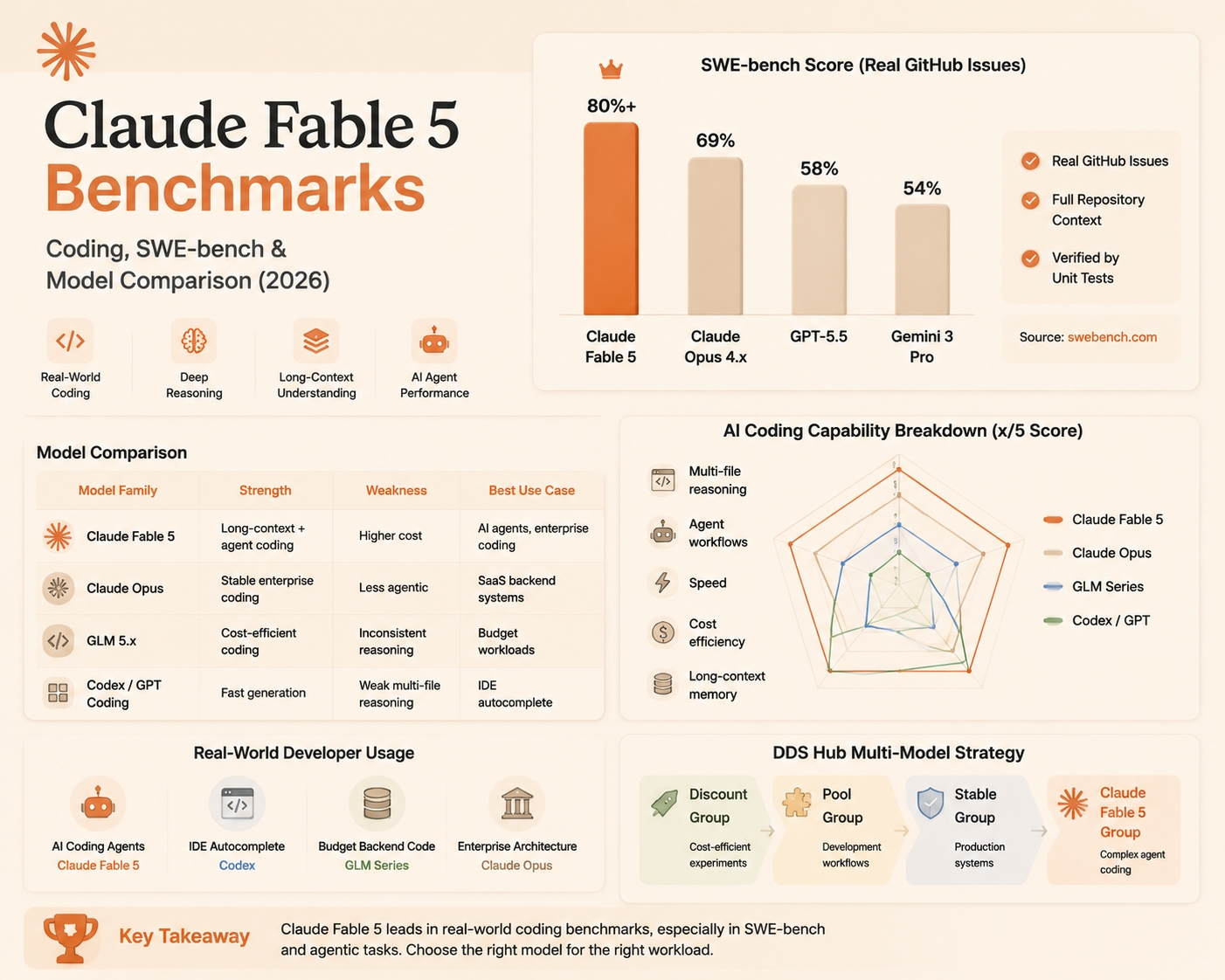
SWE-bench Performance (Core Benchmark)
SWE-bench evaluates real GitHub issue solving ability. You can review the official benchmark and the original research paper.
Results Overview
| Model | SWE-bench Score | Strength |
|---|---|---|
| Claude Fable 5 | 80%+ | Strong multi-file reasoning |
| Claude Opus 4.x | 69% | Stable enterprise coding |
| GPT-5.5 | 58% | Fast general coding |
| Gemini 3 Pro | 54% | Multimodal reasoning |
Benchmark figures reflect publicly reported SWE-bench-style evaluations and vary by test harness and configuration.
Why SWE-bench Matters
SWE-bench is one of the most realistic coding benchmarks because it evaluates:
- Real GitHub issues
- Actual unit tests
- Full repository context
It is much closer to production engineering than traditional coding tests, which is why it has become a core reference for measuring agentic coding ability.
Agentic Coding Benchmarks (Feature-Level Tasks)
Beyond single-issue fixes, feature-level benchmarks measure whether a model can build complete functionality across many steps.
Key findings from feature-level research:
- Multi-step feature development remains difficult
- Most models fail long-horizon tasks
- Reasoning models perform more consistently
This is where Claude Fable 5's long-context memory and planning ability give it an advantage over faster but shallower models.
Model Comparison (Coding Ecosystem)
GLM vs Claude vs Codex vs Opus
| Model Family | Strength | Weakness | Best Use Case |
|---|---|---|---|
| Claude Fable 5 | Long-context + agent coding | Higher cost | AI agents, enterprise coding |
| Claude Opus | Stable enterprise coding | Less agentic | SaaS backend systems |
| GLM 5.x | Cost-efficient coding | Inconsistent reasoning | Budget workloads |
| Codex / GPT coding | Fast generation | Weak multi-file reasoning | IDE autocomplete |
References: OpenAI code guide and Anthropic Claude Opus news.
AI Coding Capability Breakdown (Score out of 5)
| Capability | Claude Fable 5 | Claude Opus | GLM Series | Codex |
|---|---|---|---|---|
| Multi-file reasoning | 5/5 | 4/5 | 3/5 | 2/5 |
| Agent workflows | 5/5 | 3/5 | 3/5 | 2/5 |
| Speed | 3/5 | 4/5 | 4/5 | 5/5 |
| Cost efficiency | 2/5 | 3/5 | 5/5 | 4/5 |
| Long-context memory | 5/5 | 4/5 | 3/5 | 2/5 |
Interpretation
- Claude Fable 5 (5/5 reasoning) → best for complex engineering systems
- Claude Opus (balanced 3–4/5) → enterprise stability
- GLM (5/5 cost efficiency) → budget coding workloads
- Codex (5/5 speed) → IDE and snippet generation
Real-World Developer Usage
| Use Case | Model Used | Reason |
|---|---|---|
| AI coding agents | Claude Fable 5 | Long-horizon reasoning |
| IDE autocomplete | Codex | Fast response |
| Budget backend code | GLM | Low cost |
| Enterprise architecture | Claude Opus | Stability |
Academic & Industry Research
Recent research has expanded coding evaluation in three important directions:
- Execution-based evaluation, which runs generated code against tests instead of matching text
- Multi-repository reasoning, which measures understanding across separate codebases
- Long-horizon failure analysis, which studies why models break down on extended tasks
AI coding is shifting from "correct code generation" to "system-level reliability."
This shift favors models like Claude Fable 5 that maintain context and reasoning quality over long, multi-step engineering work.
Claude Fable 5 in Production Systems
Common production use cases include:
- Full repository debugging
- Autonomous coding agents
- System design assistance
- Enterprise automation
For a deeper look at how teams deploy it, see the Claude Fable 5 use cases and the AI agents guide.
DDS Hub Multi-Model Strategy
DDS Hub organizes models into groups for real-world deployment:
| Group | Purpose |
|---|---|
| Discount Group | Cost-efficient experiments |
| Pool Group | Development workflows |
| Stable Group | Production systems |
| Claude Fable 5 Group | Complex agent coding |
This allows teams to combine:
- Isolated benchmarking
- Cost control
- Environment separation
- A multi-model architecture
You can compare every available model on the DDS Hub models page and configure your first request from the setup documentation. For cost planning, see the Claude Fable 5 pricing guide and the Claude Fable 5 API guide.
Key Takeaways
Claude Fable 5 is a frontier coding and reasoning model designed for:
- SWE-bench level tasks
- Multi-file debugging
- AI agent workflows
- Long-context engineering
Modern AI systems increasingly require multi-model orchestration rather than single-model dependency. By benchmarking each model on the tasks it does best—and routing workloads through a group-based platform like DDS Hub—developers can maximize both performance and cost efficiency as their applications scale.