
Claude Fable 5 Pricing Explained: API Costs, Official Docs and Deployment Strategy (2026)
As AI models become more powerful, pricing has become one of the most important factors in real-world adoption.
Claude Fable 5 is Anthropic's most capable public model, designed for advanced reasoning, coding, AI agents, and enterprise-grade workflows. While its performance is significantly higher than smaller models, its cost structure also reflects its position as a frontier model.
For developers, understanding pricing is not just about API costs—it is about designing the right deployment strategy that balances performance, reliability, and operational efficiency.
In this guide, we break down Claude Fable 5 pricing using official sources and explain how developers optimize costs in production environments.
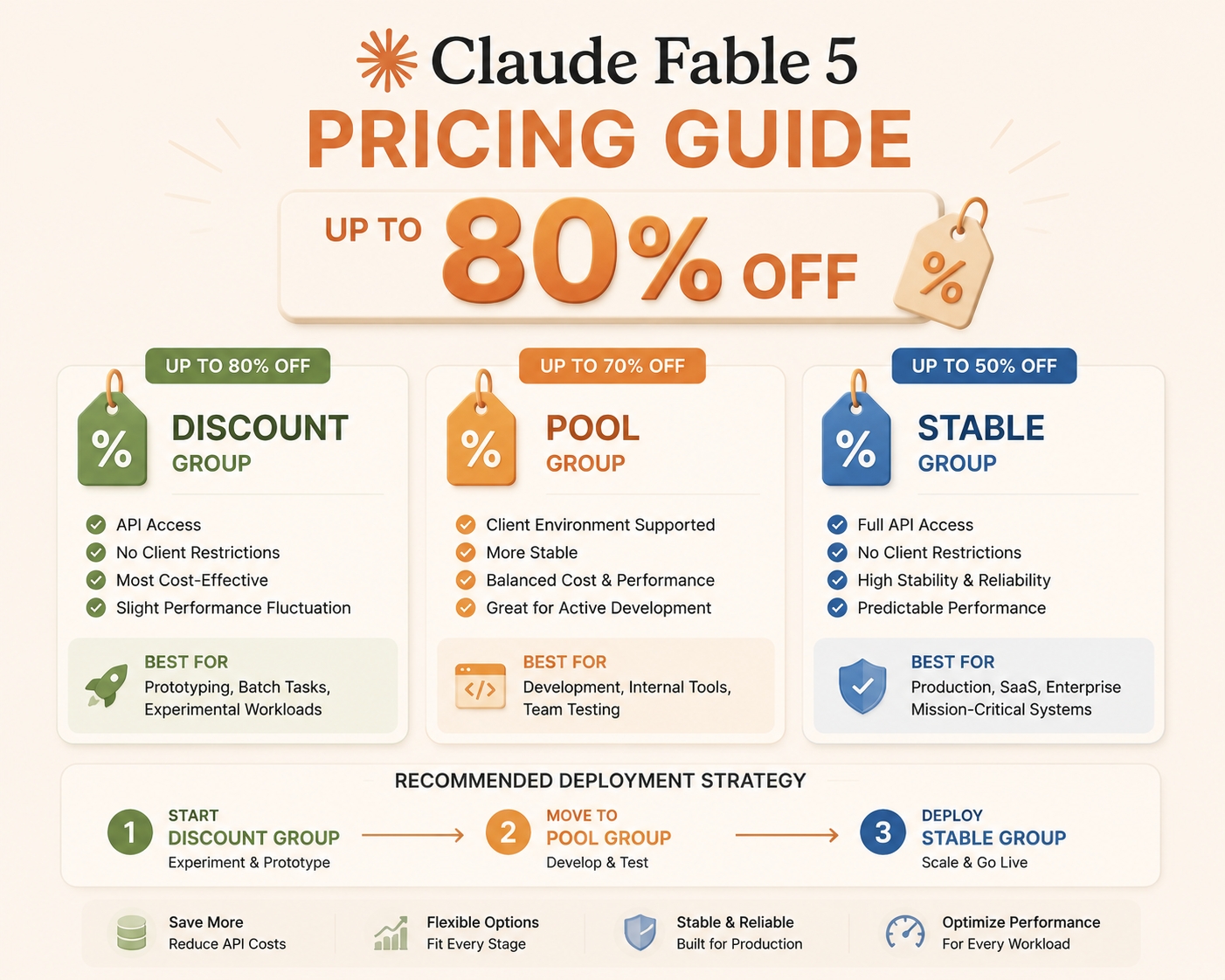
Official Claude Fable 5 API Pricing
According to Anthropic's official API documentation, Claude Fable 5 is positioned as a premium frontier model with the following pricing structure:
- Input tokens: approximately $10 per 1M tokens
- Output tokens: approximately $50 per 1M tokens
You can verify the latest official pricing details directly from Anthropic's documentation:
These pricing tiers reflect Claude Fable 5's positioning as a high-performance model optimized for complex reasoning, coding, and long-context AI workflows.
Compared with smaller models such as Claude Sonnet 5, Fable 5 is significantly more expensive—but it also delivers higher accuracy, deeper reasoning capability, and better performance in multi-step tasks. If you want a full capability overview before evaluating cost, see our Claude Fable 5 API guide.
When Claude Fable 5 Is Worth the Cost
Not every workload requires a frontier model.
Claude Fable 5 is best suited for tasks where output quality and reasoning depth matter more than cost efficiency.
High-value use cases include:
- Large-scale software engineering tasks
- AI agent workflows with tool integration
- Enterprise knowledge systems
- Research and technical analysis
- Complex code generation and refactoring
- Long-context reasoning tasks
In these scenarios, using a cheaper model may lead to lower-quality outputs, increased debugging time, and higher iteration costs—ultimately increasing total system cost. For more concrete examples, explore 10 real-world Claude Fable 5 use cases.
The Real Challenge: Cost vs Stability vs Flexibility
In production AI systems, pricing is only one part of the equation.
Developers must also consider:
- Request stability
- Latency consistency
- Model availability
- Environment separation
- Development vs production workloads
This is why many engineering teams adopt multi-tier model deployment strategies instead of relying on a single model configuration.
Claude Fable 5 Deployment Options in DDS Hub
DDS Hub organizes AI models into structured Model Groups, allowing developers to choose deployment strategies based on cost, stability, and environment requirements.
Instead of a single pricing model, developers select a group that fits their workload.
Discount Group (Up to 80% Off)
Pricing level: up to 80% cheaper than standard deployment.
Characteristics:
- API access supported
- No strict client limitations
- May experience slight performance fluctuations
Best for:
- Lightweight coding tasks
- Prototyping
- Batch processing
- Experimental workloads
- Non-critical AI features
This group prioritizes maximum cost efficiency and is ideal for experimentation and early-stage development.
Pool Group (Up to 70% Off)
Pricing level: around 70% cheaper than standard pricing.
Characteristics:
- Only available in supported client environments
- More stable than the discount group
- Balanced cost and performance
Best for:
- Development environments
- Internal tools
- Team testing workflows
- Product prototyping
This group is designed for active development stages, offering a balance between stability and cost savings.
Stable Group (Up to 50% Off)
Pricing level: around 50% cheaper than standard pricing.
Characteristics:
- Full API access
- No client restrictions
- High stability and reliability
Best for:
- Production systems
- SaaS applications
- Enterprise integrations
- Mission-critical workflows
- AI agents in production
This is the most balanced deployment option, combining stability, flexibility, and predictable performance.
Choosing the Right Deployment Strategy
| Stage | Recommended Group |
|---|---|
| Early prototyping | Discount Group |
| Active development | Pool Group |
| Production systems | Stable Group |
Many teams use a staged migration approach:
- Start with the Discount Group for experimentation
- Move to the Pool Group during development
- Deploy the Stable Group in production
This ensures both cost optimization and system reliability. You can compare every available model group on the DDS Hub models page and check current rates on the pricing page.
Why Developers Use Multiple Groups
Modern AI systems rarely rely on a single deployment configuration.
Using multiple model groups allows teams to:
- Separate production and testing environments
- Control API costs per workflow
- Improve system reliability
- Reduce deployment risk
- Optimize performance per task type
This approach is especially useful for:
- AI SaaS platforms
- Coding assistants
- Autonomous AI agents
- Enterprise automation systems
DDS Hub Model Group Strategy
DDS Hub enables flexible AI deployment by organizing models into structured groups rather than a single flat API system.
For Claude Fable 5, developers can:
- Select a pricing group based on workload requirements
- Create dedicated API keys per group
- Isolate development, staging, and production environments
- Scale usage independently per project
This allows teams to maintain consistent integration logic while optimizing cost and reliability. See the setup documentation to configure your first request.
Final Thoughts
Claude Fable 5 delivers frontier-level performance, but its real-world cost depends heavily on how it is deployed.
Understanding official pricing is important, but production efficiency depends equally on deployment strategy.
Most successful AI systems do not rely on a single pricing tier. Instead, they combine multiple deployment groups:
- Discount Group for experimentation
- Pool Group for development
- Stable Group for production
This layered architecture allows developers to balance cost efficiency with system reliability while scaling AI applications effectively.
As AI adoption continues to grow, teams that optimize both model selection and deployment structure will have a significant advantage in building scalable and cost-efficient systems.