
How Developers Are Using Claude Fable 5 to Build AI Agents in 2026
The conversation around artificial intelligence has shifted dramatically over the past year. Instead of asking which large language model writes the best responses, developers are now focused on a more practical question:
Which model can reliably complete real work?
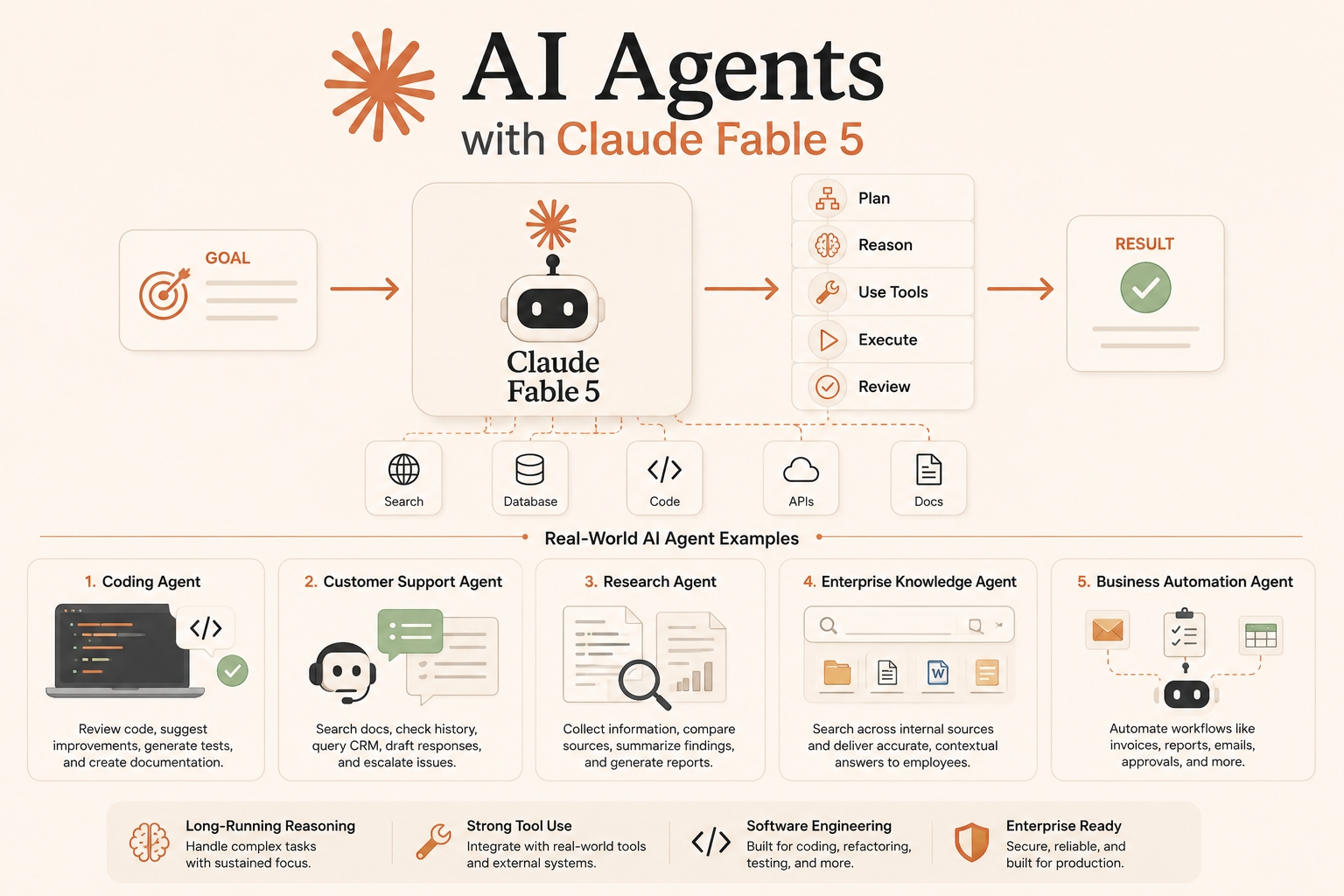
That shift has fueled the rapid growth of AI agents — systems that can plan tasks, call tools, interact with external services, remember context, and complete objectives with minimal human intervention.
Claude Fable 5 is one of the strongest models for these agentic workflows. Rather than acting as a simple chatbot, it is designed to handle long-running reasoning, structured planning, and complex software engineering tasks, making it well suited for modern AI applications.
In this guide, we'll explore why Claude Fable 5 is becoming a popular choice for AI agents and how development teams can deploy it effectively. For a broader look at the model, see our Claude Fable 5 API guide and 10 real-world use cases.
What Makes an AI Agent Different?
A traditional chatbot waits for a prompt and generates a response.
An AI agent goes much further. It can:
- Break a goal into smaller tasks
- Decide what information it needs
- Call external APIs and tools
- Analyze intermediate results
- Adjust its plan based on new information
- Continue working until the task is complete
For example, instead of simply answering "How do I deploy a Kubernetes cluster?", an AI agent could:
- Read your infrastructure configuration.
- Validate the deployment files.
- Generate missing resources.
- Execute deployment commands.
- Monitor the rollout.
- Produce a deployment report.
This ability to coordinate multiple steps is why AI agents are becoming central to enterprise AI.
Why Claude Fable 5 Excels at Agentic Workflows
Building an effective AI agent requires more than raw intelligence. It demands reliability, planning, and the ability to maintain context across long interactions.
Claude Fable 5 offers several advantages.
Long-Running Reasoning
Many workflows require dozens of intermediate decisions before reaching a final answer.
Claude Fable 5 is optimized for sustained reasoning, allowing it to work through complex objectives without losing track of previous steps.
Strong Tool Use
Modern AI agents rarely operate in isolation.
Instead, they integrate with:
- Search APIs
- Databases
- CRM systems
- Git repositories
- Issue trackers
- Cloud platforms
Claude Fable 5 performs well when coordinating these external tools, enabling developers to build assistants that interact with real-world systems instead of producing text alone.
Software Engineering
Coding agents continue to be one of the fastest-growing applications of AI.
Claude Fable 5 can support tasks such as:
- Repository analysis
- Multi-file refactoring
- Pull request reviews
- Test generation
- Bug investigation
- Technical documentation
These capabilities make it valuable for development teams looking to automate repetitive engineering work while maintaining high-quality output.
Five Practical AI Agent Examples
1. Coding Agent
A development team can build an agent that monitors GitHub pull requests, reviews code quality, suggests improvements, generates documentation, and creates unit tests before human reviewers begin their work.
2. Customer Support Agent
Instead of answering frequently asked questions, an intelligent support agent can:
- Search documentation
- Retrieve customer history
- Query CRM systems
- Draft responses
- Escalate complex issues
This creates faster and more personalized support experiences.
3. Research Agent
Researchers often spend hours gathering information from multiple sources.
A Claude Fable 5 agent can:
- Collect technical documentation
- Compare academic papers
- Summarize findings
- Generate structured reports
- Highlight conflicting information
This significantly reduces the time required for technical research.
4. Enterprise Knowledge Agent
Large organizations generate thousands of documents across departments.
An internal AI agent can search knowledge bases, HR policies, engineering documentation, product specifications, and meeting notes to answer employee questions with contextual awareness.
5. Business Automation Agent
AI agents are increasingly orchestrating operational workflows such as:
- Invoice processing
- Report generation
- Email triage
- Task assignment
- Meeting summaries
- Workflow approvals
By combining reasoning with external integrations, organizations can automate processes that previously required extensive manual coordination.
Should Every AI Agent Use Claude Fable 5?
Not necessarily.
The best model depends on the complexity of the workload.
For high-volume, low-latency applications — such as customer support or simple content generation — a lighter model may provide better cost efficiency.
Claude Fable 5 becomes the better choice when an agent must:
- Maintain long-term context
- Solve complex problems
- Coordinate multiple tools
- Work across large codebases
- Execute sophisticated workflows
Many production systems adopt a layered strategy, using different models for different stages of an AI pipeline. Our Claude Fable 5 vs Sonnet 5 comparison breaks down where each model fits.
Accessing Claude Fable 5 Through DDS Hub
As AI applications grow more sophisticated, development teams often evaluate multiple models before deploying agents into production.
DDS Hub simplifies this process by organizing supported models into dedicated Model Groups.
Rather than using one API key for every available model, developers choose the model group that best fits their workload, create an API key for that group, and activate usage after topping up their account balance.
For example:
- A Claude Sonnet 5 group can power customer-facing assistants that prioritize speed and cost efficiency.
- A Claude Fable 5 group can support autonomous coding agents and enterprise reasoning tasks.
- Separate groups are also available for Claude Opus, Codex, and GLM, allowing teams to evaluate different model families without maintaining multiple provider integrations.
This group-based approach makes it easier to isolate projects, manage permissions, and optimize API costs while keeping the development experience consistent. You can browse the options on the DDS Hub models page, follow the setup documentation, or activate API access on DDS Hub to get started.
Best Practices for Building Claude Fable 5 Agents
Successful AI agents require more than selecting a capable model.
Consider these recommendations:
- Keep each task focused and well defined.
- Combine the model with external tools instead of expecting it to know everything.
- Store intermediate state to improve reliability.
- Route simpler requests to smaller models when possible.
- Monitor latency, token usage, and task success rates in production.
A flexible architecture that supports multiple model groups allows teams to evolve their AI systems as new models become available.
Final Thoughts
AI agents are quickly becoming one of the most important software development trends, and Claude Fable 5 is well positioned to support this shift.
Its strengths in reasoning, software engineering, planning, and tool use make it an excellent foundation for applications that need to complete meaningful work rather than simply generate text.
However, successful deployments depend on more than choosing the most capable model. Teams also need an infrastructure that supports experimentation, cost optimization, and flexible deployment strategies.
By selecting the appropriate model group and using dedicated API keys for different workloads, developers can build scalable AI agents while maintaining clear project boundaries and efficient resource management.
As autonomous AI continues to mature, organizations that combine powerful models with thoughtful engineering practices will be best positioned to build the next generation of intelligent applications.