
Claude Fable 5 API Guide: Features, Pricing, Benchmarks and How to Get Started
Artificial intelligence models continue to evolve rapidly, but only a few releases significantly change how developers build software. Claude Fable 5 is one of those milestones.
Introduced by Anthropic as its most capable publicly available Claude model, Claude Fable 5 brings substantial improvements in software engineering, long-running AI agents, scientific reasoning, multimodal understanding, and enterprise automation. Rather than focusing solely on benchmark scores, Fable 5 is designed to solve complex, real-world problems that require planning, memory, and sustained reasoning over extended periods.
For developers building AI-powered products, understanding when and how to use Claude Fable 5 can have a meaningful impact on both productivity and application quality.
In this guide, we'll explore the model's key capabilities, pricing, ideal use cases, and how developers can start integrating Claude Fable 5 into production workflows.
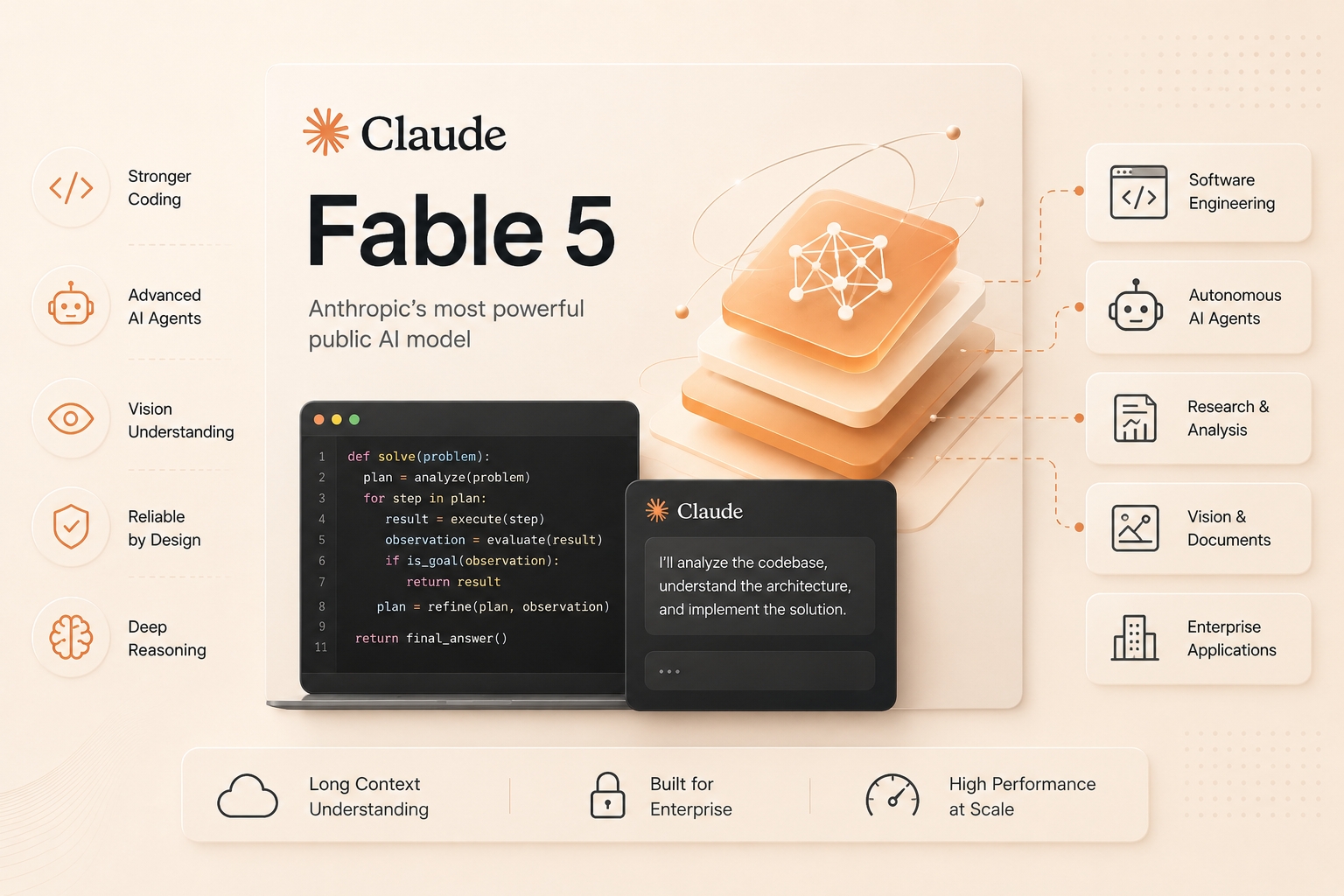
What Is Claude Fable 5?
Claude Fable 5 is Anthropic's latest flagship language model available to the public. It represents the commercial version of Anthropic's Mythos-class architecture, delivering advanced reasoning capabilities while incorporating additional safety mechanisms suitable for enterprise deployment.
Compared with previous Claude models, Fable 5 is designed to handle significantly more complex tasks. Instead of generating isolated responses, it can maintain context across long workflows, reason through multi-step problems, and collaborate with external tools to complete larger objectives.
According to Anthropic, Claude Fable 5 improves performance across several important areas:
- Software engineering
- Autonomous AI agents
- Scientific research
- Vision understanding
- Long-context reasoning
- Knowledge-intensive tasks
These improvements make Claude Fable 5 particularly attractive for organizations building production AI systems rather than simple chatbot experiences.
What's New in Claude Fable 5?
More Powerful Software Engineering
Coding has become one of the most important applications of modern language models.
Claude Fable 5 is designed to work across large codebases rather than only generating individual functions. Developers can use it to understand existing repositories, refactor legacy systems, generate documentation, review pull requests, and assist with complex debugging tasks.
For engineering teams maintaining large applications, repository-level understanding is often more valuable than isolated code generation.
Better AI Agent Performance
Modern AI applications increasingly rely on autonomous agents capable of completing multi-step workflows.
Claude Fable 5 improves its ability to:
- Plan complex tasks
- Call external APIs
- Use developer tools
- Maintain long conversations
- Execute structured workflows
- Adapt to changing objectives
These capabilities make it well suited for AI assistants that automate customer support, internal operations, software development, and enterprise knowledge management.
Enhanced Vision Understanding
Claude Fable 5 also expands Anthropic's multimodal capabilities.
The model can analyze:
- Screenshots
- User interface designs
- Charts
- Technical diagrams
- Tables
- PDF documents
This enables developers to build applications that combine visual understanding with natural language reasoning, such as document analysis platforms or intelligent design assistants.
Improved Reliability
Production AI systems require consistency as much as intelligence.
Anthropic has focused on improving instruction following and reducing incorrect or fabricated responses, helping developers build applications that produce more predictable outputs with less manual validation.
Claude Fable 5 API Pricing
Claude Fable 5 is positioned as Anthropic's premium public model.
Because of its advanced reasoning capabilities, it is intended for workloads where higher-quality outputs justify additional API costs.
Typical enterprise scenarios include:
- AI coding assistants
- Long-running autonomous agents
- Research platforms
- Legal analysis
- Scientific computing
- Enterprise knowledge systems
For simpler workloads such as customer support or general content generation, organizations may prefer smaller Claude models to optimize operational costs.
Choosing the appropriate model based on workload complexity often delivers better overall cost efficiency than using the largest model for every request.
Best Use Cases for Claude Fable 5
Enterprise Software Development
Large engineering teams can use Claude Fable 5 to understand complex repositories, generate architecture documentation, and accelerate software modernization projects.
AI Research
Its strong reasoning capabilities make the model valuable for literature review, hypothesis generation, and technical analysis.
Autonomous AI Agents
Claude Fable 5 performs particularly well in workflows requiring planning, memory, and interaction with external tools over multiple steps.
Knowledge Management
Organizations with extensive internal documentation can build intelligent assistants capable of answering detailed questions across large knowledge bases.
Scientific Applications
Researchers can use Claude Fable 5 to summarize academic papers, organize research findings, and assist with complex analytical tasks.
Choosing the Right Claude Model
Not every project requires Anthropic's most capable model.
For example:
- Claude Sonnet 5 offers an excellent balance between performance, speed, and cost for everyday development.
- Claude Opus remains suitable for demanding reasoning workloads.
- Claude Fable 5 is designed for the most complex enterprise applications where deeper reasoning and longer autonomous execution provide measurable value.
Many organizations combine multiple Claude models depending on the complexity of each task rather than relying exclusively on a single model. You can compare the available options on the DDS Hub models page.
Access Claude Fable 5 Through DDS Hub
As AI products become more sophisticated, developers often need access to different models for different workloads.
DDS Hub simplifies this process by providing access to multiple AI model groups through a consistent API experience.
Instead of using a single API key for every model, DDS Hub organizes models into dedicated Model Groups.
To access Claude Fable 5, developers simply:
- Select the Claude Fable 5 model group.
- Create an API key for that specific group.
- Top up their account balance.
- Begin making API requests using the supported models within that group.
This group-based approach provides greater flexibility for teams managing multiple projects, environments, or pricing strategies.
In addition to Claude Fable 5, DDS Hub also supports model groups for:
- Claude Sonnet 5
- Claude Opus
- OpenAI Codex
- GLM
This allows developers to choose the most appropriate model family based on performance, latency, and budget without maintaining multiple provider accounts.
Whether you're building an AI coding assistant, deploying enterprise automation, or experimenting with new agent architectures, DDS Hub provides a straightforward way to access the models you need. See the setup documentation to configure your first request, or activate API access on DDS Hub to get started.
Best Practices
Before deploying Claude Fable 5 in production, developers should consider a few practical recommendations:
- Use structured prompts with clearly defined objectives.
- Combine the model with external tools when building AI agents.
- Monitor token usage to optimize operational costs.
- Benchmark Claude Fable 5 alongside smaller models to determine the most cost-effective routing strategy.
- Keep application architectures flexible enough to support multiple model groups as requirements evolve.
These practices help maximize both performance and long-term scalability.
Final Thoughts
Claude Fable 5 represents Anthropic's most advanced publicly available AI model to date.
Its improvements in reasoning, software engineering, AI agents, and multimodal understanding make it an excellent choice for organizations building sophisticated AI applications rather than simple conversational experiences.
However, selecting the right model is only part of the equation. Successful AI products also require flexible infrastructure, thoughtful cost management, and the ability to choose the right model for each workload.
By combining Claude Fable 5 with a group-based API platform such as DDS Hub, developers can evaluate different Claude model families, manage projects more effectively, and build scalable AI applications without unnecessary operational complexity.
As AI development continues to accelerate, Claude Fable 5 is likely to become one of the most influential models for enterprise software engineering and next-generation autonomous AI systems.