
10 Real-World Claude Fable 5 Use Cases Every Developer Should Know
As large language models continue to evolve, the biggest question for developers is no longer "Which model is the smartest?" It's "Which model is the best fit for my application?"
Claude Fable 5, Anthropic's most capable publicly available model, is designed for workloads that demand advanced reasoning, long-running execution, and high-quality code generation. While benchmark scores provide one way to evaluate a model, real-world applications reveal where it truly excels.
Whether you're building an AI-powered SaaS product, modernizing enterprise software, or experimenting with autonomous AI agents, Claude Fable 5 offers capabilities that extend far beyond traditional chatbot interactions.
In this article, we'll explore ten practical ways developers are already using Claude Fable 5 to build intelligent applications. For a full overview of the model itself, see our Claude Fable 5 API guide.
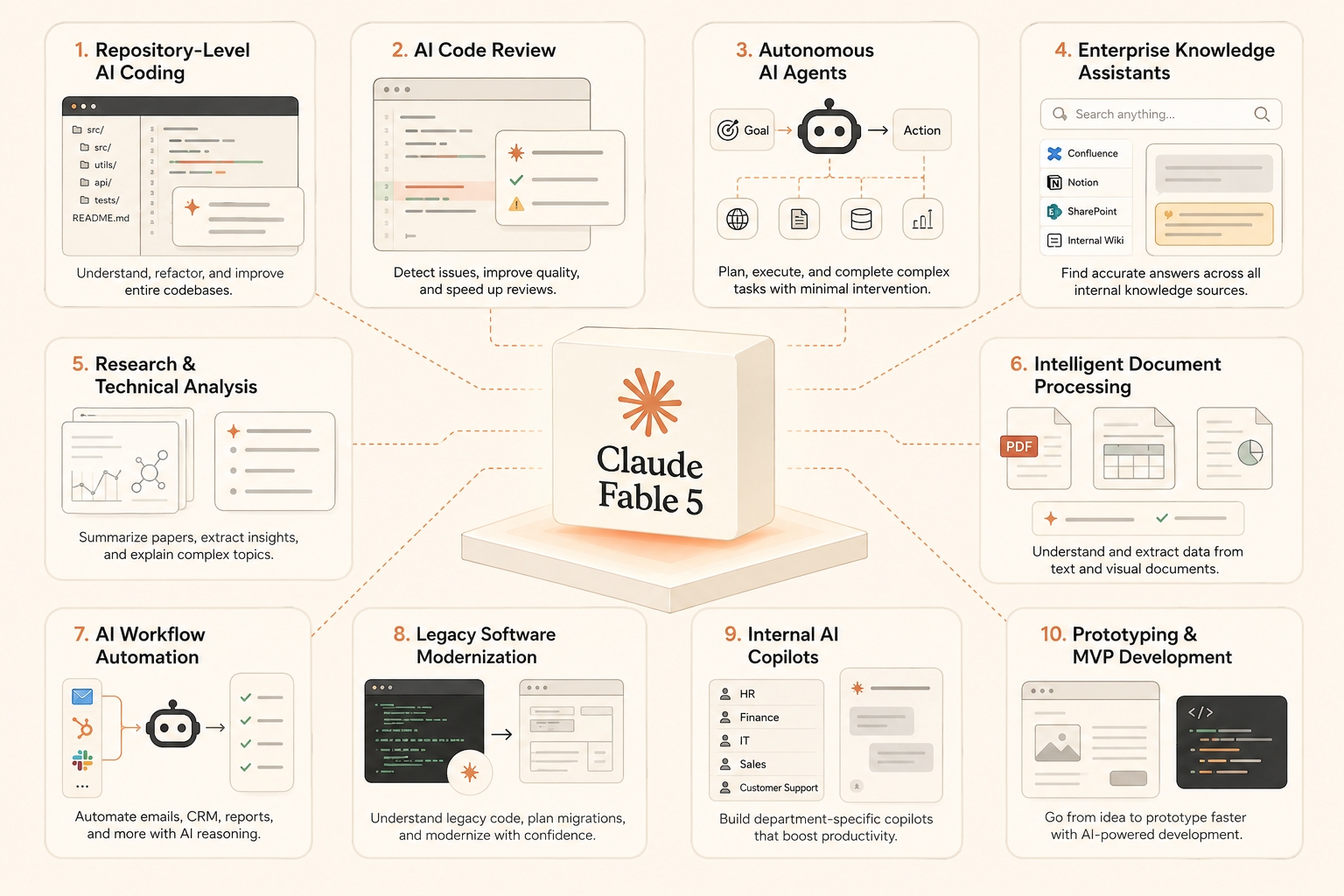
1. Repository-Level AI Coding
Most AI coding assistants perform well when generating individual functions or answering programming questions.
Claude Fable 5 goes further by understanding relationships across an entire repository.
Developers can use it to:
- Refactor legacy projects
- Explain unfamiliar codebases
- Generate technical documentation
- Identify architectural issues
- Suggest code improvements across multiple files
This makes it particularly valuable for engineering teams working with large production systems rather than small personal projects.
2. AI Code Review
Manual code reviews often become a bottleneck as engineering teams grow.
Claude Fable 5 can assist reviewers by:
- Explaining pull requests
- Detecting potential bugs
- Identifying security concerns
- Improving code readability
- Checking coding standards
Instead of replacing human reviewers, it helps engineers focus on higher-level design decisions while reducing repetitive review work.
3. Autonomous AI Agents
One of Claude Fable 5's biggest strengths is its ability to execute long-running workflows.
Unlike traditional chatbots that simply respond to prompts, AI agents can:
- Break large goals into smaller tasks
- Call external APIs
- Search documentation
- Generate reports
- Make decisions based on previous results
These capabilities make Claude Fable 5 an excellent foundation for building autonomous software agents that can complete meaningful work with minimal human intervention.
4. Enterprise Knowledge Assistants
Many organizations struggle to make internal knowledge easily accessible.
Policies, documentation, product specifications, and technical manuals are often scattered across multiple platforms.
Claude Fable 5 can power enterprise assistants that search across internal knowledge bases and provide accurate, context-aware answers to employees.
Typical integrations include:
- Confluence
- Notion
- SharePoint
- Internal Wikis
- Product documentation
- Technical knowledge bases
5. Research and Technical Analysis
Researchers frequently spend hours reading papers, comparing findings, and organizing information.
Claude Fable 5 can accelerate these workflows by:
- Summarizing academic publications
- Comparing multiple research papers
- Extracting technical insights
- Organizing references
- Explaining complex concepts
For engineering and R&D teams, this reduces the time required to understand rapidly evolving technologies.
6. Intelligent Document Processing
Businesses process thousands of documents every day.
Claude Fable 5's multimodal capabilities allow it to understand both text and visual information from documents such as:
- Contracts
- Invoices
- Financial reports
- Technical manuals
- Product specifications
- PDF files
Instead of relying solely on OCR, developers can build workflows that combine document understanding with reasoning, making it easier to automate business processes.
7. AI Workflow Automation
Automation platforms such as n8n, Zapier, and custom orchestration systems are becoming increasingly AI-driven.
Claude Fable 5 can act as the reasoning engine behind workflows that involve:
- Email processing
- Customer requests
- CRM updates
- Task prioritization
- Report generation
- Knowledge retrieval
Its ability to understand context across multiple steps makes these automations significantly more reliable than simple rule-based systems.
8. Legacy Software Modernization
Many enterprises continue to rely on software written years — or even decades — ago.
Migrating these systems is often expensive and time-consuming.
Claude Fable 5 helps engineering teams:
- Understand legacy code
- Suggest modernization strategies
- Generate migration plans
- Refactor outdated components
- Document existing architecture
Rather than replacing developers, it accelerates modernization projects while reducing technical debt.
9. Internal AI Copilots
Organizations increasingly build internal AI assistants for departments such as:
- Human Resources
- Finance
- IT
- Sales
- Customer Success
- Operations
Claude Fable 5 enables these assistants to answer questions, retrieve documents, summarize meetings, and automate repetitive workflows while maintaining awareness of organizational context.
10. AI-Powered SaaS Products
Many startups now embed AI directly into their products.
Claude Fable 5 can serve as the intelligence layer behind features including:
- AI writing assistants
- Coding copilots
- Business analytics
- Workflow automation
- Customer support
- Data analysis
Because the model excels at reasoning and structured problem-solving, it fits naturally into applications where users expect more than simple conversational responses.
Choosing the Right Claude Model
Although Claude Fable 5 offers Anthropic's most advanced public capabilities, it isn't always the best choice for every request.
For example:
- Claude Sonnet 5 is often better for high-volume, latency-sensitive applications.
- Claude Fable 5 excels when deeper reasoning or long-running workflows are required.
- Many engineering teams combine multiple Claude models, routing requests based on complexity to balance performance and cost.
Selecting the right model for each workload typically delivers better efficiency than relying exclusively on a single model. For a direct comparison, see our Claude Fable 5 vs Sonnet 5 guide.
Access Claude Fable 5 Through DDS Hub
Development teams rarely build applications around a single AI model.
Different workloads often require different performance, pricing, and reasoning capabilities.
DDS Hub supports this flexibility by organizing supported models into dedicated Model Groups.
Instead of sharing one API key across every model, developers select the model group that best matches their requirements, create a dedicated API key for that group, and activate API usage after topping up their account balance.
For example, a team might:
- Use a Claude Sonnet 5 group for high-volume customer interactions.
- Deploy a Claude Fable 5 group for repository analysis and autonomous AI agents.
- Choose a Codex group for software engineering workflows.
- Integrate a GLM group for multilingual or cost-sensitive applications.
This group-based structure makes it easier to separate projects, manage permissions, and optimize API spending while maintaining a consistent integration experience.
As projects grow, teams can evaluate different model groups without redesigning their entire AI infrastructure. You can browse the available options on the DDS Hub models page, follow the setup documentation to configure your first request, or activate API access on DDS Hub to get started.
Final Thoughts
Claude Fable 5 is much more than a chatbot.
Its greatest value lies in solving complex problems that require reasoning, planning, and sustained execution. Whether you're building coding assistants, enterprise copilots, document processing pipelines, or autonomous AI agents, the model provides the intelligence needed for production-grade applications.
The most successful AI teams don't simply choose the most powerful model — they choose the right model for each workload. By combining Claude Fable 5 with a flexible deployment strategy and group-based API management, developers can build scalable AI systems that balance capability, performance, and cost.
As AI adoption continues to accelerate, understanding practical use cases — not just benchmark scores — will be the key to building applications that deliver real business value.