
Claude Sonnet 5 API Guide: Features, Pricing, Benchmarks and How to Get Started
Anthropic has officially introduced Claude Sonnet 5, the latest generation of its flagship balanced AI model. Designed for developers, businesses and AI product teams, Sonnet 5 brings significant improvements in coding, reasoning, agent workflows and overall efficiency while maintaining the speed that made the Sonnet family popular.
For many teams, Sonnet has become the default model for day-to-day development because it offers an excellent balance between intelligence, latency and cost. With the release of Sonnet 5, Anthropic has pushed that balance even further.
In this guide, we'll cover everything developers need to know about Claude Sonnet 5, including its new capabilities, API pricing, benchmark improvements, ideal use cases and the easiest way to integrate it into your applications.
What Is Claude Sonnet 5?
Claude Sonnet 5 is the newest model in Anthropic's Claude family and succeeds the Sonnet 4.6 generation.
Unlike heavyweight reasoning models that prioritize maximum capability at the expense of speed, Sonnet is designed to deliver high-quality results while remaining fast enough for production workloads.
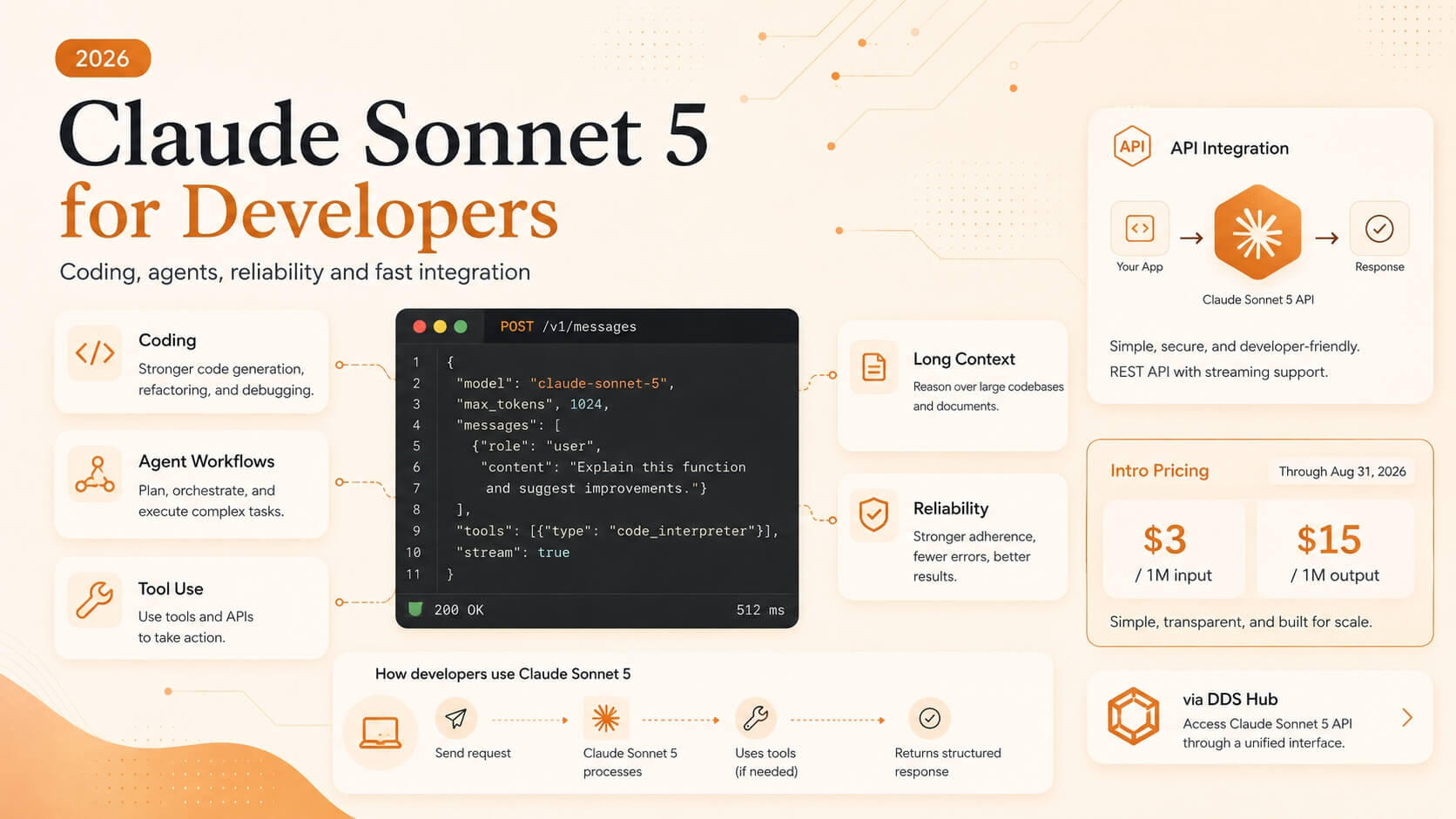
According to Anthropic, Sonnet 5 includes improvements in:
- Software engineering
- Agentic workflows
- Long-context reasoning
- Tool use
- Instruction following
- Reliability
- Cost efficiency
The model is now the default Claude experience for Free and Pro users and is also available through the Claude API under the model name claude-sonnet-5.
What's New in Claude Sonnet 5?
Compared with previous Sonnet releases, the latest model introduces several meaningful improvements.
Stronger Coding Performance
One of the biggest upgrades is software engineering. Anthropic reports that Sonnet 5 performs better on coding benchmarks and real-world programming tasks, making it particularly suitable for:
- Backend development
- Frontend generation
- Debugging
- Refactoring
- AI coding assistants
- Repository understanding
Developers using AI pair-programming tools should notice improved code quality and fewer correction cycles.
Better Agent Workflows
AI agents continue to be one of the fastest-growing categories in software development. Claude Sonnet 5 improves the model's ability to:
- Follow complex instructions
- Use external tools
- Complete multi-step tasks
- Maintain long conversations
- Execute structured workflows
These improvements make Sonnet 5 particularly attractive for businesses building AI assistants and autonomous workflows.
Improved Reliability
One challenge with large language models is hallucination — producing incorrect or fabricated information. Anthropic highlights that Sonnet 5 reduces hallucinations and follows instructions more consistently than previous generations.
For enterprise applications, this translates into:
- More predictable outputs
- Better customer experiences
- Reduced manual review
- Higher production confidence
Faster Everyday Development
Many developers don't need the most powerful model for every request. Instead, they need a model that can respond quickly while maintaining high quality. This has always been the Sonnet family's biggest advantage.
Sonnet 5 continues that philosophy by offering stronger reasoning without sacrificing responsiveness.
Claude Sonnet 5 API Pricing
Anthropic has announced introductory API pricing for Claude Sonnet 5 through August 31, 2026. After that date, standard API pricing will apply.
For developers building production systems, promotional pricing provides an opportunity to evaluate the model before long-term costs take effect.
As always, actual API expenses depend on token usage, prompt size and application architecture. Teams with high request volumes should monitor usage carefully and optimize prompts where possible. For a broader look at lowering model costs, see our guide on DDS Hub vs official API pricing.
Claude Sonnet 5 vs Sonnet 4.6
Many existing Claude users are asking whether upgrading is worthwhile. In most cases, the answer is yes.
Compared with Sonnet 4.6, Sonnet 5 offers improvements in:
| Category | Sonnet 4.6 | Sonnet 5 |
|---|---|---|
| Coding | Excellent | Even stronger |
| Agent workflows | Strong | Improved |
| Tool use | Strong | Improved |
| Instruction following | Very good | Better |
| Reliability | Strong | Higher |
| Cost efficiency | Good | Improved |
Although Sonnet 4.6 remains a capable model, Sonnet 5 is positioned as its direct successor for most production workloads.
Best Use Cases
Claude Sonnet 5 is particularly well suited for:
AI Coding Assistants
Generate production-ready code, explain complex functions, review pull requests and accelerate software development.
Customer Support Automation
Provide accurate responses, summarize conversations and integrate with CRM systems.
Enterprise Knowledge Systems
Search internal documentation, answer employee questions and generate reports.
AI Agents
Build intelligent assistants capable of planning tasks, calling APIs and executing workflows.
Content Generation
Create technical documentation, marketing content, emails and long-form articles with consistent quality.
Accessing Claude Sonnet 5 Through DDS Hub
For many developers, integrating directly with multiple AI providers creates unnecessary operational complexity.
Projects often require access to more than one model — for example:
- Claude Sonnet 5 for reasoning
- Codex for software engineering
- GLM for multilingual applications
Instead of maintaining separate integrations, many teams use a unified API platform.
DDS Hub provides access to:
- Claude Sonnet 5
- Claude Opus
- Codex
- GLM
through a single API interface. Developers can register for a free API key and activate usage by adding account balance.
Compared with managing multiple providers independently, DDS Hub offers several practical benefits:
- Unified API endpoint
- Flexible model groups
- Lower pricing than standard official API rates for supported groups
- Simplified billing
- Faster model switching
- Easier experimentation across leading AI models
Developers can activate API access here: Activate API access on DDS Hub. You can also browse the DDS Hub models page or read the setup docs to get started.
Best Practices
To get the most from Claude Sonnet 5:
- Use structured prompts
- Keep prompts focused and concise
- Break complex tasks into multiple steps
- Combine Sonnet 5 with tool calling for agent workflows
- Monitor token usage to control API costs
Small improvements in prompt design can significantly improve both quality and efficiency.
Final Thoughts
Claude Sonnet 5 represents another significant step forward for Anthropic's flagship balanced model.
With stronger coding capabilities, better agent workflows, improved instruction following and enhanced reliability, it is positioned to become the default choice for many production AI applications.
For developers building real-world products, the decision is no longer just about choosing the smartest model — it is about selecting the right balance of capability, speed and cost.
Whether you're building an AI coding assistant, customer support platform or enterprise automation system, Claude Sonnet 5 deserves serious consideration. And for teams looking to simplify deployment while accessing multiple leading AI models, unified platforms such as DDS Hub provide a flexible and cost-effective integration strategy. If you're just getting started with Claude access, see our free Claude Opus 4.8 API key guide.
FAQ
What is the Claude Sonnet 5 API model name?
You call it through the Claude API under the model name claude-sonnet-5. On a unified gateway like DDS Hub you select the same model by name.
Is Claude Sonnet 5 better than Sonnet 4.6?
For most production workloads, yes. Sonnet 5 improves on coding, agent workflows, tool use, instruction following, reliability and cost efficiency compared with Sonnet 4.6.
How much does the Claude Sonnet 5 API cost?
Anthropic announced introductory API pricing through August 31, 2026, after which standard pricing applies. Actual cost depends on token usage and prompt size; routing through DDS Hub lowers pricing for supported model groups.
What is Claude Sonnet 5 best for?
It's a balanced model well suited to AI coding assistants, customer support automation, enterprise knowledge systems, AI agents and high-quality content generation.
How do I access Claude Sonnet 5?
Use Anthropic's official API, or register on DDS Hub for a free API key, top up your balance, and call claude-sonnet-5 alongside Claude Opus, Codex and GLM through one integration.