
Claude Fable 5 vs Sonnet 5: Features, Pricing and Coding Comparison
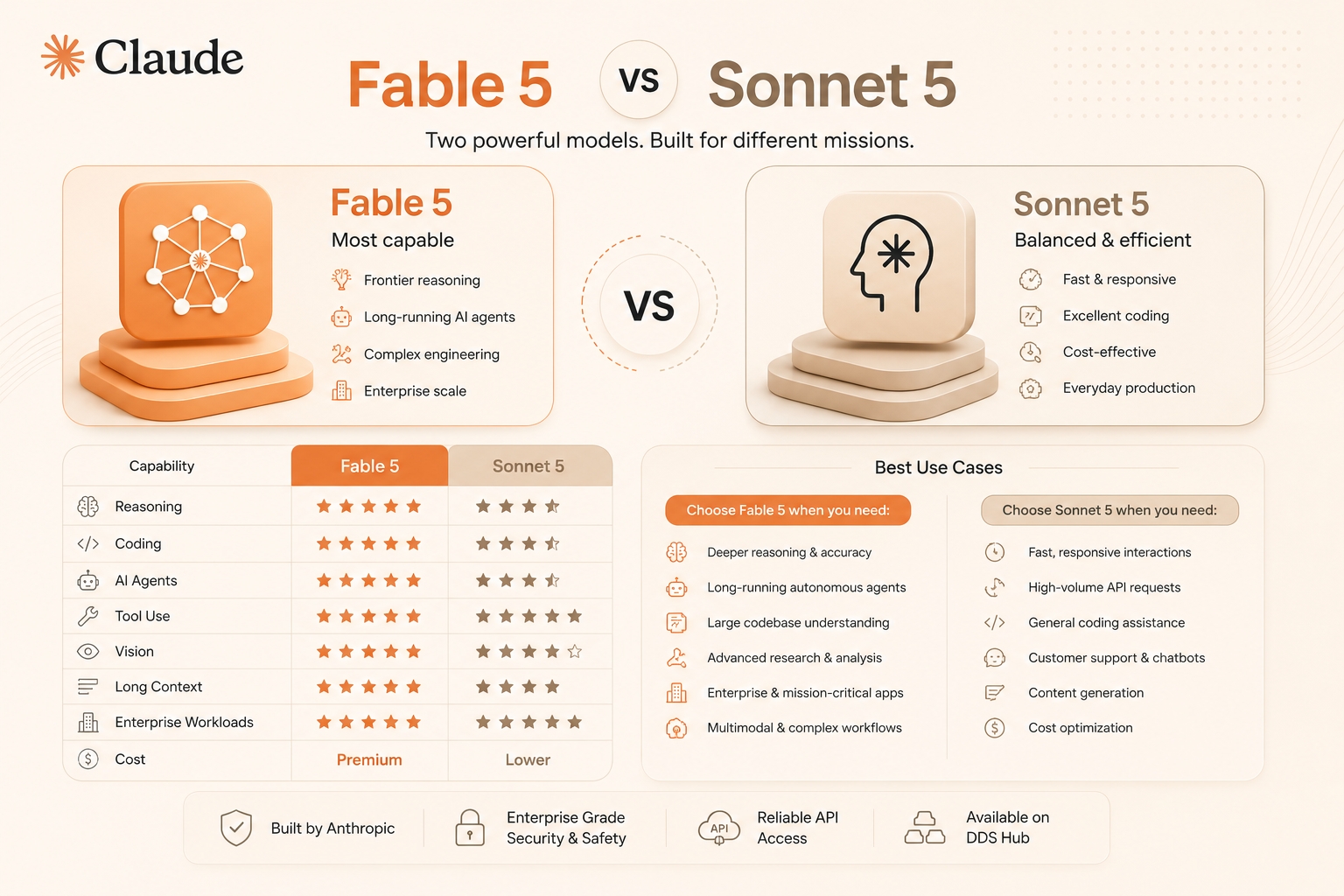
Anthropic now offers multiple high-performance AI models, each optimized for different workloads. While Claude Sonnet 5 has become the default choice for many developers because of its balance between speed, intelligence and cost, Claude Fable 5 represents Anthropic's most capable publicly available model, designed for complex reasoning, long-running AI agents and enterprise-scale software engineering.
This naturally leads to one of the most common questions developers ask:
Should you choose Claude Sonnet 5 or Claude Fable 5?
The answer depends on your workload, performance requirements and budget.
In this guide, we'll compare both models across coding, reasoning, AI agents, latency, pricing and real-world development scenarios to help you make the right decision.
Understanding the Two Models
Although both models belong to Anthropic's Claude family, they target different audiences.
Claude Sonnet 5
Claude Sonnet 5 is Anthropic's balanced model. It delivers excellent reasoning while remaining fast enough for everyday production workloads.
It is particularly suitable for:
- AI coding assistants
- Customer support
- Knowledge retrieval
- Content generation
- SaaS applications
- General software development
Many development teams choose Sonnet 5 as their default model because it provides strong performance with lower operational costs than flagship models. For a full feature and pricing breakdown, see our Claude Sonnet 5 API guide.
Claude Fable 5
Claude Fable 5 sits at the top of Anthropic's publicly available model lineup.
It is designed for workloads that require:
- deeper reasoning
- longer autonomous execution
- complex software engineering
- advanced research
- sophisticated AI agents
- multimodal enterprise workflows
Rather than replacing Sonnet 5, Fable 5 extends Anthropic's capabilities into more demanding enterprise scenarios. Learn more in our Claude Fable 5 API guide.
Feature Comparison
| Feature | Claude Sonnet 5 | Claude Fable 5 |
|---|---|---|
| Reasoning | Excellent | Outstanding |
| Coding | Excellent | Best-in-class |
| AI Agents | Strong | Superior |
| Tool Use | Excellent | Excellent |
| Vision | Excellent | Enhanced |
| Long-running Tasks | Good | Excellent |
| Enterprise Workloads | Excellent | Outstanding |
| Cost | Lower | Premium |
For many organizations, both models can coexist, each serving different stages of an AI workflow.
Coding Performance
Software engineering remains one of the most important applications for large language models.
Claude Sonnet 5 performs exceptionally well for everyday development tasks such as:
- writing new functions
- debugging
- code explanation
- documentation
- pull request reviews
For individual developers and startups, Sonnet 5 is often sufficient for the majority of coding workflows.
Claude Fable 5 goes a step further.
Its strengths become more apparent when working with:
- very large repositories
- multi-file refactoring
- architecture redesign
- long-running coding sessions
- enterprise modernization projects
If your AI assistant frequently works across thousands of files or must maintain context throughout complex engineering tasks, Fable 5 offers a meaningful advantage.
AI Agent Capabilities
Modern AI applications increasingly rely on autonomous agents rather than simple chat interfaces.
Examples include:
- software development agents
- customer support automation
- workflow orchestration
- enterprise assistants
- internal knowledge systems
Claude Sonnet 5 performs well for lightweight agents that execute relatively short workflows.
Claude Fable 5 is better suited for agents that:
- plan complex tasks
- maintain long-term context
- interact with multiple external tools
- execute workflows over extended periods
Organizations investing heavily in agentic AI may benefit from Fable 5's stronger planning and sustained reasoning abilities.
Pricing Considerations
Performance should always be evaluated alongside cost.
For applications processing millions of API requests each month, selecting the right model can significantly affect infrastructure expenses.
In general:
Choose Sonnet 5 when:
- latency is important
- request volume is high
- tasks are relatively straightforward
- cost optimization is a priority
Choose Fable 5 when:
- output quality is more important than speed
- workflows involve complex reasoning
- AI agents execute multi-step tasks
- software engineering accuracy is critical
Many organizations route requests dynamically, using Sonnet 5 for routine operations and Fable 5 only when deeper reasoning is required.
Which Model Is Better for Different Use Cases?
Startup SaaS
Recommended: Claude Sonnet 5
Lower operating costs and excellent overall performance make Sonnet 5 an ideal default choice.
AI Coding Platform
Recommended: Sonnet 5 + Fable 5
Use Sonnet 5 for everyday coding assistance and Fable 5 for repository-level analysis or complex refactoring.
Enterprise Knowledge Assistant
Recommended: Claude Fable 5
Long-context reasoning and advanced planning improve answer quality across extensive documentation.
Research
Recommended: Claude Fable 5
Scientific analysis and complex reasoning are among its strongest capabilities.
Customer Support
Recommended: Claude Sonnet 5
Most customer conversations do not require frontier-level reasoning, making Sonnet 5 the more cost-effective option.
Accessing Claude Models Through DDS Hub
Many development teams work with multiple Claude models rather than relying on a single one.
DDS Hub supports this workflow through Model Groups.
Instead of providing one API key for every model, DDS Hub organizes supported models into dedicated groups.
Developers simply:
- Choose the model group that fits their workload.
- Generate an API key for that group.
- Add account balance.
- Start calling the supported models within the selected group.
For example, teams can create separate API keys for:
- Claude Fable 5
- Claude Sonnet 5
- Claude Opus
- Codex
- GLM
This approach offers greater flexibility for project isolation, permission management and pricing optimization.
It also allows engineering teams to evaluate different model families without maintaining multiple provider accounts or separate integration workflows. You can compare the available options on the DDS Hub models page or follow the setup documentation to configure your first request.
Whether you're building AI agents, coding assistants or enterprise automation platforms, choosing the appropriate model group makes it easier to match performance with budget. When you're ready, activate API access on DDS Hub to get started.
Final Recommendation
There isn't a single "best" Claude model.
Instead, each model is optimized for a different class of problems.
If your application prioritizes:
- speed
- operational cost
- everyday software development
Claude Sonnet 5 is likely the best choice.
If your application depends on:
- frontier-level reasoning
- long-running AI agents
- large-scale software engineering
- enterprise research
- advanced automation
Claude Fable 5 is the stronger option.
For many organizations, the most effective strategy is not choosing one model over the other but combining both, using each where it delivers the greatest value.
As Anthropic continues to expand the Claude ecosystem, developers who build flexible, model-agnostic architectures will be best positioned to take advantage of future AI advancements.