
Claude Sonnet 5 vs Claude Sonnet 4.6: Should Developers Upgrade?
Anthropic has officially released Claude Sonnet 5, introducing notable improvements in coding, agent workflows, instruction following and overall reliability.
For existing Claude users, one question immediately follows: is upgrading from Sonnet 4.6 worth it?
If your applications already rely on Claude Sonnet 4.6, migrating to a new model involves more than simply changing the model name. Teams need to evaluate output quality, latency, pricing, compatibility and long-term maintenance before deploying a new model in production.
This guide compares Claude Sonnet 5 with Sonnet 4.6 from a developer's perspective to help you decide when upgrading makes sense.
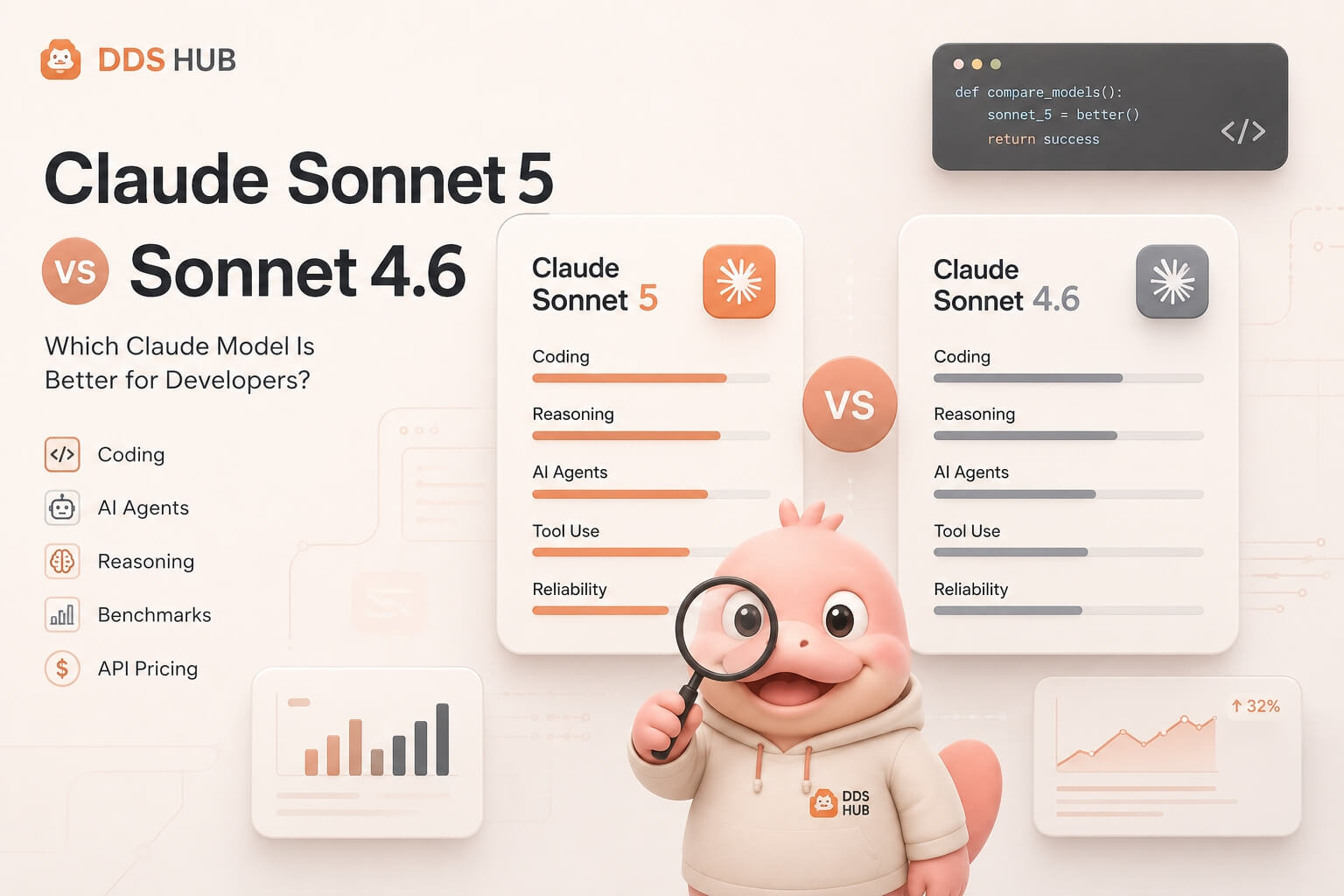
Claude Sonnet 5 at a Glance
Claude Sonnet 5 is Anthropic's latest balanced model, designed to deliver stronger reasoning while maintaining the speed and efficiency that made previous Sonnet releases popular.
According to Anthropic's official announcement, Sonnet 5 improves:
- Coding quality
- AI agent performance
- Tool use
- Instruction following
- Reliability
- Cost efficiency
It also becomes the default Claude experience for Free and Pro users and is available through the Anthropic API as claude-sonnet-5. For a full feature and pricing breakdown, see our Claude Sonnet 5 API guide.
Claude Sonnet 4.6 Still Isn't Obsolete
Although Sonnet 5 introduces meaningful improvements, Sonnet 4.6 remains an excellent production model.
Many applications built on Sonnet 4.6 continue to perform well, especially for:
- Customer support
- Knowledge retrieval
- Document summarization
- Content generation
- General business automation
If your existing workflows are stable, there is no urgent requirement to migrate immediately. Instead, evaluate whether Sonnet 5's improvements justify the transition for your specific workloads.
Feature Comparison
| Category | Claude Sonnet 4.6 | Claude Sonnet 5 |
|---|---|---|
| Coding | Excellent | Improved |
| Reasoning | Excellent | Improved |
| Tool Use | Strong | Better |
| AI Agents | Strong | Significantly Better |
| Long Context | Excellent | Excellent |
| Instruction Following | Very Good | More Reliable |
| Hallucination Rate | Low | Lower |
| Speed | Fast | Fast |
| API Availability | Yes | Yes |
While the improvements may appear incremental on paper, they become more noticeable during long-running development workflows.
Coding Performance
One of the biggest reasons developers adopt Claude is software engineering. Anthropic states that Sonnet 5 delivers stronger coding performance across both internal evaluations and external benchmarks.
Developers should expect improvements in:
- Code generation
- Bug fixing
- Repository understanding
- Refactoring
- Function implementation
- Documentation generation
For teams building AI coding assistants or integrating Claude into IDE workflows, these improvements can reduce manual corrections and accelerate development.
AI Agents and Tool Use
Agentic AI has become one of the fastest-growing areas of AI development. Compared with Sonnet 4.6, Sonnet 5 performs better when handling:
- Multi-step reasoning
- Tool calling
- External API interactions
- Workflow automation
- Long-running conversations
This makes Sonnet 5 especially attractive for applications built with frameworks such as LangGraph, AutoGen, CrewAI or custom agent architectures. If your application relies heavily on orchestration and tool execution, Sonnet 5 offers meaningful advantages.
Reliability and Instruction Following
Reliability is often more important than raw intelligence. Enterprise applications need models that:
- Follow instructions consistently
- Produce structured outputs
- Avoid unnecessary creativity
- Generate predictable responses
Anthropic reports that Sonnet 5 reduces hallucinations and follows developer instructions more accurately than previous Sonnet versions. For production systems, these improvements can reduce downstream validation and improve user trust.
API Pricing
Anthropic introduced promotional pricing for Claude Sonnet 5 through August 31, 2026, after which standard API pricing applies.
For developers evaluating migration, this promotional period offers a good opportunity to benchmark Sonnet 5 using real production prompts before making a long-term decision.
When comparing costs, it's important to consider:
- Input tokens
- Output tokens
- Average prompt size
- Context window usage
- Expected monthly request volume
A model that generates more accurate answers on the first attempt can sometimes reduce total costs despite a higher per-token price. For a broader look at cutting model costs, see DDS Hub vs official API pricing.
Should You Upgrade?
The answer depends on your workload.
Upgrade to Sonnet 5 if you:
- Build AI coding tools
- Develop autonomous agents
- Require stronger reasoning
- Need better tool use
- Want the latest Anthropic improvements
Stay on Sonnet 4.6 if you:
- Already have stable production systems
- Prioritize minimizing migration work
- Don't yet need advanced agent capabilities
- Prefer to validate new models before deployment
Many organizations choose a gradual rollout, testing Sonnet 5 on selected workloads before migrating all traffic.
Simplifying Multi-Model Development with DDS Hub
As AI ecosystems become more diverse, developers increasingly work with multiple models rather than relying on just one. For example:
- Claude Sonnet 5 for reasoning and agents
- Claude Opus for the most demanding tasks
- Codex for specialized coding workflows
- GLM for multilingual applications
Managing separate API accounts for each provider adds operational complexity. DDS Hub offers a unified API platform that allows developers to access multiple leading AI models through a single integration.
With DDS Hub, you can:
- Register for a free API key
- Activate usage by topping up your balance
- Switch between supported model groups
- Use one API format across multiple models
- Benefit from discounted pricing on supported model groups compared with standard official API rates
This makes it easier to evaluate Sonnet 5 alongside other models without rewriting your infrastructure. You can browse the DDS Hub models page or get started here: Activate API access on DDS Hub.
Final Verdict
Claude Sonnet 5 is not a complete redesign of the Sonnet family — it is a thoughtful evolution. Its improvements focus on the areas developers care about most:
- Better coding
- More reliable reasoning
- Stronger AI agents
- Improved tool use
- Higher consistency
For new AI projects, Sonnet 5 is the recommended starting point. For existing Sonnet 4.6 deployments, a staged evaluation using real production workloads is the best way to determine whether the upgrade delivers measurable business value.
As Anthropic continues to advance the Claude family, Sonnet 5 is well positioned to become the default model for many production AI applications.
FAQ
Should I upgrade from Sonnet 4.6 to Sonnet 5?
Upgrade if you build coding tools, autonomous agents, or need stronger reasoning and tool use. If your Sonnet 4.6 systems are stable and you don't need advanced agent capabilities yet, a staged evaluation before migrating is the safer path.
What's the biggest difference between Sonnet 5 and Sonnet 4.6?
The most noticeable gains are in AI agents, tool use, coding and instruction-following reliability. Long context and speed remain strong on both.
Is Sonnet 4.6 still good enough?
Yes. Sonnet 4.6 remains an excellent production model for customer support, retrieval, summarization and content generation. There's no urgent need to migrate stable workloads.
Does upgrading require code changes?
The API is compatible — you mainly change the model name to claude-sonnet-5. Still, validate output quality and latency on real prompts before switching production traffic.
How can I test Sonnet 5 against Sonnet 4.6 easily?
Use a unified gateway like DDS Hub: one integration lets you switch between model groups by name, so you can benchmark Sonnet 5, Sonnet 4.6 and other models without rebuilding your infrastructure.