
Why AI Coding Uses So Many Tokens? Loop Engineering and AI Coding Cost Optimization
Many developers experience the same surprise when they start using modern AI coding assistants: "I only asked AI to fix a small issue. Why did it consume thousands of tokens?"
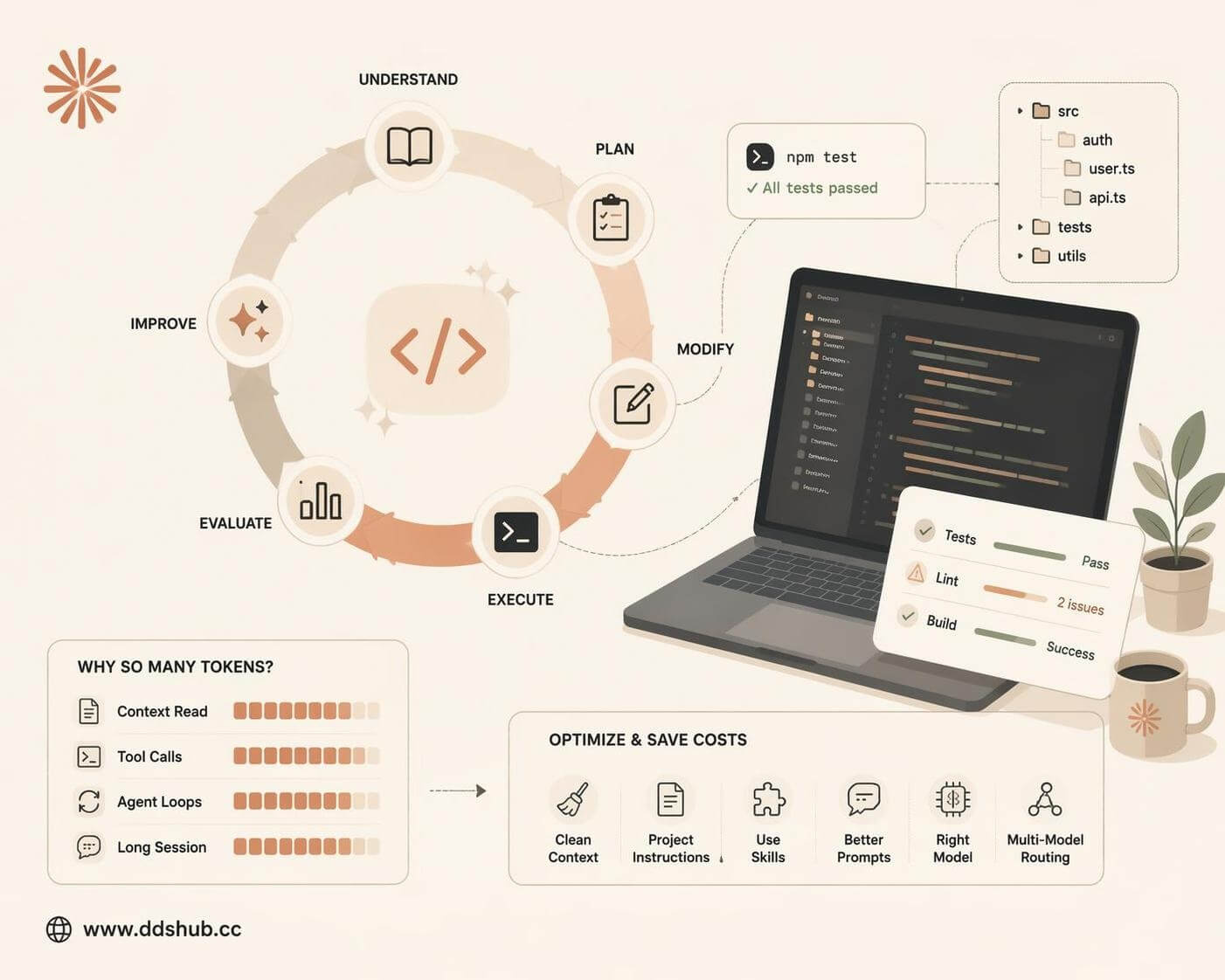
The reason is that modern AI coding tools are no longer simple code generators. Traditional AI assistants worked like this:
Question
    ↓
AI Response
    ↓
Done
However, tools such as Claude Code, OpenAI Codex, and other AI coding agents work very differently. They operate through a continuous development cycle that includes understanding the project, planning changes, editing files, running commands, reviewing results, and fixing problems.
This new development approach is often described as Loop Engineering.
Understanding how this loop works is the key to understanding why AI coding consumes more tokens and how developers can significantly reduce API costs without sacrificing productivity.
What Is Loop Engineering?
Loop Engineering describes a development workflow where AI agents continuously interact with a software project through multiple cycles.
Instead of generating code once, the AI follows a repeated loop:
Understand
    ↓
Plan
    ↓
Modify
    ↓
Execute
    ↓
Evaluate
    ↓
Improve
    ↓
Repeat
For example, when asking an AI coding agent to add a new feature, the process may look like:
User Request
    ↓
Read project structure
    ↓
Analyze existing code
    ↓
Identify dependencies
    ↓
Create implementation plan
    ↓
Modify multiple files
    ↓
Run tests
    ↓
Analyze errors
    ↓
Fix issues
    ↓
Complete task
Every step requires additional model interactions, which means every loop consumes more tokens.
Why AI Coding Uses More Tokens Than Traditional Chat
1. AI Needs Context Before Writing Code
A normal chatbot can answer a question with only the current conversation.
AI coding agents need much more information:
- Project structure
- Existing files
- Dependencies
- Coding conventions
- Previous changes
- Test results
For example, a developer might ask: "Add authentication to this application."
A human engineer would first inspect:
- Current authentication system
- Database structure
- User model
- Security settings
- Existing APIs
AI agents do the same thing. The difference is that every file read and every analysis step contributes to token usage.
2. Every Engineering Loop Creates Additional Token Consumption
The biggest difference between AI chat and AI coding is the number of loops.
A simple conversation:
Prompt
    ↓
Answer
An AI coding task:
Prompt
    ↓
Analyze
    ↓
Search Files
    ↓
Read Code
    ↓
Plan
    ↓
Edit
    ↓
Run Test
    ↓
Read Error
    ↓
Fix
    ↓
Test Again
A single coding request may trigger multiple internal reasoning cycles. This is why AI coding agents can consume far more tokens than users initially expect.
3. Tool Usage Increases Token Consumption
Modern AI coding agents rely heavily on tools. Common tools include:
- File search
- Terminal execution
- Git operations
- Code analysis
- Testing frameworks
- MCP integrations
Each tool call creates additional context. For example:
AI
    ↓
Search files
    ↓
Read result
    ↓
Analyze
    ↓
Modify code
    ↓
Run test
    ↓
Analyze failure
The more tools involved, the larger the context becomes.
4. Long Conversations Create Context Growth
Many developers keep the same AI coding session open for hours. However, previous discussions, code changes, and debugging information may remain part of the context.
A session may gradually grow:
| Stage | Context |
|---|---|
| Initial request | Small |
| After analysis | Larger |
| After several edits | Large |
| Long debugging session | Very large |
Eventually, even a simple request may require processing a large amount of previous information.
The Real Cost Drivers of AI Coding
Token usage is usually caused by several factors together.
| Factor | Impact on Token Usage |
|---|---|
| Large repositories | Very High |
| Long coding sessions | Very High |
| Multiple agent loops | Very High |
| Excessive tool calls | High |
| Poor prompts | Medium |
| Wrong model selection | Medium |
| Repeated context | High |
How to Reduce AI Coding Token Usage
Reducing cost is not simply about choosing a cheaper model. The biggest improvements come from optimizing the workflow.
1. Keep AI Context Clean
One of the easiest improvements is managing context properly. Avoid letting sessions accumulate:
- outdated discussions;
- unrelated debugging history;
- unnecessary files.
For Claude Code users, commands such as /clear and /compact can help reduce unnecessary context.
A clean context allows the model to focus on the current task.
2. Use Project Instructions Instead of Repeating Prompts
Many developers repeatedly send the same information:
- You are a senior engineer.
- Use clean architecture.
- Follow our coding style.
- Write tests.
- Review security issues.
This wastes tokens.
A better approach is storing project-level instructions using files such as CLAUDE.md or equivalent project configuration files.
The AI can automatically understand:
- project rules;
- coding standards;
- architecture decisions.
This reduces repeated prompt overhead.
3. Use Skills Instead of Huge Prompts
Large instruction prompts are another common source of unnecessary token usage.
Instead of loading everything every time:
50KB developer instructions
+
Task
+
Repository
developers can use modular skills. For example:
/code-review/security-check/database-debug
Only the required capability is loaded when needed.
This follows the same principle as software engineering: modular systems are easier to maintain and more efficient.
4. Improve Prompt Engineering
Poor prompts create unnecessary loops.
Bad prompt: "Fix this issue." The AI may need several rounds of investigation.
Better prompt:
- Analyze the authentication error.
- Identify the root cause.
- Modify only related files.
- Add regression tests.
- Keep existing architecture.
A clearer objective reduces unnecessary exploration.
5. Choose the Right Model for Each Loop
Different tasks require different levels of intelligence. A common mistake is using the most expensive model for everything.
A better workflow:
| Task | Recommended Model |
|---|---|
| Architecture design | Advanced reasoning model |
| Large refactoring | Claude-level reasoning model |
| Feature implementation | Coding-focused model |
| Simple modifications | Lightweight model |
| Testing and debugging | Fast coding model |
Developers can combine multiple models instead of relying on one model for every stage.
6. Optimize Your AI Model Routing
As AI development becomes more complex, many teams are moving toward multi-model workflows.
A typical workflow:
Architecture
    ↓
Claude
    ↓
Implementation
    ↓
Codex
    ↓
Review
    ↓
Claude
    ↓
Optimization
    ↓
GLM
Using different models for different stages can significantly reduce costs while maintaining quality.
Platforms such as DDS Hub support different model groups for Claude, Codex, and GLM, allowing developers to choose suitable resources depending on their workflow requirements.
How DDS Hub Helps Developers Optimize AI Coding Costs
For developers using multiple AI coding tools, managing different providers can become complicated.
DDS Hub provides dedicated model groups for different AI ecosystems, including Claude, Codex, and GLM.
Instead of using one expensive model for every task, developers can select the appropriate model group based on:
- coding requirements;
- stability needs;
- API usage patterns;
- cost considerations.
For example:
- Claude-based workflows can focus on reasoning and architecture.
- Codex workflows can focus on implementation speed.
- GLM workflows can handle cost-sensitive scenarios.
This allows developers to build more flexible AI coding workflows rather than depending on a single model.
Final Thoughts
AI coding consumes more tokens because software development itself is an iterative process.
Modern AI coding agents are not simply generating code. They are participating in a continuous engineering loop: understand → plan → modify → test → improve.
This Loop Engineering workflow creates much higher productivity, but it also introduces new challenges around token usage and API costs.
The most effective optimization strategy is not simply reducing AI usage. Instead, developers should improve the entire workflow:
- manage context carefully;
- use skills and project instructions;
- write better prompts;
- select the right model;
- combine multiple AI resources intelligently.
As AI coding continues to evolve, understanding Loop Engineering will become just as important as understanding Prompt Engineering.