
Unlimited Claude Fable 5: Build AI Agents Without Weekly Quotas
Claude Fable 5 has quickly become one of the most capable AI models available for software engineering, autonomous agents, and complex reasoning. Its ability to understand large codebases, maintain long-term context, and solve difficult programming problems has made it the preferred model for many developers building next-generation AI applications.
For personal use, the Claude subscription experience is excellent. Opening Claude Code, asking questions, reviewing code, and collaborating with the model feels natural and productive. For many developers, it has become an essential part of their daily workflow.
The experience changes, however, when Claude moves from being a personal assistant to becoming the engine behind an AI product.
Once an AI agent starts running continuously, or a coding assistant begins serving hundreds of users instead of one developer, weekly usage quotas become something that developers have to design around rather than ignore. Instead of focusing on product features, teams may find themselves monitoring remaining capacity, waiting for quotas to reset, or delaying long-running tasks until more usage becomes available.
This is why more development teams are gradually moving away from subscription-based workflows and adopting API-based architectures instead.
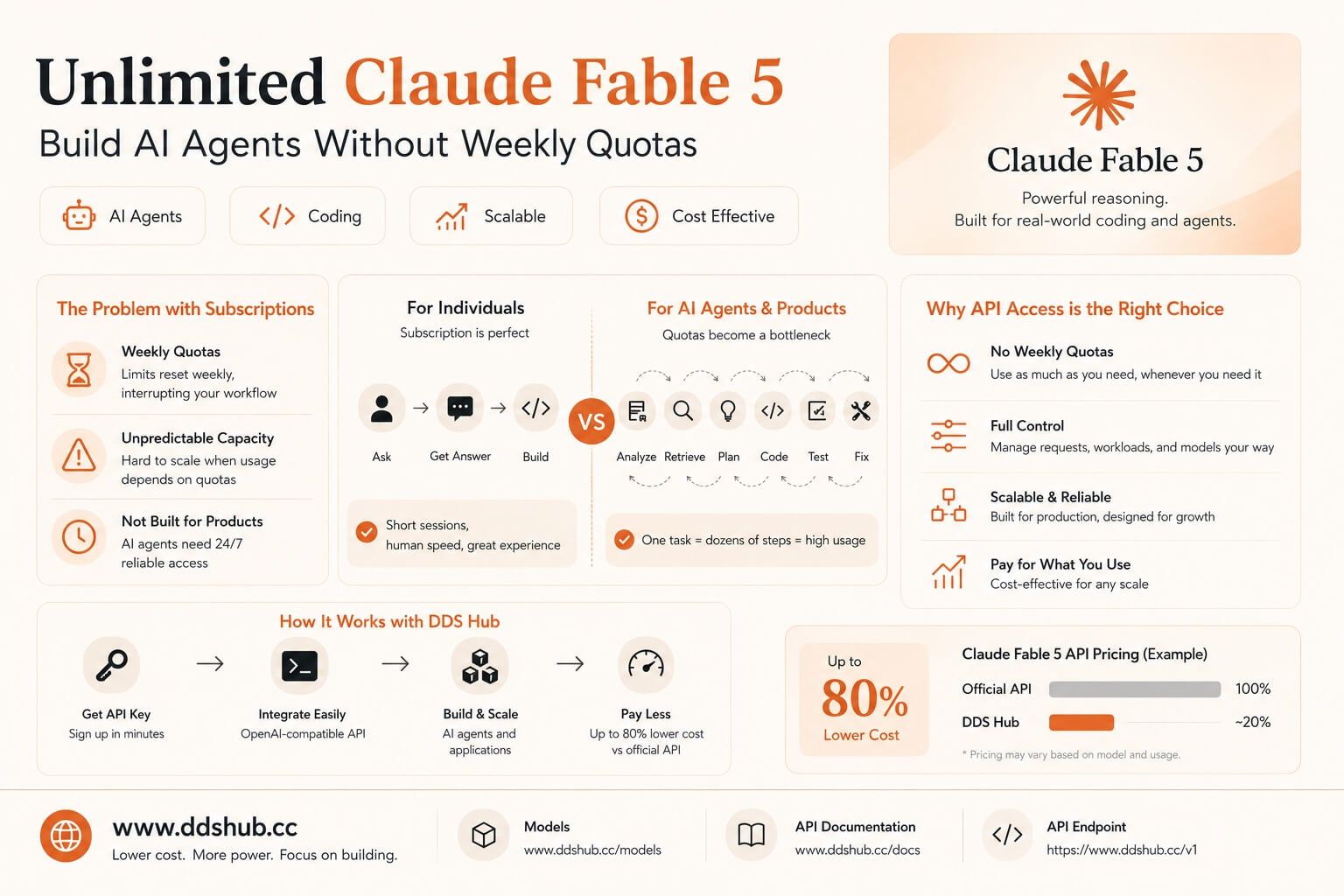
AI Agents Consume Claude Very Differently From Human Users
A person using Claude Code typically works in short sessions. They ask a question, review the answer, modify a piece of code, and continue developing. Even when working for several hours, the interaction is still driven by human speed.
AI agents behave very differently.
A single request may trigger repository analysis, documentation retrieval, dependency inspection, implementation planning, code generation, automated testing, bug fixing, and several additional rounds of reasoning before producing a final result.
From the developer's perspective, it feels like one task.
From the model's perspective, it may involve dozens of independent reasoning steps.
This explains why developers building AI coding platforms often consume model capacity much faster than individual users, even when the visible workload appears similar.
As AI workflows become increasingly autonomous, usage grows with the number of users rather than with the number of developers maintaining the system.
Weekly Quotas Are Reasonable for Individuals but Challenging for Products
Subscription plans are designed around personal productivity.
Most individual users never need to think about infrastructure, concurrency, or thousands of automated requests. Their goal is simply to access a powerful AI model whenever they need help.
Commercial software has different requirements.
An AI coding assistant cannot pause simply because the underlying account has reached its weekly allowance. A customer support agent cannot stop responding while waiting for the next quota reset. An autonomous coding workflow cannot postpone deployment because model capacity is temporarily unavailable.
The challenge is not that subscription limits exist.
The challenge is that production systems need predictable availability.
When AI becomes part of a product instead of a personal tool, consistency matters just as much as model intelligence.
Building AI Products Requires Infrastructure Instead of Subscriptions
As AI applications mature, developers gradually discover that subscriptions and APIs solve different problems.
A subscription is optimized for people.
An API is optimized for software.
With API access, developers decide when requests are sent, how workloads are distributed, which models handle different tasks, and how usage is monitored. Instead of treating AI as a standalone application, they integrate it directly into their own products and control the entire workflow.
This flexibility becomes increasingly valuable as applications grow.
Many production systems no longer rely on a single model. They may use Claude Fable 5 for difficult reasoning, another model for classification, and a lightweight model for repetitive processing. This type of architecture reduces costs while improving performance, something that is difficult to achieve when everything depends on a single subscription account.
Unlimited Claude Fable 5 Through API Access
When developers talk about "unlimited Claude Fable 5," they usually do not mean unlimited free usage.
What they really want is the ability to keep building without planning their work around subscription quotas.
API access changes that experience.
Instead of being constrained by weekly allowances, developers pay according to actual consumption. As long as sufficient API balance is available, applications can continue processing requests without waiting for quota resets.
This model is particularly attractive for teams building AI coding assistants, SaaS platforms, internal automation systems, and autonomous agents, where usage fluctuates depending on customer demand rather than personal working hours.
Rather than ask, "How many requests do I have left this week?" developers can focus on optimizing token usage, improving prompts, and scaling their applications.
A Lower-Cost Way to Access Claude Fable 5
Although API access removes subscription quota concerns, official API pricing can become expensive for high-volume workloads.
For startups and independent developers, infrastructure cost is often just as important as model capability.
DDS Hub provides an alternative approach by offering Claude API access through a unified API platform. Instead of managing multiple accounts or relying on personal subscriptions, developers can integrate Claude models through a standard OpenAI-compatible API while paying significantly less than the official Claude API price. Current Claude API pricing on DDS Hub is approximately 20% of the official API cost, making it easier to run AI agents and coding workflows at scale.
Because the platform exposes standard API endpoints, existing applications can usually be integrated with minimal changes. Teams can also switch between Claude, GPT, Codex, GLM, and other supported models without rebuilding their infrastructure every time a new frontier model is released.
Website: DDS Hub
Models: DDS Hub Models
API Documentation: DDS Hub API Documentation
API Endpoint:
https://www.ddshub.cc/v1Focus on Building Instead of Managing Quotas
One of the biggest changes happening in AI development is that developers are spending less time interacting directly with models and more time building systems that interact with models automatically.
That shift changes everything.
Instead of measuring productivity by the number of conversations, developers measure success by the number of tasks their AI systems complete.
Instead of asking whether a subscription is sufficient, they ask whether their infrastructure can continue serving users tomorrow, next week, and next month.
Once AI becomes part of a product, reliability becomes a feature.
Final Thoughts
Claude Fable 5 is one of the most capable models available for AI coding and autonomous reasoning, and it continues to push the boundaries of what AI agents can accomplish.
For personal development, a Claude subscription remains an excellent choice because it offers a simple and polished experience.
For production systems, however, the priorities change. Continuous availability, predictable costs, scalable infrastructure, and flexible integration become far more important than the convenience of a personal subscription.
Developers searching for "unlimited Claude Fable 5" are usually looking for exactly that: not unlimited intelligence, but uninterrupted development.
API-based access provides that flexibility, allowing teams to build AI products without planning their roadmap around weekly subscription quotas. Combined with lower-cost API platforms such as DDS Hub, it also makes running Claude-powered applications more practical as usage continues to grow.