
OpenRouter vs DDShub vs Official API: Which AI Gateway Is Better for Developers?
The way developers access AI models is changing.
In the early stage of generative AI development, most developers connected directly to official APIs from providers such as OpenAI and Anthropic. This approach was simple: choose a model, create an API key, and start building.
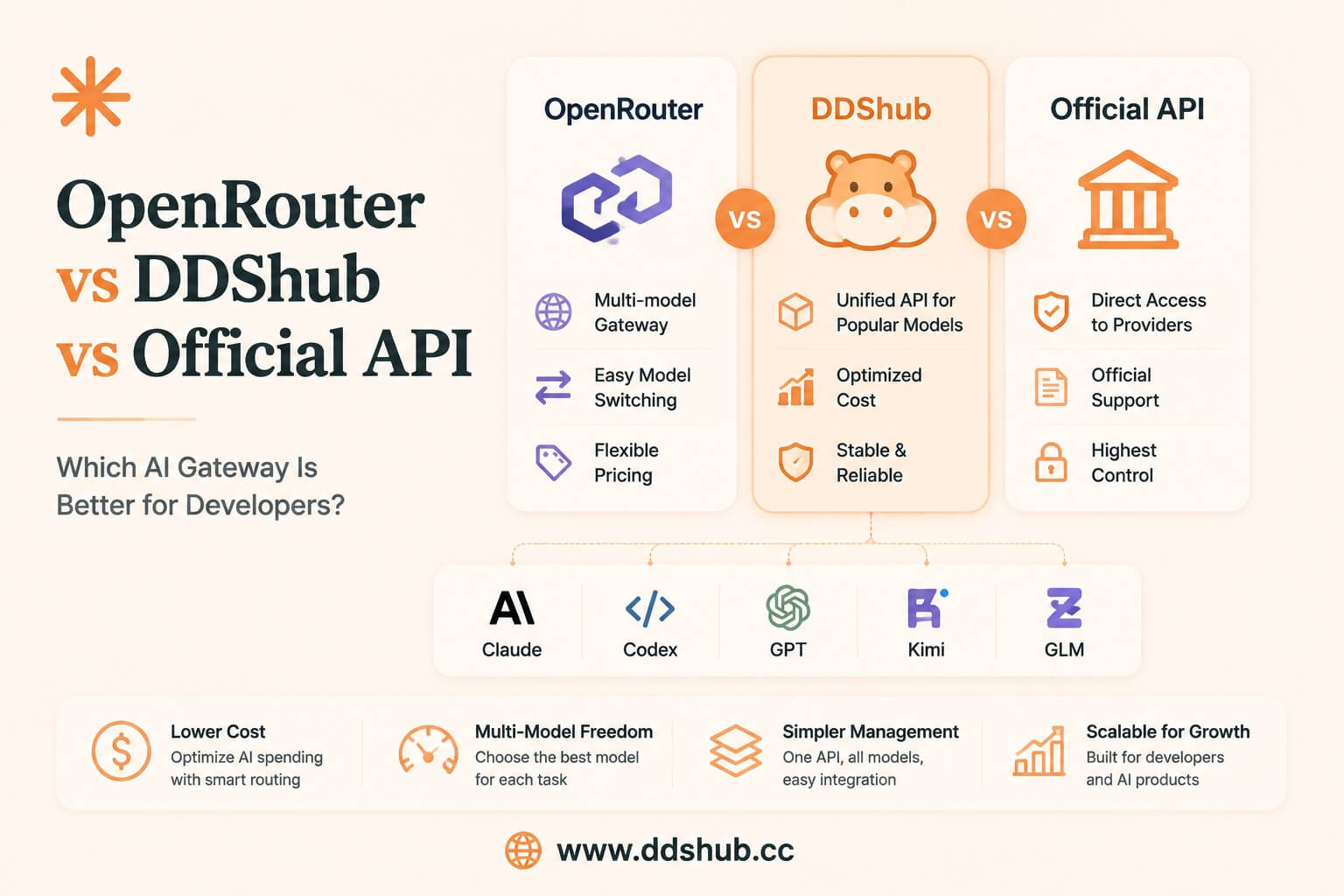
However, as the AI ecosystem expanded, developers started using multiple models at the same time.
A modern AI application may use Claude for advanced reasoning, Codex for software engineering, GPT models for general tasks, Kimi for long-context analysis, and GLM for cost-efficient workloads.
Managing multiple providers directly introduces new challenges. Developers need to maintain different API keys, payment methods, usage dashboards, and integration systems.
This has created demand for AI API gateway platforms.
Among the popular options, OpenRouter has become one of the most recognized AI gateways, while platforms such as DDShub focus on providing developers with simplified access to multiple AI models.
The question many developers ask is:
Should you use OpenRouter, DDShub, or connect directly to official APIs?
The answer depends on your requirements, including cost, model availability, stability, and how you plan to build your AI application.
What Is an AI API Gateway?
An AI API gateway is a platform that provides access to multiple AI models through a unified API interface.
Instead of creating separate integrations for every provider, developers can use one API endpoint to connect with different models.
For example, a developer building an AI coding assistant may want to use:
- Claude for architecture analysis and complex reasoning.
- Codex for generating and modifying code.
- Kimi for processing large technical documents.
- GLM for high-volume and cost-sensitive requests.
Without an API gateway, each model requires separate management.
An AI gateway simplifies this process by providing a centralized layer between applications and AI providers.
Official API: The Direct Model Access Approach
Official APIs provide direct access to AI providers.
Examples include:
- OpenAI API: https://platform.openai.com/
- Anthropic API: https://platform.claude.com/
- Google AI: https://ai.google.dev/
The main advantage of official APIs is direct access to the original provider.
Developers receive official documentation, direct model availability, and support from the model company.
For organizations with strict compliance requirements or applications that depend heavily on one provider, official APIs remain an important option.
However, direct API usage also creates challenges as applications scale.
The first challenge is cost.
Premium models such as advanced reasoning models can become expensive when used extensively in production environments.
The second challenge is management complexity.
A company using multiple models needs to maintain multiple accounts, API keys, billing systems, and monitoring tools.
OpenRouter: A Popular Multi-Model API Gateway
OpenRouter has become one of the most recognized platforms in the AI gateway market.
Official website: https://openrouter.ai/
Its main advantage is providing access to many AI models through a unified API format.
Developers can switch between different models without rebuilding their applications.
For example, a developer can experiment with different language models by changing the model parameter instead of creating separate integrations.
This flexibility makes OpenRouter attractive for:
- AI application developers
- Researchers testing different models
- Startups experimenting with multiple providers
However, developers should also consider factors beyond model availability.
Production applications usually care about:
- API pricing
- Request stability
- Model routing behavior
- Regional availability
- Long-term infrastructure planning
A platform optimized for experimentation may not always be the same as a platform optimized for specific production workflows.
DDShub: Multi-Model API Access for AI Applications
DDShub focuses on providing developers with simplified access to popular AI models through a unified API platform.
Instead of managing multiple AI providers separately, developers can access models including:
- Claude
- Codex
- GLM
- Kimi
The goal is to help developers build AI applications without dealing with the complexity of multiple provider accounts and different integration systems.
For example, an AI coding product can combine different models depending on the task.
Claude can handle complex reasoning and architecture decisions.
Codex can handle software engineering workflows.
Kimi can process large documents and technical information.
GLM can support high-volume requests where cost efficiency is important.
This multi-model approach allows developers to optimize both performance and cost.
- DDShub: https://www.ddshub.cc
- Models: https://www.ddshub.cc/models
- API Documentation: https://www.ddshub.cc/docs
OpenRouter vs DDShub vs Official API Comparison
| Category | Official API | OpenRouter | DDShub |
|---|---|---|---|
| Access Method | Direct provider connection | Multi-model gateway | Multi-model API platform |
| Model Availability | Provider-specific | Multiple providers | Multiple AI models |
| API Management | Separate accounts | Unified API | Unified API |
| Model Switching | Requires integration changes | Easy switching | Easy switching |
| Pricing Strategy | Official pricing | Platform pricing | Optimized platform pricing |
| Best Use Case | Direct provider access | Testing and experimentation | Production AI applications |
Pricing: Why Developers Compare AI API Platforms
AI API pricing has become one of the biggest concerns for developers.
The cost of an AI application is not only determined by the model price.
It also depends on how efficiently the application uses models.
For example, an AI agent may use a powerful reasoning model to understand a complex task, but it does not need the same level of intelligence for simple operations such as summarization or classification.
A good AI architecture assigns different workloads to different models.
This approach reduces unnecessary spending.
Instead of using a single expensive model for every request, developers can create a model strategy:
| Application Requirement | Recommended Model Type |
|---|---|
| Complex reasoning | Claude |
| Coding workflows | Codex |
| Long context analysis | Kimi |
| Cost-sensitive workloads | GLM |
This is one of the main reasons developers are moving toward multi-model API platforms.
Stability and Reliability: What Developers Should Consider
When choosing an AI API platform, price is only one factor.
Production applications also require stability.
Developers should consider:
- API availability
- Request latency
- Rate limits
- Model switching capability
- Usage monitoring
Official APIs provide direct infrastructure from model providers.
AI gateways provide flexibility through centralized management.
For many applications, the best solution depends on the business requirement.
A small experiment may prioritize quick access to many models.
A production AI application may prioritize predictable performance and cost management.
Which AI API Platform Should Developers Choose?
The answer depends on the stage of development.
For developers experimenting with a single model and requiring direct access, official APIs remain a strong choice.
For developers researching different models or building prototypes, an AI gateway can provide faster experimentation.
For teams building production AI applications, a multi-model API platform can simplify infrastructure management and improve cost efficiency.
The important question is not:
"Which platform has the most models?"
The better question is:
"Which platform helps my application use the right model at the right cost?"
The Future of AI Development Is Multi-Model
The AI industry is moving beyond the idea of one universal model.
Different models have different strengths.
Claude provides strong reasoning.
Codex focuses on software engineering.
Kimi handles long-context tasks.
GLM provides efficient large-scale deployment options.
Future AI applications will increasingly combine multiple models instead of relying on a single provider.
AI API gateways will play an important role by helping developers manage this increasingly complex ecosystem.
Conclusion
Official APIs, OpenRouter, and DDShub represent different approaches to accessing AI models.
Official APIs provide direct access and maximum control.
OpenRouter provides convenient access to many AI models through a unified interface.
DDShub focuses on helping developers build multi-model AI applications with simplified management and flexible model selection.
As AI applications become more advanced, developers will need more than just powerful models.
They will need efficient infrastructure that makes AI development easier, more scalable, and more cost-effective.
The future of AI is not choosing one model.
It is building systems that know how to use many models effectively.