
Official API vs AI API Gateway: Cost, Stability, and Multi-Model Management Explained
The rapid growth of AI applications has changed the way developers think about API infrastructure.
A few years ago, integrating AI into an application usually meant choosing one provider and connecting directly to its official API. Today, developers are building more complex systems that combine multiple AI models, including Claude, Codex, GPT, GLM, and Kimi, depending on the requirements of each workload.
This evolution has created an important question for developers and companies:
Should you connect directly to official AI APIs, or use an AI API gateway platform?
There is no universal answer.
Official APIs provide direct access to model providers and remain the preferred choice for many enterprise applications. However, as AI usage grows, developers increasingly face challenges related to API costs, account management, model switching, and infrastructure complexity.
AI API gateways have emerged as an alternative approach by simplifying multi-model access and helping developers optimize AI workloads.
Understanding the difference between these two approaches is becoming essential for anyone building AI-powered products.
What Is an Official AI API?
An official API means developers connect directly to the AI model provider.
For example, developers can access OpenAI models through the OpenAI API platform, Claude models through Anthropic's API platform, and other models through their respective official services.
Official API documentation:
- OpenAI API: https://platform.openai.com/
- Anthropic API: https://platform.claude.com/
- Google AI Platform: https://ai.google.dev/
The biggest advantage of official APIs is that developers interact directly with the model provider. They receive official documentation, direct access to supported models, and the latest API capabilities.
For applications that require strict compliance, direct vendor relationships, or specialized enterprise agreements, official APIs are often the natural choice.
However, direct access also means developers are responsible for managing every aspect of the AI infrastructure.
What Is an AI API Gateway?
An AI API gateway works as an intermediate platform between developers and multiple AI model providers.
Instead of integrating separately with different AI companies, developers can access multiple models through a unified API interface.
This approach is becoming increasingly popular because modern AI applications rarely rely on only one model.
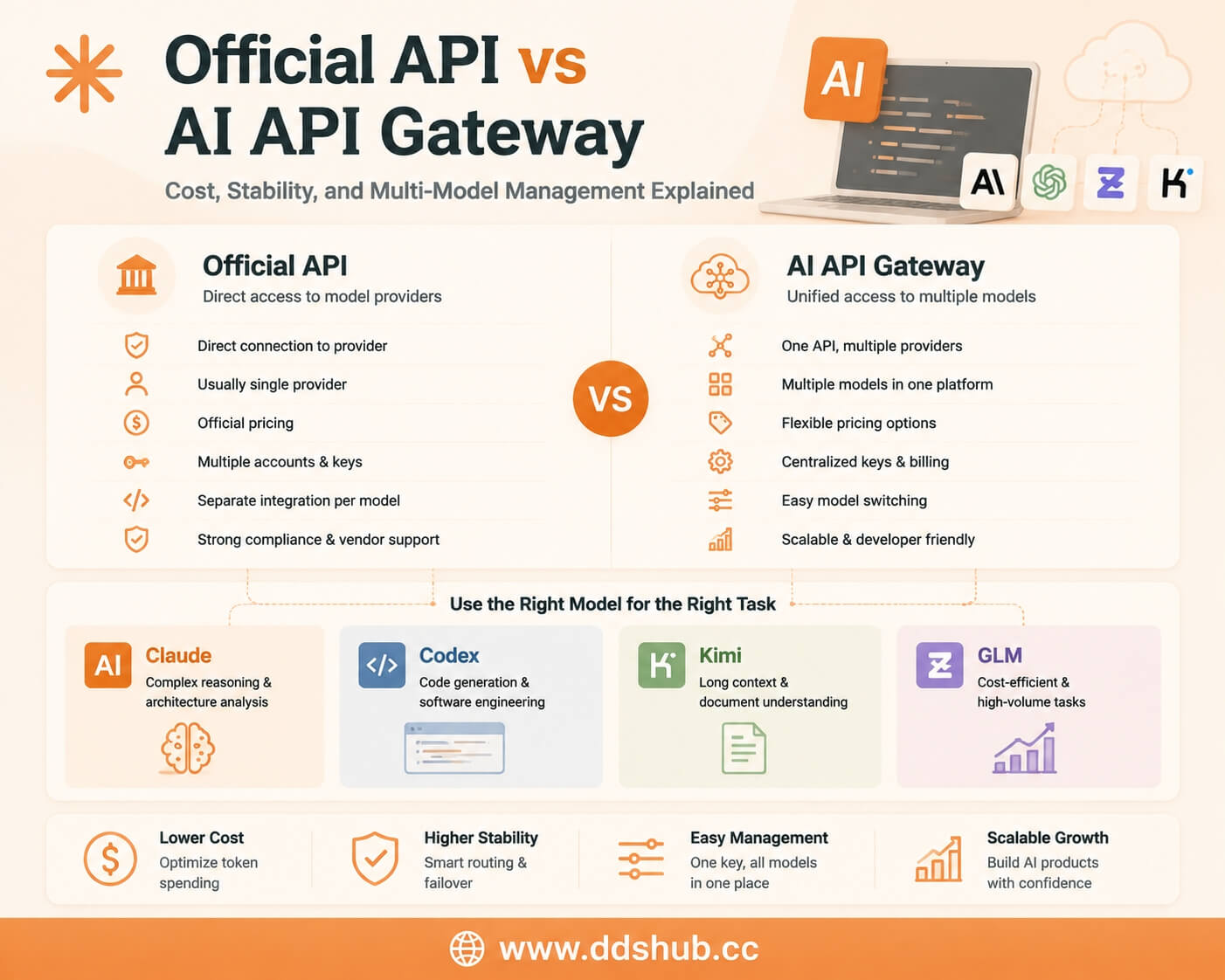
A typical AI product may use Claude for advanced reasoning, Codex for software engineering tasks, Kimi for long-context document analysis, and GLM for cost-sensitive workloads.
Without an API gateway, developers need to maintain multiple accounts, API keys, billing systems, and integration methods.
An AI gateway simplifies this process by providing a unified management layer.
Official API vs AI API Gateway: Key Differences
The main difference is not model intelligence. Both approaches can provide access to powerful AI models.
The difference is how developers manage access, cost, and scalability.
| Category | Official API | AI API Gateway |
|---|---|---|
| Connection | Direct connection to model provider | Unified connection to multiple models |
| Model selection | Usually limited to one provider | Multiple providers in one platform |
| Pricing | Official pricing model | Platform-based pricing options |
| API management | Multiple accounts required | Centralized management |
| Model switching | Requires separate integration | Easier switching between models |
| Enterprise control | Strong vendor relationship | Flexible multi-model architecture |
| Best for | Direct access and compliance | AI products using multiple models |
Cost Comparison: Why Developers Look Beyond Official APIs
AI API pricing is one of the biggest considerations when moving from experimentation to production.
Most AI providers use token-based pricing. The final cost depends not only on the model price but also on how the application uses the model.
A simple chatbot request may consume a few thousand tokens, while an AI coding agent may consume significantly more because it needs to analyze repositories, understand context, generate code, and iterate through multiple steps.
For example, an AI development assistant may use a powerful reasoning model to understand a complex software architecture, but using the same model for simple tasks such as formatting responses or summarizing logs may not be cost-efficient.
This is why many developers are moving toward multi-model strategies.
Instead of sending every request to the most expensive model, applications can select the appropriate model based on the task.
A typical architecture may look like this:
| Task | Suitable Model Type |
|---|---|
| Complex reasoning and architecture analysis | Claude |
| Code generation and software engineering | Codex |
| Long document understanding | Kimi |
| High-volume and cost-sensitive tasks | GLM |
This approach reduces unnecessary AI spending while maintaining application quality.
Stability: Is Official API Always More Reliable?
Many developers assume that official APIs are always more stable because they come directly from the model provider.
Official infrastructure does provide significant advantages, including direct support and dedicated engineering resources. However, reliability in AI applications depends on more than just the API endpoint.
Large AI services can still experience challenges such as traffic spikes, regional limitations, rate limits, and temporary availability issues.
For production applications, stability usually depends on the complete architecture:
- How requests are distributed
- Whether backup models exist
- How usage limits are managed
- Whether the system can switch providers when necessary
This is one reason why larger AI applications increasingly adopt multi-model architectures.
Instead of depending entirely on one provider, they create flexible systems that can adapt based on availability, cost, and performance requirements.
Multi-Model Management: The Biggest Advantage of AI Gateways
The AI industry is moving from a single-model era into a multi-model era.
In the past, companies often selected one model and built their applications around it.
Today, developers recognize that different models have different strengths.
A software engineering platform may use Claude for planning and reasoning, Codex for implementation, Kimi for analyzing technical documentation, and GLM for lightweight operations.
Managing this architecture directly through multiple official APIs can become complicated.
Developers need to maintain different authentication systems, monitor different billing dashboards, and update integrations whenever providers change their APIs.
An AI API gateway reduces this operational complexity by providing one unified access layer.
When Should Developers Choose Official APIs?
Official APIs remain the right choice for many scenarios.
Companies that require direct vendor relationships, strict compliance requirements, or early access to newly released features may prefer official access.
For example, a large enterprise building a highly regulated application may prioritize direct communication with the model provider over flexibility.
Official APIs are also suitable when a project relies heavily on one specific ecosystem and does not require multiple models.
When Should Developers Choose an AI API Gateway?
AI API gateways become more valuable when applications require flexibility.
Developers building AI agents, coding assistants, automation platforms, or SaaS products often need access to multiple models.
In these scenarios, the ability to quickly switch between Claude, Codex, GPT, GLM, and Kimi can significantly simplify development.
An AI gateway also helps teams experiment with different models without rebuilding their infrastructure every time.
DDS Hub: A Multi-Model API Platform for Developers
As AI applications become more complex, developers need simpler ways to manage multiple AI models.
DDS Hub provides a unified API platform that allows developers to access different AI models through a consistent interface.
Instead of maintaining separate integrations for every provider, developers can build applications using a flexible multi-model approach.
For example, an AI coding assistant can combine Claude for reasoning, Codex for programming tasks, Kimi for document analysis, and GLM for cost optimization.
This architecture allows developers to balance performance, availability, and cost depending on their application requirements.
- DDS Hub: https://www.ddshub.cc
- Models: https://www.ddshub.cc/models
- API Documentation: https://www.ddshub.cc/docs
The Future of AI Infrastructure Is Multi-Model
The debate between official APIs and AI API gateways is not simply about choosing one over the other.
Official APIs provide direct access, strong ecosystem support, and the latest model capabilities.
AI API gateways provide flexibility, simplified management, and easier multi-model deployment.
As AI applications continue to evolve, developers will increasingly focus less on finding one perfect model and more on building systems that intelligently combine multiple models.
The future of AI development is not only about better models.
It is about building better AI infrastructure that allows developers to use the right model, at the right time, for the right cost.