
Kimi K3 vs GLM 5.2: Which AI Model Is Better for Coding Agents, Long Context and AI Applications?
The AI model market is entering a new stage where developers are no longer choosing models only based on benchmark scores. As companies move from simple chatbots toward AI agents, automated workflows, and enterprise intelligence systems, the ability of a model to understand complex information, write reliable code, and operate efficiently has become increasingly important.
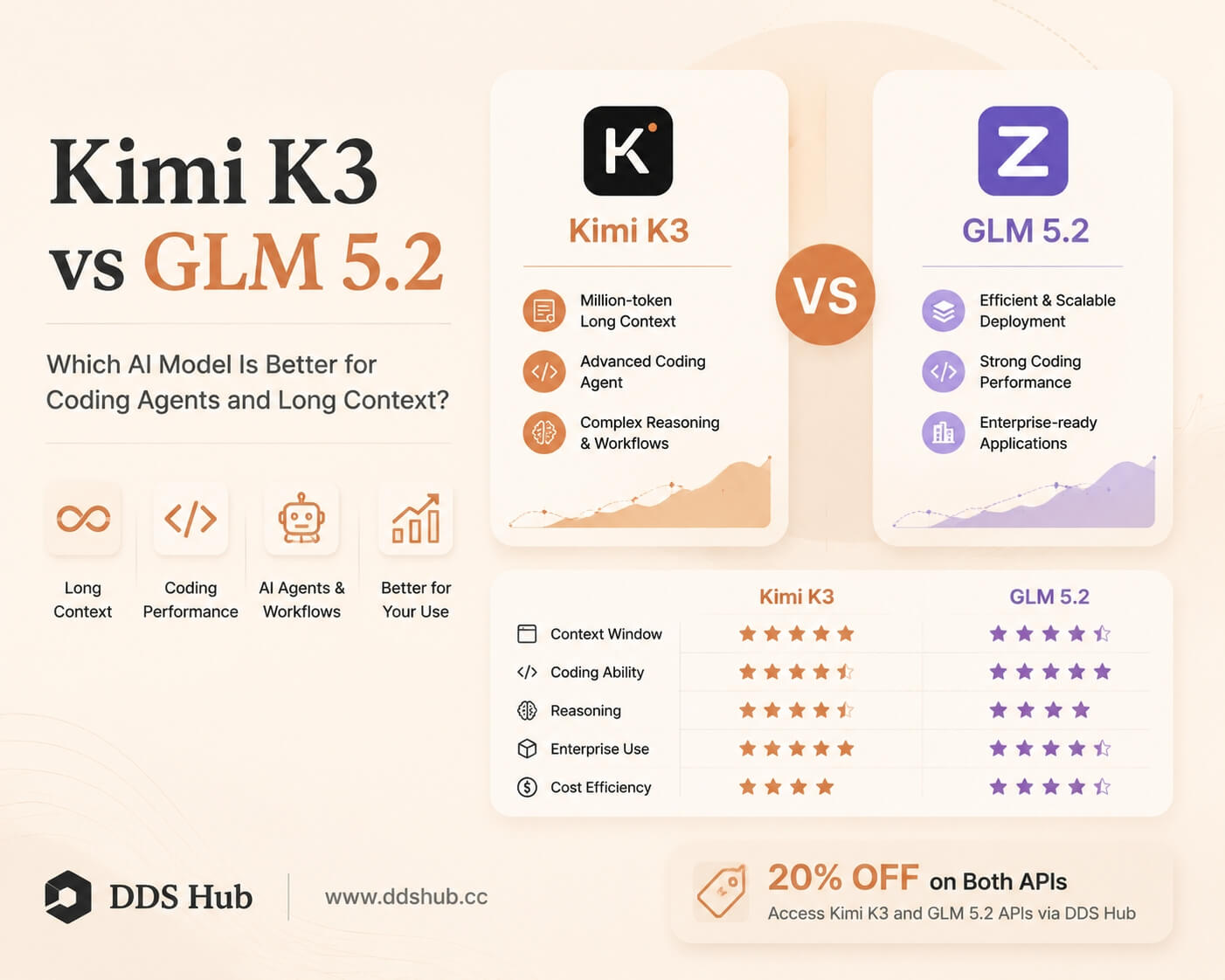
Among the latest generation of AI models, Kimi K3 from Moonshot AI and GLM 5.2 from Zhipu AI have attracted significant attention from developers. Both models represent the rapid development of Chinese AI technology and are competing with international models such as GPT-5.6, Claude, and DeepSeek.
Although Kimi K3 and GLM 5.2 are often compared together, they are designed with different priorities. Kimi K3 focuses on long-context intelligence, advanced reasoning, and AI agent workflows, while GLM 5.2 focuses on efficient deployment, strong coding ability, and practical enterprise applications.
For developers who want to evaluate both models without managing multiple providers, DDS Hub provides unified API access to Kimi K3 and GLM 5.2 with 20% discounted pricing, allowing teams to reduce AI infrastructure costs while testing different models.
Explore Kimi K3 and GLM 5.2 API: https://www.ddshub.cc
Overview: Kimi K3 and GLM 5.2 Positioning
Before comparing technical details, it is important to understand the different philosophies behind these two models.
Kimi K3 is designed as a high-capability model for complex AI workflows. Its main strengths are long-context processing, coding agents, and tasks that require maintaining a large amount of information over extended interactions.
GLM 5.2 continues Zhipu AI's focus on practical AI deployment. It aims to provide strong reasoning and coding performance while maintaining efficiency, making it suitable for businesses that need scalable AI solutions.
The following table summarizes the overall positioning:
| Aspect | Kimi K3 | GLM 5.2 |
|---|---|---|
| Developer | Moonshot AI | Zhipu AI |
| Main Focus | Long-context intelligence and AI agents | Efficient AI deployment and enterprise applications |
| Best Known For | Large context, coding workflows | Cost efficiency, reasoning, coding |
| Target Users | Developers building advanced AI systems | Developers and enterprises seeking scalable AI |
| Competition | GPT-5.6, Claude | DeepSeek, GPT, Claude |
Neither model is designed to replace all other AI systems. Instead, they target slightly different application requirements.
Context Window Comparison: Why Long Context Matters
One of the biggest trends in modern AI development is the move toward long-context models.
A larger context window allows AI systems to process more information at once, which is especially important for software development, document analysis, and enterprise knowledge applications.
Kimi K3 is particularly recognized for its million-token context capability, allowing developers to provide large amounts of information, including source code, technical documentation, and business data, within a single interaction.
GLM 5.2 also supports large-context applications and is designed for scenarios where AI needs to process extensive information.
The difference is not only about the maximum number of tokens. The more important question is how effectively a model can reason across that information.
| Capability | Kimi K3 | GLM 5.2 |
|---|---|---|
| Long-context processing | Excellent | Excellent |
| Large document understanding | Strong | Strong |
| Repository-level code analysis | Strong | Strong |
| Multi-step reasoning | Strong | Strong |
| Enterprise knowledge applications | Excellent | Strong |
For developers building AI assistants that need to understand entire projects or large knowledge bases, both models provide significant advantages over traditional AI assistants.
Kimi K3 vs GLM 5.2 for AI Coding Agents
Coding has become one of the most important areas of competition between advanced AI models.
Modern AI coding tools are evolving from autocomplete assistants into autonomous development agents. These systems need to understand existing codebases, plan solutions, modify multiple files, and debug problems.
Kimi K3 is strongly positioned toward this type of workflow. Its long-context capability allows developers to provide more project information, reducing the need to repeatedly explain the code structure.
For example, when working on a large software project, an AI agent powered by Kimi K3 can analyze relationships between different modules, understand previous implementation decisions, and suggest changes based on the complete project context.
GLM 5.2 also performs strongly in coding scenarios. Its advantage comes from balancing coding capability with efficiency, making it attractive for developers who need reliable AI programming assistance at scale.
The difference can be summarized as follows:
| Coding Scenario | Recommended Model |
|---|---|
| Large repository understanding | Kimi K3 |
| Complex coding agents | Kimi K3 |
| Cost-sensitive coding assistants | GLM 5.2 |
| Enterprise development tools | Both depending on requirements |
For individual developers building advanced coding agents, Kimi K3 may provide stronger advantages in complex projects. For companies deploying coding assistants to many users, GLM 5.2's efficiency can become an important factor.
Kimi K3 vs GLM 5.2 API Pricing and Cost Efficiency
API pricing is becoming one of the most important factors when selecting an AI model.
A model that performs well in benchmarks may not always be the best choice for production applications. Companies need to consider how much each AI request costs, how many users the system supports, and whether the model can maintain quality at scale.
Kimi K3 is positioned as a higher-capability model, especially for applications where better reasoning and context understanding can improve productivity.
GLM 5.2 focuses more heavily on efficiency, making it attractive for applications that require frequent API calls.
| Aspect | Kimi K3 | GLM 5.2 |
|---|---|---|
| Intelligence Level | High | High |
| Cost Efficiency | Competitive | Strong |
| Best Cost Scenario | Complex AI workflows | High-volume applications |
| Production Scaling | Strong | Strong |
For many companies, the best strategy is not choosing only one model.
A practical AI system may use Kimi K3 for difficult reasoning tasks while using GLM 5.2 for simpler, high-frequency requests.
Kimi K3 vs GLM 5.2 for Enterprise Applications
Enterprise AI adoption requires more than model intelligence. Companies also care about reliability, integration flexibility, language capability, and operational costs.
Kimi K3 is especially suitable for organizations building knowledge-intensive AI systems, such as internal research assistants, software engineering agents, and enterprise search platforms.
GLM 5.2 has strong potential in enterprise environments where companies need efficient AI deployment, especially for Chinese-language applications and customized AI solutions.
| Application | Better Choice |
|---|---|
| AI coding assistant | Kimi K3 |
| Enterprise knowledge assistant | Kimi K3 |
| Large-scale customer service | GLM 5.2 |
| Cost-sensitive AI SaaS | GLM 5.2 |
| Research assistant | Kimi K3 |
However, the final choice depends on the specific workflow. Many production systems will eventually combine multiple models rather than relying on a single AI provider.
Kimi K3 vs GLM 5.2 Compared with GPT-5.6, Claude and DeepSeek
The AI market is becoming increasingly competitive.
GPT-5.6 provides strong general intelligence and mature API infrastructure. Claude remains popular among developers because of its coding and writing performance. DeepSeek attracts attention because of its strong cost-performance ratio.
Kimi K3 and GLM 5.2 add more choices for developers, especially those looking for alternatives with strong Chinese language capability and competitive pricing.
| Model | Main Advantage | Best Use Case |
|---|---|---|
| Kimi K3 | Long context and AI agents | Coding agents, research, enterprise knowledge |
| GLM 5.2 | Efficiency and deployment flexibility | Enterprise AI applications |
| GPT-5.6 | General intelligence ecosystem | General AI applications |
| Claude | Coding and writing quality | Developer workflows |
| DeepSeek | Cost efficiency | High-volume AI workloads |
The future of AI development will likely involve selecting the right model for each task instead of searching for one universal winner.
Save 20% on Kimi K3 and GLM 5.2 API with DDS Hub
For developers, testing multiple AI models can become complicated because each provider has different API systems, billing methods, and integration processes.
DDS Hub simplifies this experience by providing unified access to popular AI models, including Kimi K3 and GLM 5.2.
Currently, DDS Hub provides:
- 20% discount on Kimi K3 API
- 20% discount on GLM 5.2 API
Developers can compare different models, optimize API costs, and choose the best model for different application scenarios.
Whether you are building AI coding agents, SaaS products, enterprise assistants, or automation platforms, DDS Hub helps reduce AI API expenses while maintaining access to advanced models.
Try Kimi K3 and GLM 5.2 API: https://www.ddshub.cc
Conclusion: Kimi K3 or GLM 5.2, Which One Should Developers Choose?
Kimi K3 and GLM 5.2 represent two different approaches to modern AI development.
Kimi K3 focuses on pushing the boundaries of long-context intelligence and advanced AI workflows. It is particularly attractive for developers building coding agents, research assistants, and complex knowledge systems.
GLM 5.2 focuses on practical deployment and cost-efficient AI applications. It is a strong option for companies that need scalable AI services while controlling operational expenses.
The best choice depends on the application.
For complex reasoning and long-context workflows, Kimi K3 provides strong advantages.
For efficient production deployment, GLM 5.2 is highly competitive.
With DDS Hub's 20% discounted API access, developers can test both models and select the best AI infrastructure based on real-world performance.
FAQ
Is Kimi K3 better than GLM 5.2?
Kimi K3 is stronger for long-context tasks and advanced AI agents, while GLM 5.2 focuses more on efficient deployment and scalable applications.
Which AI model is better for coding?
Both models perform well for coding. Kimi K3 is better suited for complex repository-level tasks, while GLM 5.2 is competitive for efficient coding assistants.
Which API is cheaper, Kimi K3 or GLM 5.2?
GLM 5.2 is generally positioned as a cost-efficient model, while Kimi K3 provides additional value through stronger context and reasoning capabilities.
Can I get Kimi K3 and GLM 5.2 API discounts?
Yes. DDS Hub currently provides 20% discounted access to both Kimi K3 and GLM 5.2 APIs.