
Kimi K3 vs Fable 5: Which AI Model Should Developers Choose in 2026?
The AI model market is becoming increasingly competitive. Developers are no longer choosing AI models based only on general conversation quality. Instead, they evaluate models on practical capabilities such as software engineering, long-context understanding, autonomous agents, cost efficiency, and integration flexibility.
Two models that represent very different AI development strategies are Kimi K3 from Moonshot AI and Claude Fable 5 from Anthropic.
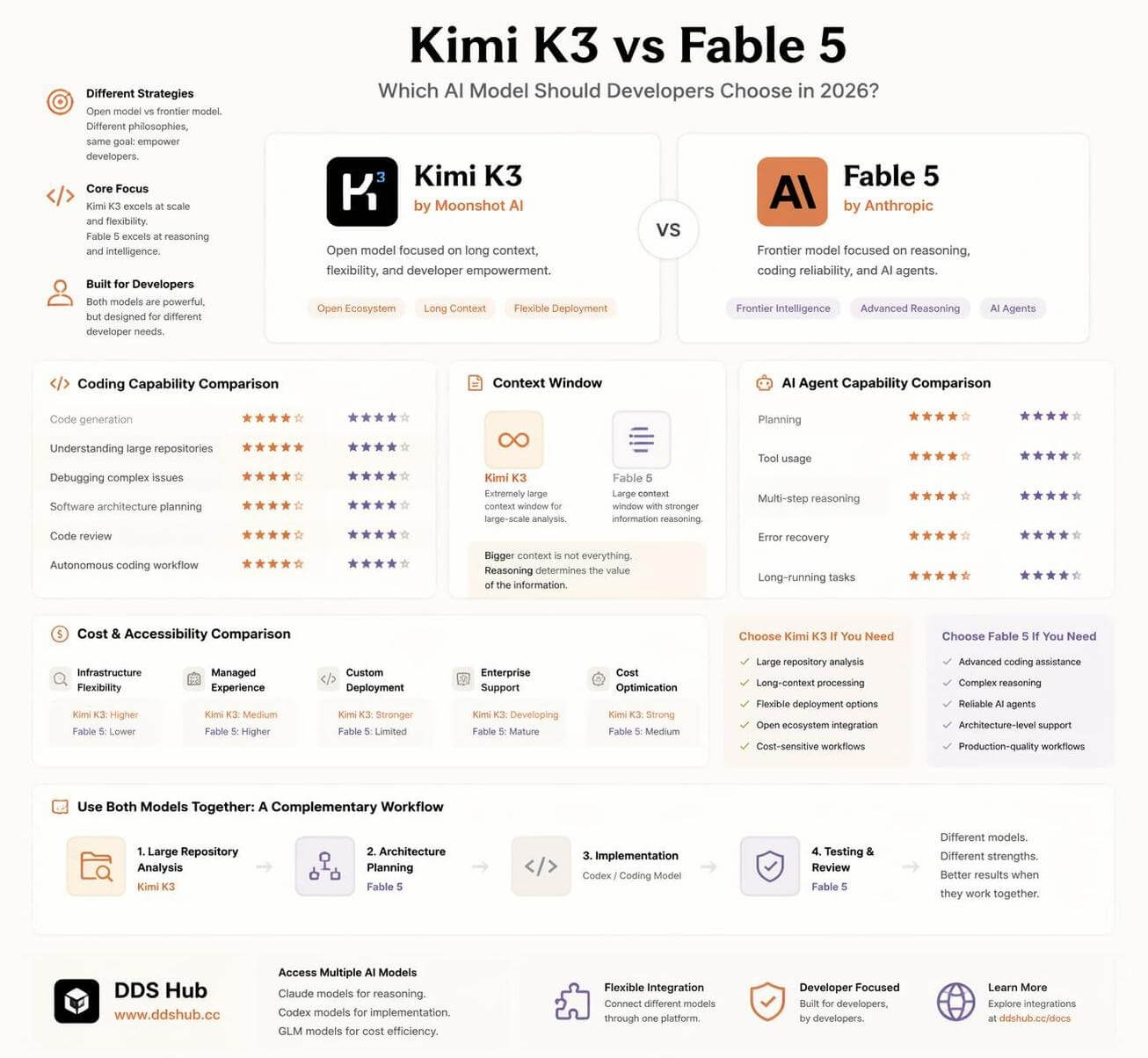
Kimi K3 represents the new generation of large-scale open AI models, focusing on long context, developer accessibility, and flexible deployment. Claude Fable 5 represents the frontier closed-model approach, focusing on advanced reasoning, coding reliability, and AI agent capabilities.
Rather than asking which model is universally better, the more important question is: which model is better for your specific workflow?
Kimi K3 vs Claude Fable 5 Overview
| Feature | Kimi K3 | Claude Fable 5 |
|---|---|---|
| Developer | Moonshot AI | Anthropic |
| Model Approach | Open AI ecosystem | Closed frontier model |
| Main Focus | Long context, coding, flexibility | Reasoning, coding, agents |
| Context Capability | Extremely large context | Large context |
| Coding Ability | Strong | Advanced |
| Agent Capability | Good | Excellent |
| Deployment Flexibility | High | Medium |
| Developer Ecosystem | Growing | Mature |
| Best Use Case | Large-scale analysis and flexible deployment | Professional AI coding workflows |
Different AI Strategies: Open Model vs Frontier Model
The biggest difference between Kimi K3 and Claude Fable 5 is not only their benchmark performance. It is their overall product philosophy.
Kimi K3: Large Context and Open Ecosystem
Kimi K3 follows the direction of modern open AI models. Its focus is providing developers with more flexibility through large-scale model architecture, long-context processing, open ecosystem compatibility, and broader deployment options.
This approach is attractive for developers who want more control over AI infrastructure. Typical use cases include analyzing large repositories, processing long technical documents, building internal AI systems, and creating customized AI workflows.
For organizations that care about flexibility and cost optimization, Kimi K3 provides an interesting alternative to fully managed AI services.
Claude Fable 5: Frontier Intelligence for Complex Workflows
Claude Fable 5 represents Anthropic's frontier model strategy. Instead of focusing only on model size or context length, it emphasizes advanced reasoning, complex problem solving, reliable coding assistance, and multi-step agent execution.
Modern AI coding requires more than generating code. A strong coding model needs to understand existing architecture, dependencies, possible side effects, business requirements, and testing strategies. This is where frontier reasoning models have a significant advantage.
Coding Capability Comparison
For most developers, coding performance is the most important comparison. However, coding itself contains different tasks. Writing a small function, debugging a production issue, and refactoring a large application require different capabilities.
| Coding Capability | Kimi K3 | Claude Fable 5 |
|---|---|---|
| Code generation | 4/5 | 5/5 |
| Understanding large repositories | 5/5 | 5/5 |
| Debugging complex issues | 4/5 | 5/5 |
| Software architecture planning | 4/5 | 5/5 |
| Code review | 4/5 | 5/5 |
| Autonomous coding workflow | 4/5 | 5/5 |
Kimi K3 Coding Strengths
Kimi K3's biggest advantage is its ability to process large amounts of information. For developers working with enterprise repositories, legacy systems, large documentation sets, and complex project structures, long-context capability can become extremely valuable.
A developer may provide multiple source files, architecture documentation, API specifications, and historical changes, and allow the model to analyze a broader picture. This makes Kimi K3 especially interesting for repository-level understanding and large-scale analysis.
Claude Fable 5 Coding Strengths
Claude Fable 5 focuses more heavily on reasoning quality. For advanced software engineering tasks, the model needs to understand not only what code should be written, but why certain approaches are better.
Examples include redesigning system architecture, debugging difficult production issues, improving security, optimizing performance, and maintaining compatibility. These tasks require deeper reasoning and better decision-making.
For professional developers using AI as an engineering partner, reasoning quality often matters more than simply generating more code.
Context Window: Is Bigger Always Better?
One of Kimi K3's major advantages is its large context capability. A larger context window allows AI models to process more files, longer conversations, bigger documents, and larger repositories.
However, context size alone does not determine model intelligence. A model still needs to identify important information, ignore irrelevant details, and make correct decisions.
A large context window provides more information, but reasoning determines whether that information is used effectively.
AI Agent Capability Comparison
The next generation of AI development is moving from chat assistants toward autonomous coding agents. AI agents need to understand objectives, create plans, use tools, modify files, test results, and improve solutions. This creates a new requirement: consistent reasoning across multiple steps.
| Agent Capability | Kimi K3 | Claude Fable 5 |
|---|---|---|
| Planning | 4/5 | 5/5 |
| Tool usage | 4/5 | 5/5 |
| Multi-step reasoning | 4/5 | 5/5 |
| Error recovery | 4/5 | 5/5 |
| Long-running tasks | 5/5 | 5/5 |
Cost and Accessibility Comparison
Cost is another important factor when choosing an AI model. Open models and closed models usually optimize for different goals.
| Category | Kimi K3 | Claude Fable 5 |
|---|---|---|
| Infrastructure flexibility | Higher | Lower |
| Managed experience | Medium | Higher |
| Custom deployment | Stronger | Limited |
| Enterprise support | Developing | Mature |
| Cost optimization | Strong | Medium |
Kimi K3 may appeal to teams that want more control over deployment and infrastructure. Claude Fable 5 may appeal to teams that prioritize maximum capability and a mature AI development ecosystem.
Which Model Should Developers Choose?
Choose Kimi K3 if you need:
- Large repository analysis
- Long-context processing
- Flexible deployment options
- Open ecosystem integration
- Cost-sensitive AI workflows
Choose Claude Fable 5 if you need:
- Advanced coding assistance
- Complex reasoning
- Reliable AI agents
- Architecture-level support
- Production-quality development workflows
Can Developers Use Both Models Together?
The future of AI development may not be about choosing one model. Different models can serve different roles in the same workflow.
Large Repository Analysis
    ↓
Kimi K3
    ↓
Architecture Planning
    ↓
Claude Fable 5
    ↓
Implementation
    ↓
Coding Model (Codex / GLM)
    ↓
Testing and Review
    ↓
Claude Fable 5
In this workflow, each model handles the tasks where it performs best.
Using Multiple AI Models with DDS Hub
As AI development becomes more complex, developers increasingly use multiple models instead of relying on one AI provider.
DDS Hub provides access to different AI model ecosystems through dedicated model groups, allowing developers to select models based on different requirements. For example, Claude-based models can handle reasoning-heavy workflows, Codex models can focus on software implementation, and GLM models can provide cost-efficient AI access.
Instead of searching for one "perfect" model, developers can build flexible workflows where each model contributes its own strengths. You can learn more about supported AI integrations through the official documentation.
Final Thoughts
Kimi K3 and Claude Fable 5 represent two different directions in AI development.
Kimi K3 shows the increasing capability of open AI models, especially in long-context processing, flexibility, and developer accessibility. Claude Fable 5 represents the continued evolution of frontier AI models, focusing on advanced reasoning, coding reliability, and autonomous agent workflows.
There is no single winner. For developers who need flexibility, large-scale analysis, and cost optimization, Kimi K3 can be an attractive choice. For developers who need maximum reasoning ability, professional coding assistance, and reliable AI agents, Claude Fable 5 may be the stronger option.
The future of AI development will likely not belong to one model, but to workflows that combine multiple models intelligently.