
Kimi K3 vs Claude vs Codex: How AI Coding Models Handle Context Engineering
AI coding is entering a new stage.
A few years ago, developers mainly evaluated AI models by asking: "Can this model generate code?" Today, that question is no longer enough.
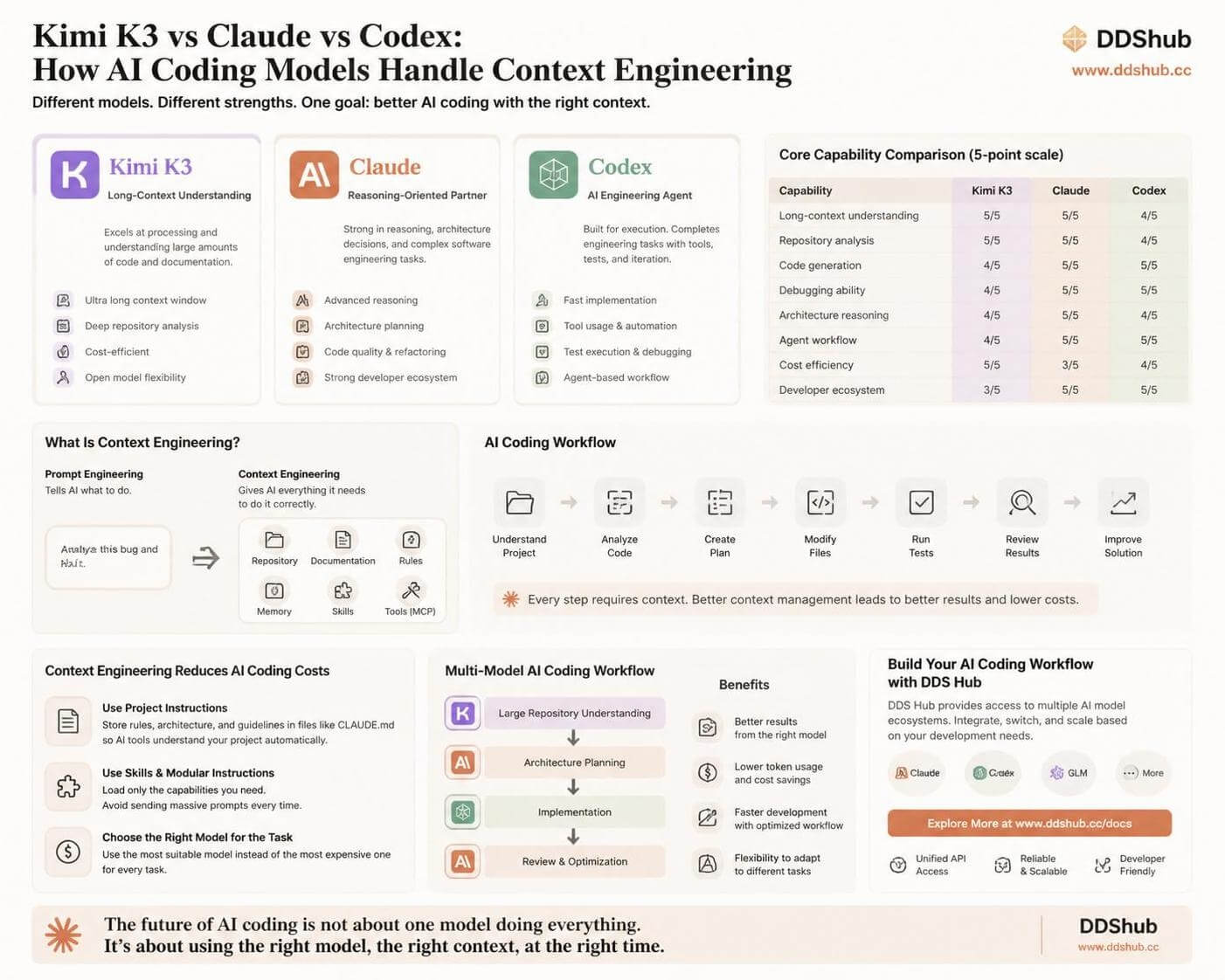
Modern AI coding assistants such as Claude Code, OpenAI Codex, and emerging models like Kimi K3 are becoming more like engineering partners. They do not simply generate snippets. They analyze repositories, understand architecture, read documentation, use tools, modify files, run tests, and continuously improve their solutions.
This shift introduces a new concept that is becoming increasingly important: Context Engineering.
The future competition between AI coding models will not only depend on model intelligence, but also on how effectively each model can understand, manage, and utilize context.
Kimi K3, Claude, and Codex represent three different approaches to this challenge. Kimi K3 focuses on long-context understanding and open model flexibility. Claude focuses on reasoning quality and complex software engineering. Codex focuses on coding execution and agent-based development workflows.
Understanding their differences helps developers choose the right model for the right task.
What Is Context Engineering?
Prompt Engineering focuses on improving how users communicate with AI.
A weak prompt:
Fix this bug.A better prompt:
Analyze this authentication issue, identify the root cause,
modify only necessary files, and add regression tests.
However, AI coding requires more than a good prompt. A real software project contains thousands of files, existing architecture decisions, coding conventions, dependencies, previous changes, and testing requirements.
Context Engineering is the process of designing the environment that allows AI models to work effectively. It includes repository structure, project instructions, memory, skills, MCP tools, documentation, and task history.
In other words: Prompt Engineering tells AI what to do. Context Engineering gives AI everything it needs to do it correctly.
Why Context Engineering Matters More Than Ever in AI Coding
Traditional chat models usually handle one question at a time. AI coding agents work differently.
A typical AI coding workflow looks like:
Understand Project
    ↓
Analyze Existing Code
    ↓
Create Plan
    ↓
Modify Files
    ↓
Run Tests
    ↓
Review Results
    ↓
Improve Solution
Every step requires context. If the model does not understand the project structure, it may edit the wrong files, break existing features, create duplicate solutions, or waste tokens exploring irrelevant areas.
Therefore, better context management often improves AI coding performance more than simply choosing a larger model.
Kimi K3 vs Claude vs Codex Overview
| Feature | Kimi K3 | Claude | Codex |
|---|---|---|---|
| Long-context understanding | 5/5 | 5/5 | 4/5 |
| Repository analysis | 5/5 | 5/5 | 4/5 |
| Code generation | 4/5 | 5/5 | 5/5 |
| Debugging ability | 4/5 | 5/5 | 5/5 |
| Architecture reasoning | 4/5 | 5/5 | 4/5 |
| Agent workflow | 4/5 | 5/5 | 5/5 |
| Cost efficiency | 5/5 | 3/5 | 4/5 |
| Developer ecosystem | 3/5 | 5/5 | 5/5 |
The table does not represent an absolute ranking. Instead, it shows where each model is strongest.
Kimi K3: The Long-Context AI Coding Model
Kimi K3's biggest advantage is its focus on large-context understanding.
For AI coding, context length is extremely valuable because software projects are not isolated pieces of code. A developer working on a large application may need the AI model to understand frontend components, backend services, database schemas, API documentation, and deployment configuration.
Kimi K3 is particularly interesting for scenarios where understanding large amounts of information is the primary challenge, such as analyzing enterprise repositories, migrating legacy applications, reviewing large codebases, and understanding complex documentation.
A large context window allows developers to provide more project information, reducing the need to manually summarize every part of the system.
However, context size alone does not guarantee better coding results. A model must still be able to reason about the information it receives. This is where Claude and Codex show different strengths.
Claude: The Reasoning-Oriented AI Coding Partner
Claude's strength is not only understanding code, but reasoning about engineering decisions.
In real software development, many problems do not have a single correct answer. For example, "How should we redesign this payment system?" requires understanding security, scalability, maintainability, and business requirements. This type of problem requires deeper reasoning.
Claude Code workflows are especially strong in architecture planning, debugging complex issues, reviewing code quality, and refactoring large systems.
Instead of simply generating code, Claude often behaves more like a senior engineer reviewing technical decisions. For developers working on production systems, this reasoning capability can be more valuable than raw code generation speed.
Codex: The AI Software Engineering Agent
Codex represents a different direction. Instead of focusing primarily on conversation, Codex is designed around software execution workflows.
The goal is not only "tell me the code." The goal is "complete the engineering task."
A typical Codex workflow may involve understanding requirements, editing files, executing commands, running tests, and fixing errors.
This makes Codex particularly suitable for developers who want AI agents to participate directly in development workflows. Its strengths include implementation speed, coding automation, tool usage, and iterative development.
Context Engineering Comparison
Different models handle context in different ways.
| Context Capability | Kimi K3 | Claude | Codex |
|---|---|---|---|
| Large repository understanding | 5/5 | 5/5 | 4/5 |
| Following project rules | 4/5 | 5/5 | 5/5 |
| Maintaining coding style | 4/5 | 5/5 | 5/5 |
| Multi-step execution | 4/5 | 5/5 | 5/5 |
| Long analysis tasks | 5/5 | 5/5 | 4/5 |
How Context Engineering Reduces AI Coding Costs
One of the biggest challenges with AI coding is token usage. Many developers notice that AI coding tools consume significantly more tokens than normal chat applications.
The reason is simple: AI coding involves continuous loops. Every action creates additional context, including reading files, analyzing code, executing commands, and reviewing results. Poor context management can dramatically increase API costs.
Several strategies can reduce unnecessary token consumption.
Use Project Instructions
Instead of repeatedly explaining coding style, architecture, and project rules, developers can store instructions in project files such as CLAUDE.md. This allows AI tools to automatically understand project requirements.
Use Skills and Modular Instructions
Large prompts are inefficient. A better approach is loading only the required capability. For example, a security review task does not need the entire development guideline, and a debugging task does not need every project document. Modular skills help reduce unnecessary context.
Choose the Right Model for the Task
Using the most powerful model for every task is usually expensive. A more efficient workflow:
| Task | Suitable Model |
|---|---|
| Large repository analysis | Kimi K3 |
| Architecture decisions | Claude |
| Code implementation | Codex |
| Simple modifications | Cost-efficient models |
The future of AI coding is likely to be multi-model rather than single-model.
Building a Multi-Model AI Coding Workflow with DDS Hub
As AI coding becomes more advanced, developers are increasingly combining multiple models instead of relying on one provider.
DDS Hub provides access to different AI model ecosystems, allowing developers to select different models based on their workflow requirements. For example, Claude models can handle reasoning-heavy development tasks, Codex models can focus on implementation and coding execution, and GLM models can provide cost-efficient alternatives for specific workloads.
A practical workflow may look like:
Large Repository Understanding
    ↓
Kimi K3
    ↓
Architecture Planning
    ↓
Claude
    ↓
Implementation
    ↓
Codex
    ↓
Review and Optimization
    ↓
Claude
Instead of searching for one model that does everything, developers can create a workflow where each model performs the task it handles best.
More information about AI model integration is available in the official documentation.
Final Thoughts
Kimi K3, Claude, and Codex represent three different directions in AI coding.
Kimi K3 demonstrates the importance of long-context understanding and flexible AI infrastructure. Claude demonstrates the value of advanced reasoning and software engineering judgment. Codex demonstrates the future of autonomous coding execution.
The next generation of AI development will not be defined only by which model has the highest benchmark score. It will be defined by how effectively developers combine the right model, the right context, and the right workflow.
Context Engineering is becoming the foundation of AI coding productivity, and developers who understand how to manage context will be able to build faster, reduce token costs, and get significantly better results from AI coding tools.