
Kimi K3 API Explained: What Changed From Previous Kimi Models and Why Developers Are Switching
The AI development landscape is moving from simple chatbot applications toward more complex AI-powered systems. Developers are no longer only asking whether a model can answer questions; they are evaluating whether a model can understand large codebases, execute long workflows, operate as an AI agent, and support production applications through APIs.
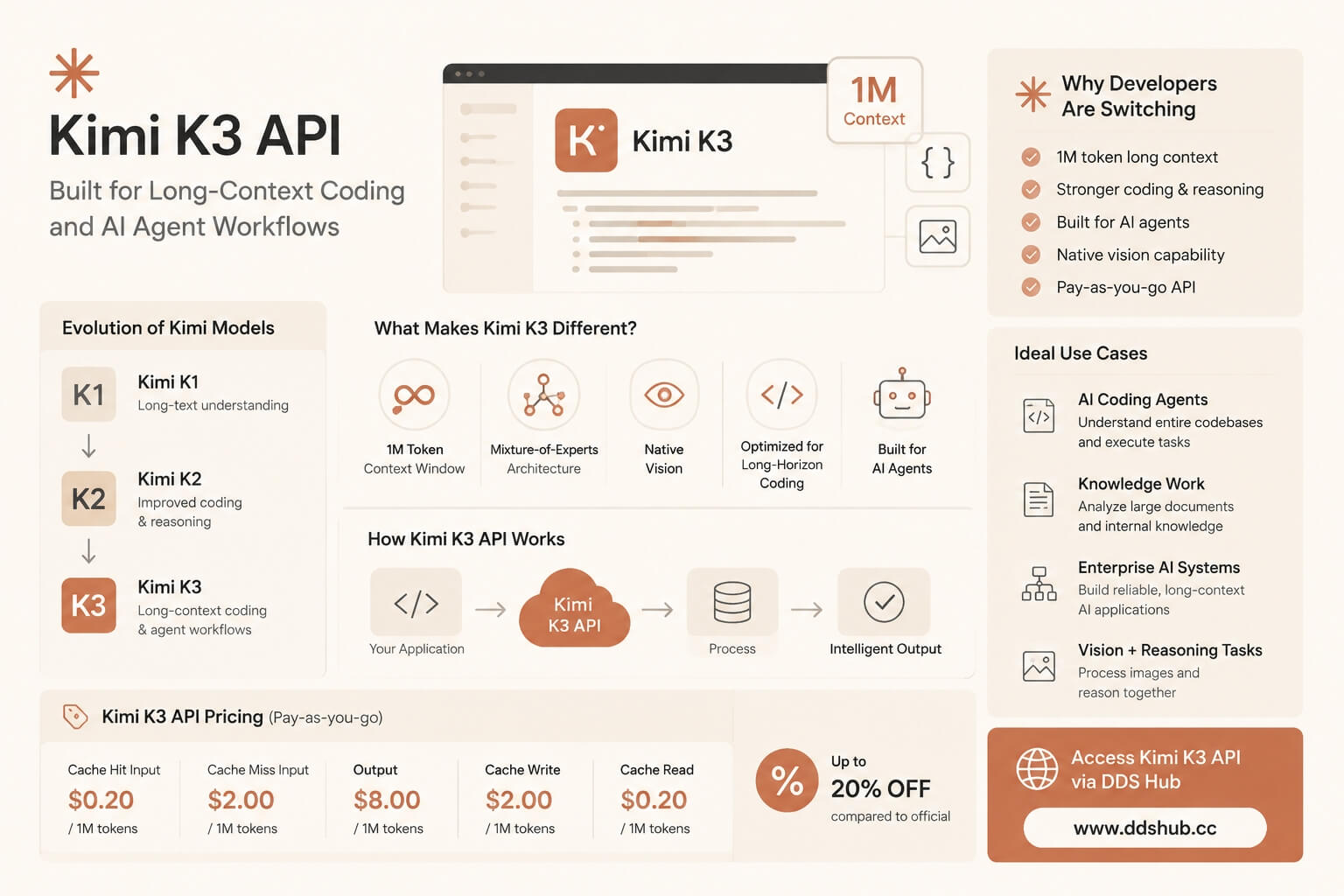
This is the reason why Kimi K3 has attracted significant attention from developers.
Compared with earlier Kimi models, Kimi K3 represents a shift from a general-purpose assistant toward a model designed specifically for long-context reasoning, software engineering, and agent-based workflows.
For developers building AI applications, the important question is not only "How powerful is Kimi K3?", but also:
"What improvements does Kimi K3 bring compared with previous Kimi models, and why should developers consider using Kimi K3 API?"
From Kimi K1/K2 to Kimi K3: The Evolution of Developer-Focused AI
Moonshot AI's Kimi series has gradually evolved from a model focused on conversational intelligence and long-document understanding into a more developer-oriented AI platform.
Earlier Kimi models became popular because of their strong Chinese language capability and long-context processing. They were frequently used for document analysis, research assistance, and knowledge-based tasks.
With Kimi K2, Moonshot expanded the model's capability toward coding and reasoning tasks. The model became more relevant for developers who wanted to use AI for programming assistance and technical workflows.
Kimi K3 continues this direction by focusing on long-horizon coding, end-to-end knowledge work, and AI agent scenarios. According to Kimi's official API documentation, kimi-k3 is the flagship model designed for long-horizon coding and end-to-end knowledge work, supporting a context window of up to 1 million tokens.
The evolution can be summarized as:
| Model | Main Focus | Typical Developer Usage |
|---|---|---|
| Kimi K1 | General intelligence and long-text understanding | Document analysis, research assistance |
| Kimi K2 | Improved reasoning and coding capability | Code generation, technical tasks |
| Kimi K3 | Long-context coding and agent workflows | AI coding agents, enterprise AI systems |
What Makes Kimi K3 Different?
The biggest improvement in Kimi K3 is not simply that it produces better answers. The more important change is that the model is designed for longer and more complex tasks.
Modern AI applications increasingly require models to maintain understanding across thousands of lines of code, large technical documents, and multi-step workflows.
A traditional chatbot may answer a single programming question.
A modern AI coding agent needs to understand an entire repository, identify dependencies, analyze architecture decisions, modify multiple files, and continue reasoning after receiving feedback.
This type of workflow requires stronger context management.
According to Moonshot AI's technical report, Kimi K3 introduces a large-scale Mixture-of-Experts architecture, native vision capability, and a 1-million-token context window. The report describes Kimi K3 as being optimized for long-horizon coding, agentic tasks, knowledge work, reasoning, and vision scenarios.
Kimi K3 API and Long Context Capability
One of the most important reasons developers consider Kimi K3 API is its context capacity.
Large context windows are becoming increasingly important because many real-world AI tasks cannot be solved with short prompts.
For example, a software company may want to build an internal coding assistant that understands an entire application repository. A research team may need an AI assistant capable of analyzing hundreds of pages of technical documentation. An enterprise may want to build a knowledge system based on thousands of internal documents.
In these scenarios, sending only small pieces of information limits the model's ability to understand the overall problem.
Kimi K3's 1 million token context window makes it suitable for applications where maintaining large amounts of information is critical.
Kimi K3 API Pricing: How Much Does It Cost?
Kimi K3 API follows a pay-as-you-go token pricing model. Developers pay according to the amount of input and output tokens processed rather than paying for a fixed subscription.
According to Kimi's official API platform, Kimi K3 pricing is:
| Model | Cache Hit Input | Input | Output |
|---|---|---|---|
| Kimi K3 API | ¥2 / 1M tokens | ¥20 / 1M tokens | ¥100 / 1M tokens |
The token-based model provides flexibility for developers because costs scale with actual usage. However, production AI applications usually consume much more than simple chatbot conversations.
An AI agent may repeatedly send context information, analyze files, call tools, and generate multiple responses during a single task.
Therefore, API cost optimization is becoming increasingly important. Developers need to consider not only the model price, but also context management, caching strategy, and model selection.
Kimi K3 API Use Cases
AI Coding Agents
Coding is one of the most important application scenarios for Kimi K3.
The next generation of coding assistants is moving beyond autocomplete. Developers increasingly expect AI systems to understand projects, analyze architecture, debug problems, and complete larger engineering tasks.
Kimi K3 is designed for these long-horizon coding workflows.
For example, a developer can provide a large software project context and ask the AI system to analyze the current architecture, identify potential issues, and suggest implementation strategies.
This type of workflow requires both reasoning capability and context understanding, which are the areas where Kimi K3 focuses.
Enterprise Knowledge Assistants
Many companies are building internal AI systems that connect company documents, technical knowledge, and operational information.
The challenge is that enterprise information is often large and fragmented.
A useful AI assistant needs to understand not only individual documents but also relationships between different sources.
Kimi K3's long-context capability makes it suitable for building knowledge assistants that can process large volumes of information within a single workflow.
AI Agent Applications
AI agents represent another important direction for Kimi K3.
Unlike traditional chatbots, AI agents need to complete tasks through multiple steps.
For example, an AI research agent may need to collect information, analyze documents, summarize findings, and generate reports.
A software engineering agent may need to understand requirements, modify code, run tests, and improve the solution.
These workflows require models that can maintain context over extended interactions.
Kimi K3 vs Claude vs Codex: Choosing the Right API Model
Kimi K3 is not designed to replace every AI model. Different models have different strengths.
Developers building production AI applications increasingly use multiple models together.
| Model | Main Strength | Best Scenario |
|---|---|---|
| Kimi K3 | Long context and agent workflows | Large projects, knowledge systems, AI agents |
| Claude | Advanced reasoning and complex analysis | Architecture design, deep reasoning |
| Codex | Software engineering | Code generation and programming workflows |
| GLM | Cost efficiency | High-volume AI applications |
For example, an AI development platform may use Kimi K3 to understand large repositories, Claude for architecture decisions, and Codex for implementation tasks.
This multi-model approach allows developers to balance capability and cost.
How Developers Can Access Kimi K3 API
Developers can access Kimi K3 through several API platforms.
The official Kimi API platform provides direct access through Moonshot AI's developer ecosystem and supports OpenAI-compatible API formats, making integration easier for existing AI applications.
For developers who need multiple models, AI gateway platforms provide another option by combining different AI providers into one API interface.
DDShub provides Kimi K3 API access together with other popular AI models, including Claude, Codex, and GLM.
Instead of managing multiple API providers separately, developers can use one platform to build multi-model AI applications.
Currently, DDShub provides Kimi K3 API access at 80% of the official API price, helping developers reduce API costs while maintaining access to Kimi K3 capabilities.
- DDShub: https://www.ddshub.cc
- Models: https://www.ddshub.cc/models
Why Developers Are Moving Toward Multi-Model AI APIs
The future of AI development is unlikely to be dominated by one single model.
Different models excel at different tasks.
Kimi K3 provides strong long-context and agent capabilities.
Claude provides advanced reasoning.
Codex focuses on software engineering.
GLM provides efficient deployment options.
As AI applications become more complex, developers need infrastructure that allows them to combine models efficiently.
This is why multi-model API platforms are becoming increasingly important.
Conclusion
Kimi K3 represents a major evolution of the Kimi model family.
Compared with previous generations, Kimi K3 moves beyond traditional conversational AI and focuses on long-context reasoning, coding, and AI agent applications.
For developers, the value of Kimi K3 API comes from its ability to handle larger tasks, understand more information, and support more advanced AI workflows.
Whether building coding assistants, enterprise knowledge systems, or autonomous AI agents, Kimi K3 provides developers with a powerful option in the growing AI API ecosystem.
As AI development continues to evolve, the most effective strategy will not be choosing a single model, but building flexible systems that can use the right model for each task.