
Kimi K3 API Review: How Moonshot's Long Context AI Model Competes with GPT-5.6, Claude and DeepSeek
The AI industry is moving from simple conversational assistants toward more advanced AI systems that can understand large amounts of information, execute multi-step workflows, and assist developers in completing complex tasks. In this new generation of AI applications, model capability is no longer measured only by how well a model answers questions. Developers are increasingly looking at context length, coding ability, agent performance, API flexibility, and overall cost efficiency.
Kimi K3, developed by Moonshot AI, is one of the latest models attracting attention because of its focus on long-context understanding and advanced AI workflows. Unlike traditional chat-oriented models, Kimi K3 is designed for scenarios where AI needs to process large-scale information, maintain context over longer tasks, and support applications such as coding agents, enterprise knowledge assistants, and research automation.
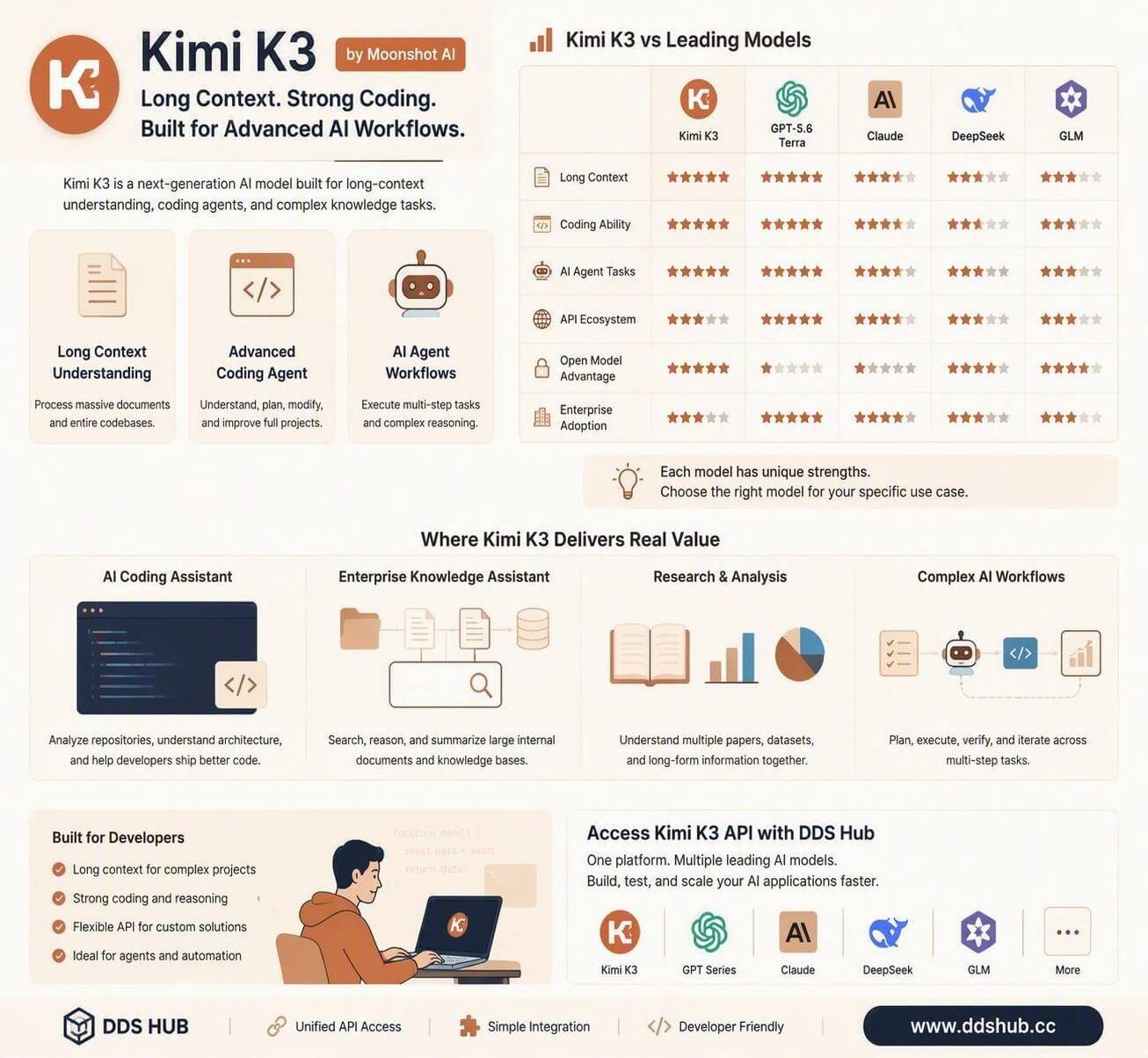
As developers compare different AI models in 2026, Kimi K3 is increasingly being evaluated alongside GPT-5.6 Terra, Claude, DeepSeek, and GLM. Each model has its own strengths, and the right choice depends heavily on the type of application being built.
For developers who want to test multiple AI models through a unified API platform, DDS Hub provides convenient access to leading AI models, including Kimi, Claude, GPT-series models, and other popular AI services.
Learn more: https://www.ddshub.cc
What Is Kimi K3?
Kimi K3 is a large language model created by Moonshot AI, designed around three major capabilities: extremely long context understanding, advanced coding assistance, and agent-based AI workflows.
According to Moonshot AI's official platform, Kimi models focus on handling complex knowledge tasks where understanding large amounts of information is essential.
Official source: https://platform.moonshot.cn/
The biggest difference between Kimi K3 and many general-purpose AI models is that it focuses on helping AI systems work with much larger information environments. Instead of only generating responses based on short conversations, Kimi K3 is designed to understand extensive documents, large software projects, and complex knowledge structures.
This makes it particularly interesting for developers building AI applications where memory and context are critical.
Kimi K3 Long Context Capability: Why It Matters for Developers
One of Kimi K3's most discussed features is its large context capability, which allows the model to process significantly more information within a single interaction.
For everyday chatbot usage, a larger context window may not always create a visible difference. However, for professional applications, context length can directly determine whether an AI system is useful or limited.
For example, when developers build an AI coding assistant, the model may need to understand an entire repository instead of a single file. A software project may contain thousands of files, technical documentation, architecture decisions, and historical changes. A model with stronger context capability can analyze these relationships more effectively and provide more relevant suggestions.
The same principle applies to enterprise knowledge systems. Companies often store years of internal documents, product specifications, technical manuals, and business information. Instead of manually searching through different sources, employees can interact with an AI assistant that understands the broader organizational knowledge base.
This is where Kimi K3's long-context design becomes valuable.
Kimi K3 as an AI Coding Agent Model
Coding has become one of the most important application areas for advanced AI models. Modern developers are moving beyond simple autocomplete tools and increasingly using AI agents that can understand requirements, analyze existing code, make changes, and assist throughout the development lifecycle.
Kimi K3 is positioned toward this type of workflow.
A traditional coding assistant usually helps with small tasks such as completing a function or explaining an error. An AI coding agent, however, needs to understand the entire project environment, reason about potential solutions, and perform multiple steps.
For example, a developer may ask an AI agent to add a payment system to an existing application. The AI needs to understand the current architecture, identify relevant files, create implementation plans, modify code, and evaluate possible problems.
This type of long-horizon coding workflow is exactly where models like Kimi K3, GPT-5.6 Terra, and Claude compete.
Kimi K3 vs GPT-5.6 Terra: Different Approaches to Advanced AI
GPT-5.6 Terra and Kimi K3 target similar users: developers building advanced AI applications, agents, and enterprise workflows.
However, their strengths are slightly different.
GPT-5.6 Terra benefits from OpenAI's mature ecosystem, broad developer adoption, and strong API infrastructure. It is designed as a balanced intelligence model that provides strong reasoning capability while maintaining improved cost efficiency after recent pricing adjustments.
Kimi K3 focuses more heavily on long-context intelligence, open ecosystem flexibility, and large-scale knowledge processing.
| Capability | Kimi K3 | GPT-5.6 Terra |
|---|---|---|
| Long Context | Excellent | Excellent |
| Coding Ability | Strong | Strong |
| AI Agent Tasks | Strong | Strong |
| API Ecosystem | Growing | Mature |
| Open Model Advantage | Strong | Limited |
| Enterprise Adoption | Growing | Strong |
For startups building customized AI solutions, Kimi K3's flexibility can be attractive. For companies looking for a mature global AI infrastructure ecosystem, GPT-5.6 Terra remains a strong option.
Kimi K3 vs Claude: Coding and Knowledge Work Comparison
Claude has become one of the most popular AI models among developers, especially for programming, technical writing, and complex reasoning tasks.
Anthropic's official documentation: https://docs.anthropic.com/
Claude's popularity comes from its strong performance in coding workflows and its ability to generate clear, structured responses. Many developers use Claude for software development assistance, documentation writing, and AI-powered productivity tools.
Kimi K3 approaches the same market from a different angle. Instead of focusing primarily on conversational intelligence, it emphasizes large-scale context understanding and longer AI workflows.
For developers working with massive codebases, large documents, or enterprise knowledge systems, Kimi K3's context advantage can become an important factor.
For users who prioritize writing quality and mature coding workflows, Claude remains a highly competitive option.
Kimi K3 vs DeepSeek: Performance and Cost Considerations
DeepSeek has significantly influenced the AI market by demonstrating that powerful models can be offered at highly competitive prices.
Official DeepSeek API: https://api-docs.deepseek.com/
DeepSeek is widely considered an attractive choice for developers who prioritize cost efficiency, especially when building applications that require large numbers of model requests.
Kimi K3 competes differently. Its value proposition is not only about reducing token costs but also about enabling more complex workflows that require stronger context understanding.
A developer building a simple chatbot may prioritize DeepSeek's cost advantages, while a team developing an AI research assistant or coding agent may value Kimi K3's long-context capabilities.
Kimi K3 vs GLM: Chinese AI Model Competition
GLM from Zhipu AI is another important competitor, particularly among Chinese developers and enterprise users.
Official GLM platform: https://open.bigmodel.cn/
GLM has gained adoption because of its Chinese language capability and enterprise-focused ecosystem.
Kimi K3 differentiates itself through its emphasis on long-context applications, coding workflows, and AI agent scenarios.
Both models represent the rapid growth of Chinese AI infrastructure and demonstrate that developers now have more alternatives beyond US-based AI providers.
Kimi K3 API Use Cases in Real-World Applications
The strongest use cases for Kimi K3 are applications where understanding large amounts of information is necessary.
For software companies, this includes AI coding assistants that can analyze repositories and support developers throughout the development process. For enterprises, it includes knowledge assistants that can search and reason across large internal information systems.
Research organizations can also benefit from models with stronger context capability because they often need to analyze multiple documents, papers, and datasets together.
The common theme across these applications is that the AI model is not simply answering questions. It is becoming a reasoning layer that helps users work with complex information.
Access Kimi K3 API Through DDS Hub
Choosing an AI model has become more complicated because every model has different advantages.
GPT-5.6 models provide strong general intelligence and enterprise-level infrastructure. Claude is popular for coding and writing workflows. DeepSeek focuses on cost efficiency. GLM serves many Chinese enterprise scenarios. Kimi K3 provides strong long-context capability for advanced AI workflows.
For developers, testing multiple models is often the best way to identify the right solution.
DDS Hub helps simplify this process by providing unified access to different AI APIs, allowing developers and teams to compare models based on real application requirements instead of relying only on benchmarks.
Developers can explore Kimi K3 and other AI models through DDS Hub: https://www.ddshub.cc
Final Thoughts
Kimi K3 represents an important direction in AI development: models are becoming increasingly specialized for real-world workflows.
Its biggest advantages come from long-context understanding, coding agent capabilities, and the ability to handle complex knowledge tasks.
Compared with GPT-5.6 Terra, Claude, DeepSeek, and GLM, Kimi K3 does not necessarily replace every model. Instead, it occupies a unique position for developers who need AI systems capable of understanding more information and completing longer workflows.
As AI applications become more advanced, the future competition will not only be about which model is the smartest. It will be about which model provides the right combination of intelligence, context, cost, and reliability for each specific use case.
FAQ
What is Kimi K3 best used for?
Kimi K3 is best suited for coding agents, long-document analysis, enterprise knowledge assistants, and complex AI workflows that require large context understanding.
Is Kimi K3 good for coding?
Yes. Kimi K3 is designed for advanced coding workflows including repository analysis, debugging, and AI-assisted software development.
Kimi K3 vs Claude, which is better?
Claude remains strong for coding and writing tasks, while Kimi K3 provides advantages in long-context applications and flexible AI workflows.
Can developers use Kimi K3 API through DDS Hub?
Yes. DDS Hub provides simplified access to multiple AI APIs, allowing developers to explore Kimi and other leading AI models.