
Where to Get Kimi K3 API: A Complete Guide for Developers
The AI model ecosystem is rapidly moving toward a multi-model era. Instead of relying on a single AI provider, developers are increasingly combining different models based on their specific strengths. Claude is often selected for advanced reasoning, Codex is widely used for software engineering workflows, GLM provides cost-efficient AI capabilities, and Kimi has attracted significant attention because of its long-context understanding and agent-oriented capabilities.
With the growing popularity of Kimi K3, many developers are asking the same question:
Where can I get Kimi K3 API access, and which provider is the best choice for production applications?
Today, developers can access Kimi K3 through several different channels, including the official Kimi API platform, AI gateway providers, and multi-model API platforms. Each option has different advantages depending on whether the priority is direct access, pricing optimization, or managing multiple AI models through one system.
This guide explains the available Kimi K3 API providers, official pricing, common use cases, and how platforms such as DDShub help developers integrate Kimi K3 into modern AI applications.
What Is Kimi K3?
Kimi K3 is a large language model developed by Moonshot AI, designed for advanced reasoning, long-context processing, coding, and AI agent workflows.
Unlike traditional chatbot models that focus mainly on short conversations, Kimi K3 is designed for tasks that require maintaining understanding across large amounts of information. This makes it suitable for applications such as analyzing technical documents, understanding large codebases, building AI assistants, and supporting autonomous agent systems.
For developers, one of the most important features of Kimi K3 is its ability to handle long-context workloads. Modern AI applications increasingly require models that can process large amounts of information instead of only answering isolated questions.
For example, a software engineering assistant may need to understand an entire repository before suggesting architectural improvements. A research assistant may need to analyze hundreds of pages of documentation before generating useful insights. These scenarios are where long-context models like Kimi K3 become valuable.
Kimi K3 API Pricing Explained
Kimi K3 API uses a token-based pricing model, which means developers pay according to the amount of input and output tokens processed by the model.
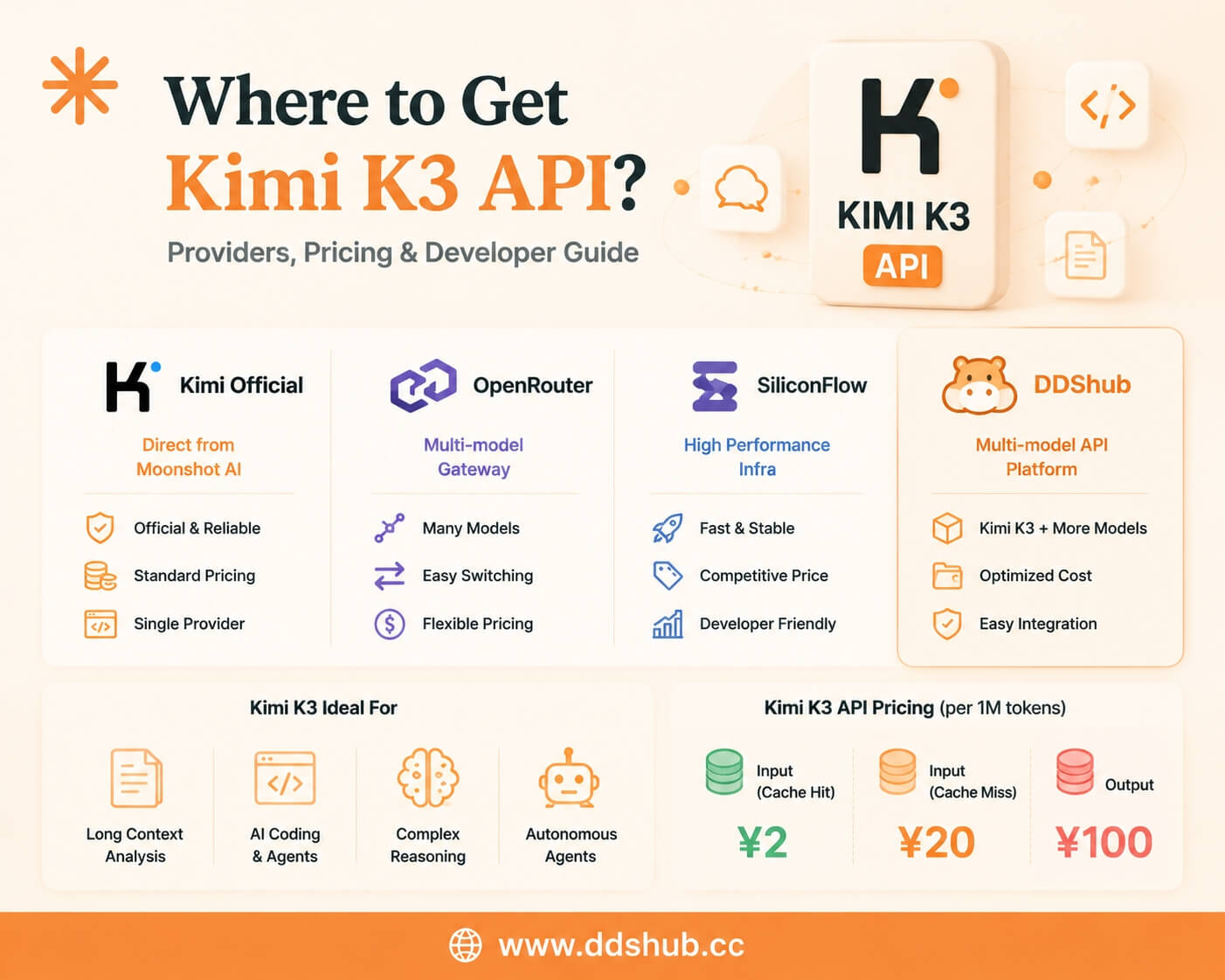
According to Kimi's official pricing information, Kimi K3 API is priced based on one million tokens. The pricing structure separates cached input, normal input, and generated output.
| Model | Input (Cache Hit) | Input (Cache Miss) | Output |
|---|---|---|---|
| Kimi K3 API | ¥2 / 1M tokens | ¥20 / 1M tokens | ¥100 / 1M tokens |
The token-based pricing model provides flexibility because developers only pay for actual usage. However, the final cost of an AI application depends on more than the model price itself.
A simple chatbot request may consume a small number of tokens, while an AI coding agent can consume significantly more because it needs to analyze files, maintain context, generate code, and complete multiple reasoning steps.
For this reason, developers building production AI applications increasingly focus on API optimization, model selection, and efficient infrastructure management.
Where Can Developers Get Kimi K3 API Access?
There are several ways to access Kimi K3 API today. The best choice depends on whether developers need direct access to Moonshot AI, a multi-model environment, or lower-cost API management.
Kimi Official API
The official Kimi API is provided directly by Moonshot AI.
Official website: https://platform.moonshot.ai/
The official API provides direct access to Kimi models and follows a developer-friendly API structure that is compatible with common AI application frameworks.
For developers who only need Kimi models and prefer working directly with the original provider, the official API is the most straightforward option.
However, using only official APIs can become complicated when applications require multiple models. A company building an AI agent may need Kimi for long-context tasks, Claude for reasoning, and Codex for coding. Managing each provider separately means maintaining different API keys, billing systems, and usage monitoring tools.
OpenRouter Kimi K3 API
OpenRouter is one of the most widely known AI API gateway platforms.
Official website: https://openrouter.ai/
The platform provides access to many AI models through a unified API interface, allowing developers to experiment with different models without creating separate integrations for every provider.
For developers comparing Kimi K3 with Claude, GPT models, or other AI systems, OpenRouter provides a convenient way to test different models within a single ecosystem.
The main advantage of OpenRouter is flexibility. Developers can switch between supported models by changing configuration rather than rebuilding their applications.
This makes OpenRouter particularly useful for research, prototyping, and developers who frequently compare model performance.
SiliconFlow Kimi K3 API
SiliconFlow is another AI infrastructure platform that provides Kimi K3 API access.
Official website: https://www.siliconflow.com/
SiliconFlow focuses on providing developers with accessible AI model deployment and API services. Its compatibility with common AI API formats makes it easier for developers to integrate Kimi K3 into existing applications.
For teams already using AI frameworks that support standard API formats, SiliconFlow provides another option for accessing Kimi K3 without managing the entire infrastructure themselves.
DDShub Kimi K3 API
DDShub provides Kimi K3 API access through a multi-model AI API platform designed for developers building AI applications.
Website: https://www.ddshub.cc
Unlike single-model API providers, DDShub focuses on helping developers manage multiple AI models through one platform.
Developers can combine Kimi K3 with other popular models, including Claude, Codex, and GLM, depending on the requirements of different application scenarios.
For example, an AI coding assistant may use Claude for architecture analysis, Codex for code implementation, Kimi K3 for understanding large technical documents, and GLM for high-volume tasks where cost efficiency is important.
This multi-model approach allows developers to balance performance and cost instead of relying on one expensive model for every request.
Currently, DDShub provides Kimi K3 API access at 80% of the official API price, allowing developers to reduce API expenses while maintaining access to Kimi K3 capabilities.
Kimi K3 API Provider Comparison
| Platform | Type | Main Advantage | Suitable For |
|---|---|---|---|
| Kimi Official API | Direct API | Official model access | Developers who only need Kimi |
| OpenRouter | AI Gateway | Easy model switching | Research and model comparison |
| SiliconFlow | AI Platform | API compatibility | Developers integrating AI services |
| DDShub | Multi-model API Platform | Multi-model access and discounted pricing | AI applications and production workflows |
Kimi K3 API Use Cases
AI Coding Assistants
One of the most promising applications for Kimi K3 is AI-assisted software development.
Modern coding assistants are becoming more advanced than simple autocomplete tools. They need to understand project structures, analyze existing implementations, and maintain context across long development sessions.
Kimi K3 can support these workflows by processing large amounts of technical information and helping developers understand complex projects.
For example, when a developer joins an unfamiliar codebase, an AI assistant powered by Kimi K3 can analyze documentation, source files, and technical specifications before providing recommendations.
AI Agents
AI agents require models that can perform multi-step reasoning instead of only responding to individual questions.
A typical AI agent may need to understand a goal, analyze available information, execute actions, review results, and continue improving the solution.
Because of this, context management and reasoning ability become extremely important.
Kimi K3 is suitable for these scenarios because many agent workflows depend on processing large amounts of information over extended interactions.
Enterprise Knowledge Systems
Companies are increasingly building internal AI systems that can search and understand business information.
Examples include internal documentation assistants, technical knowledge bases, research tools, and enterprise search systems.
Traditional AI models often struggle when the information source becomes very large. Long-context models provide advantages because they can process more information within a single interaction.
Kimi K3 can help organizations build AI applications that understand larger amounts of internal knowledge.
Kimi K3 vs Claude vs Codex vs GLM
Different AI models have different strengths, and developers increasingly choose models based on specific tasks rather than selecting one universal solution.
| Model | Main Strength |
|---|---|
| Kimi K3 | Long context, knowledge processing, AI agents |
| Claude | Advanced reasoning and complex analysis |
| Codex | Software engineering and coding workflows |
| GLM | Cost-efficient AI applications |
A modern AI application may combine several models instead of relying on only one.
This is why multi-model API platforms are becoming increasingly important for developers.
How to Choose the Right Kimi K3 API Provider
Choosing a Kimi K3 API provider depends on the goals of the project.
Developers who require direct access and only use Kimi may prefer the official API.
Teams experimenting with multiple models may prefer an AI gateway because it simplifies testing and comparison.
Companies building AI products often need more flexibility, including multiple models, cost optimization, and easier infrastructure management.
In these scenarios, a multi-model API platform can provide significant advantages.
Final Thoughts
Kimi K3 represents an important step toward more capable AI systems focused on long-context reasoning, coding, and AI agent applications.
Developers now have multiple options for accessing Kimi K3 API, ranging from the official Moonshot API to AI gateways and multi-model API platforms.
The best choice depends on whether the priority is direct access, flexibility, or cost optimization.
As AI applications continue to evolve, developers will increasingly combine different models instead of relying on a single provider.
Platforms such as DDShub make this transition easier by providing access to Kimi K3 alongside Claude, Codex, and GLM through a unified API experience, while helping developers reduce API costs with more flexible pricing options.