
Is DDS Hub Safe? A Complete Review for AI Developers (2026)
As AI coding becomes part of everyday software development, more developers are looking beyond official APIs for flexible ways to access models like Claude, Codex, and GLM. Along the way, one question comes up repeatedly: is DDS Hub safe to use?
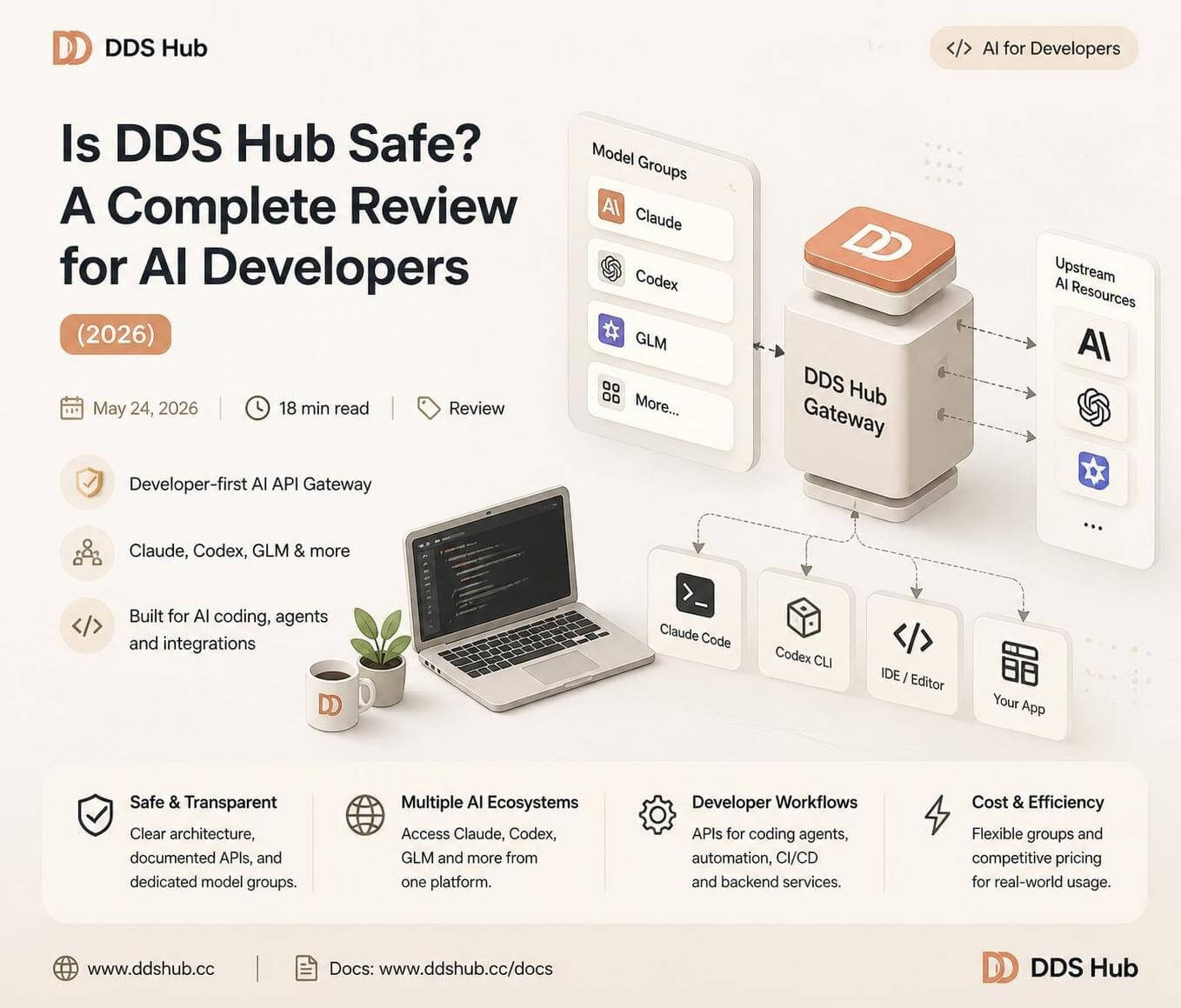
The short answer is yes—provided you understand what DDS Hub is designed to do. Rather than being an AI model developer, DDS Hub is an AI gateway platform that provides developers with structured access to multiple AI model ecosystems. Understanding how the platform works, where its APIs come from, and which use cases it targets will help you decide whether it fits your workflow. This article explains DDS Hub from a technical perspective instead of a marketing one.
What Is DDS Hub?
DDS Hub is an AI API gateway designed for developers who build applications, automation tools, AI agents, and coding workflows.
Instead of training its own large language models, DDS Hub connects developers with different AI ecosystems through dedicated model groups, allowing users to access the appropriate model family using a corresponding API key.
Unlike some platforms that expose every model behind a single API key, DDS Hub uses a group-based architecture.
API Key
    ↓
Model Group
    ↓
Claude / Codex / GLM
Each API key belongs to one model group, and each group is designed for a specific model family or development scenario. For example, a Claude API key can access Claude models within its assigned Claude group, while a Codex API key is used for Codex model groups.
This design keeps authentication, routing, permissions, and billing simple while making it easier to manage different AI workflows.
You can learn more about the platform architecture and supported integrations in the official documentation: https://www.ddshub.cc/docs
Where Do DDS Hub APIs Come From?
This is one of the questions developers ask most often. The answer depends on the model family.
For Claude and OpenAI Codex, DDS Hub provides API access built on top of subscription-backed resources. Instead of requiring every developer to purchase, configure, and manage individual subscriptions, DDS Hub converts available subscription capacity into developer-friendly API endpoints that can be integrated into applications, terminals, IDEs, and automation tools.
For GLM, DDS Hub connects through cloud-based API resources using an OpenAI-compatible interface, making migration easier for developers who already support the OpenAI API format.
A simplified request flow looks like this:
Developer
    ↓
Claude Code / Codex / IDE / API
    ↓
DDS Hub Gateway
    ↓
Selected Model Group
    ↓
Upstream AI Resources
    ↓
Model Response
Rather than replacing official AI services, DDS Hub provides an additional access layer that simplifies integration for software development workflows.
What Problems Does DDS Hub Solve?
Official subscriptions are excellent for interactive conversations through a web interface, but software development often requires something different.
Modern AI applications may execute thousands of API requests, run autonomous coding agents, process background jobs, or integrate directly into CI/CD pipelines. These workloads are fundamentally different from chatting with an AI assistant in a browser.
Developers may also encounter practical challenges such as regional payment limitations, account verification requirements, or managing multiple subscriptions across different AI providers.
DDS Hub addresses these operational challenges by exposing API access that is designed for programmatic integration instead of interactive chat sessions. Rather than switching between separate platforms for Claude, Codex, and GLM, developers can manage multiple AI ecosystems from a single dashboard while selecting the appropriate model group for each workflow.
Why Do Developers Choose DDS Hub?
One of DDS Hub's biggest advantages is that it focuses on developer workflows rather than consumer chat experiences.
Instead of providing only a browser interface, the platform is designed for API integrations, AI coding assistants, IDE extensions, automation tools, backend services, and agent-based applications.
Developers can choose different model groups depending on their requirements. For example:
| Model Group | Best Use Case |
|---|---|
| Claude Stable | Reliable API integrations |
| Claude Max Pool | Claude Code CLI workflows |
| Claude Discount | Cost-sensitive development and testing |
| Codex Basic | Official Codex client |
| Codex External | Stable API integrations |
| Codex CC | Codex inside Claude Code |
| GLM | OpenAI-compatible API |
| GLM CC | GLM with Claude Code |
Because each API key belongs to a dedicated group, developers can organize production, testing, and AI coding workloads more effectively than using a single universal API key.
Is DDS Hub Safe?
From a developer's perspective, "safe" usually means more than cybersecurity. Questions often include:
- Is the API architecture clear?
- Are supported models clearly identified?
- Is the integration process documented?
- Can it be integrated into existing developer tools?
DDS Hub provides public documentation, structured API configuration, dedicated model groups, and support for common developer workflows such as Claude Code, Codex, and OpenAI-compatible integrations. These characteristics make the platform easier to understand and integrate than manually managing multiple AI ecosystems.
Like any third-party AI platform, developers should still evaluate whether the available model groups, pricing, documentation, and support match their own production requirements before deploying business-critical workloads.
DDS Hub vs Official AI Subscriptions
DDS Hub and official subscriptions serve different purposes.
Official subscriptions are primarily designed for individual users interacting through desktop or web applications. DDS Hub, by contrast, focuses on developers who need programmable access and integration into software products.
| Feature | DDS Hub | Official Subscription |
|---|---|---|
| API Integration | Yes | Product-dependent |
| AI Coding Workflows | Yes | Limited |
| Backend Automation | Yes | Limited |
| Multiple AI Ecosystems | Claude, Codex, GLM | Usually single ecosystem |
| Developer-Oriented Model Groups | Yes | No |
| Browser Chat Experience | No | Yes |
For developers building software, APIs are often more practical than browser interfaces because they support automation, backend services, and continuous workflows.
Who Should Consider DDS Hub?
DDS Hub is particularly well suited for developers who regularly integrate AI into software rather than simply chatting with an AI assistant.
Teams using Claude Code, OpenAI Codex, or GLM APIs can benefit from dedicated model groups designed for different development scenarios, while startups building AI-powered products may appreciate managing multiple model ecosystems through a single platform.
On the other hand, users whose primary goal is casual conversation through a web interface may find an official consumer subscription more appropriate.
Final Thoughts
DDS Hub is best understood as an AI gateway for developers, not as an AI model provider. It simplifies access to multiple AI ecosystems by organizing Claude, Codex, and GLM into dedicated model groups, each accessed through its own API key. This architecture is designed for software development, automation, AI coding, and backend integrations rather than consumer chat experiences.
Whether DDS Hub is the right choice ultimately depends on your workflow. If you primarily use AI through a browser, an official subscription may already meet your needs. However, if you're building applications, integrating AI into products, using Claude Code, or managing multiple model ecosystems, DDS Hub provides a structured and developer-focused approach that can simplify deployment and day-to-day operations.
To explore the platform or review the official documentation:
Documentation: https://www.ddshub.cc/docs
Platform: https://www.ddshub.cc