
The Hidden Cost of AI Coding: Why Developers Are Paying Too Much for Claude and Codex
AI coding has fundamentally changed the way developers build software. Tools such as Claude Code, OpenAI Codex, Cursor, and other AI programming assistants can now understand entire repositories, generate complex features, debug applications, and assist developers throughout the software development lifecycle.
However, as AI coding tools become increasingly capable, developers are discovering a new challenge that was not obvious at the beginning: the cost of running AI coding workflows can grow much faster than expected.
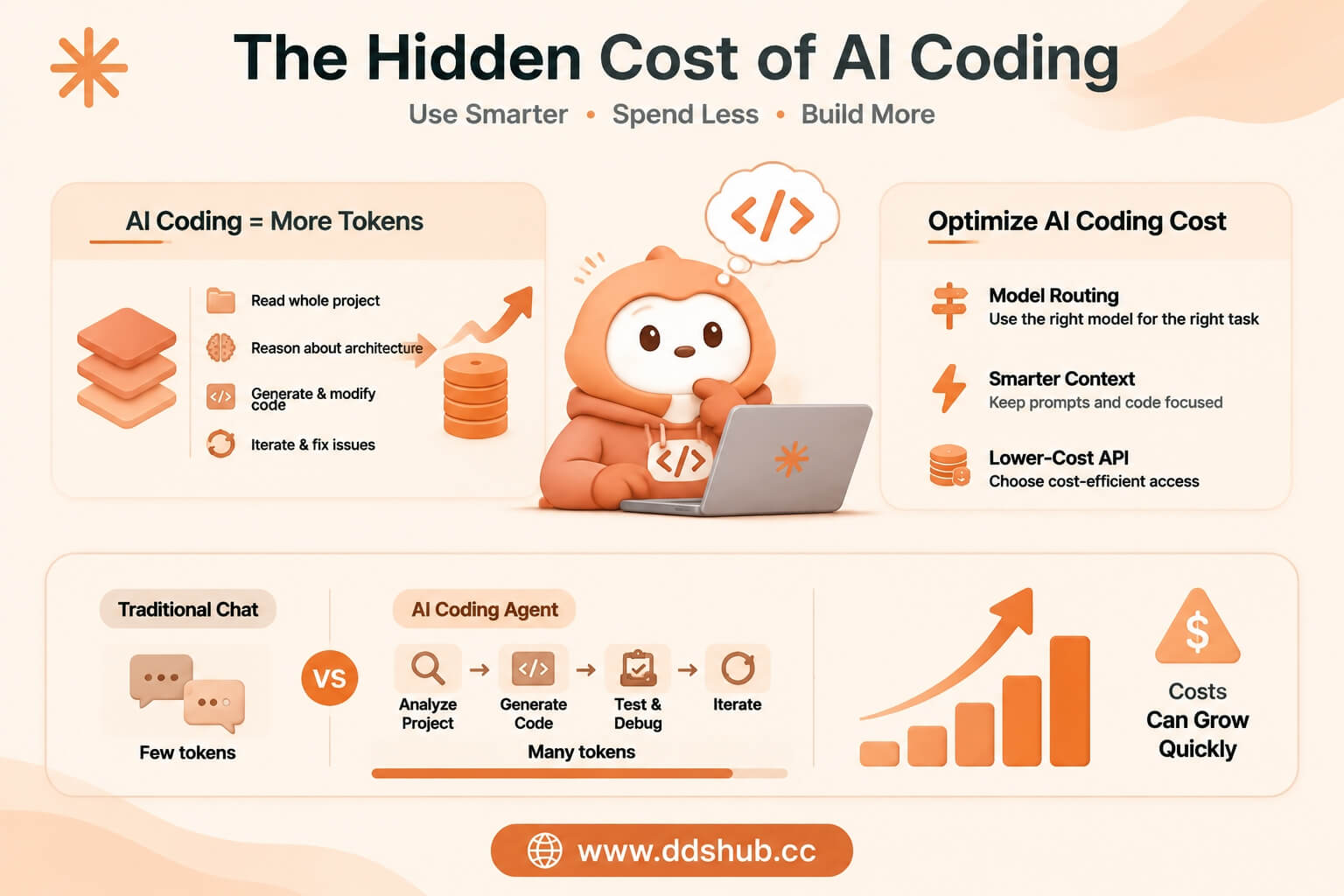
Many developers initially assume that AI coding costs should be similar to using a traditional chatbot. A developer asks a question, receives an answer, and consumes a relatively small number of tokens. In reality, modern AI coding agents work very differently because they need to understand the entire development environment before generating useful output.
When a developer asks an AI agent to add a new feature, fix a production issue, or refactor an application, the model often needs to analyze existing files, understand dependencies, review previous implementations, generate a solution, and iterate based on test results. A single request that appears simple from the user's perspective may involve multiple rounds of model interaction behind the scenes.
This hidden complexity is one of the main reasons why AI coding can become expensive.
Why AI Coding Consumes More Tokens Than Normal AI Conversations
The biggest difference between AI coding and traditional chatbot usage is the amount of context required.
A normal conversation may only include a few messages, while an AI coding agent often needs access to a complete project structure. Before making a change, the model needs to understand how different components interact, which libraries are being used, and what design patterns already exist inside the application.
For example, a developer may provide the instruction:
"Add user authentication to this application."
A human developer immediately understands that this task involves many hidden questions. Which authentication method should be used? How does the existing backend handle users? Where are permissions stored? Which frontend components need updates? What tests should be added?
An AI coding agent needs to answer these questions by analyzing the project context. The process of reading files, reasoning about the architecture, generating code, and reviewing the result all contribute to token consumption.
As AI agents become more autonomous, they become more useful, but they also require more computational resources.
Claude Code: Powerful Development Assistance With Higher Context Requirements
Claude Code has become one of the most widely used AI coding tools because of Claude's strong reasoning ability and ability to handle complex software projects.
Official Claude API information: https://www.anthropic.com/api
Developers often use Claude for repository analysis, architectural discussions, code review, debugging, and large-scale refactoring. Its strength comes from understanding relationships between different parts of a project rather than simply generating isolated code snippets.
For example, when working on a large backend system, a developer may ask Claude to analyze the existing architecture and suggest improvements before implementing a new feature. This type of task requires the model to process significant amounts of information and maintain a consistent understanding of the project.
The same capability that makes Claude powerful also creates cost challenges. Large repositories, long conversations, and repeated coding iterations can quickly increase API usage when developers rely on premium models for every step.
For individual developers using subscription plans, this often appears as usage limitations. For companies building AI-powered products, it becomes a direct infrastructure cost.
Codex: Higher Productivity, But Autonomous Coding Requires Careful Cost Management
OpenAI Codex takes a different approach by focusing specifically on software engineering workflows.
Rather than acting only as a conversational assistant, Codex is designed to help developers complete programming tasks directly. It can analyze existing code, create modifications, generate tests, and assist with debugging.
This makes Codex particularly valuable for AI coding agents where the goal is not simply answering programming questions but completing real engineering tasks.
However, autonomous coding introduces a similar cost challenge.
A coding agent may need multiple iterations before completing a task successfully. It may analyze the project, propose a solution, modify several files, run validation steps, and adjust the implementation based on feedback.
The more independent the agent becomes, the more context and reasoning cycles it requires.
For developers building software products around AI coding, managing this usage efficiently becomes an important part of system design.
The Difference Between Subscription Plans and API-Based AI Coding
Many developers begin with subscription products because they provide a simple way to access powerful AI models.
Services such as Claude Pro, Claude Max, or ChatGPT subscriptions are designed primarily for individual productivity. They work well when a developer is interacting with AI directly through an application interface.
However, production software systems have very different requirements.
A company building an AI coding assistant, internal automation platform, or developer tool needs predictable API access, usage monitoring, scalable billing, and the ability to integrate AI directly into applications.
Subscription plans are optimized for human interaction, while APIs are designed for software integration.
This difference becomes especially important when AI usage grows from personal experimentation into a business workflow.
The Hidden Cost Is Not Only the Model Price
When developers compare AI models, they often focus only on the advertised token price.
However, the real cost of AI coding depends on the entire workflow.
A model with a lower API price may still become expensive if it requires more retries or produces less efficient solutions. A premium model may actually be more cost-effective when it solves complex problems faster and reduces unnecessary iterations.
The most effective strategy is usually not choosing the cheapest model or the most powerful model.
Instead, developers are increasingly adopting multi-model architectures where different models handle different types of tasks.
For example, a development workflow may use Claude for complex reasoning and architecture decisions, Codex for implementation tasks, Kimi for processing large technical documents, and GLM for high-volume operations where cost efficiency matters more than maximum reasoning capability.
This approach allows teams to maintain strong performance while controlling AI infrastructure costs.
Example: Building a Cost-Efficient AI Coding Agent
Consider a company building an AI coding assistant for software teams.
When a developer submits a request such as "Optimize the database performance of this application," the system does not immediately need to send the task to the most expensive model.
First, the system needs to understand the existing architecture and identify potential bottlenecks. A reasoning-focused model such as Claude may be suitable for analyzing the overall design and suggesting improvements.
Once the strategy is clear, a coding-focused model such as Codex can generate the required changes, update files, and help create tests.
During the process, the agent may need to analyze hundreds of pages of technical documentation or internal specifications. A long-context model such as Kimi can handle these information-heavy tasks efficiently.
For smaller background operations, such as summarizing logs, categorizing issues, or generating simple responses, a cost-efficient model such as GLM can reduce unnecessary expenses.
The result is a more balanced AI system where each model is used according to its strengths.
How Developers Can Reduce AI Coding Costs
Reducing AI coding costs is not simply about choosing a cheaper model. It requires optimizing the entire workflow.
The first step is improving prompt quality. Clear instructions with defined goals, constraints, and expected outputs reduce unnecessary iterations and help models generate more focused responses.
The second step is managing context efficiently. Sending unnecessary files or excessive historical conversations increases token consumption without improving the final result.
The third step is implementing model routing. Instead of sending every request to a flagship model, developers can select models based on task complexity and business requirements.
These strategies become increasingly important as AI coding moves from individual tools into production-level applications.
Using DDS Hub to Build Multi-Model AI Applications
As developers adopt multiple AI models, managing different providers becomes increasingly complicated. Each provider may have different APIs, authentication methods, pricing structures, and model availability.
DDS Hub provides a unified API platform that allows developers to access multiple AI models through a consistent interface.
Developers can combine Claude, Codex, GLM, and Kimi according to different application requirements, making it easier to build AI coding assistants, automation systems, and AI agents.
For example, a company can use Claude for advanced reasoning, Codex for programming workflows, Kimi for long-context analysis, and GLM for cost-sensitive workloads without maintaining separate infrastructure for every provider.
- DDS Hub: https://www.ddshub.cc
- Models: https://www.ddshub.cc/models
- API: https://www.ddshub.cc/v1
The Future of AI Coding Is About Intelligence and Efficiency
AI coding is becoming more powerful every year, but capability alone is no longer the only factor developers need to consider.
As AI agents become more autonomous, controlling token consumption, optimizing model selection, and designing efficient workflows will become essential skills for developers.
The future of AI development will not belong to users who simply choose the strongest model.
It will belong to developers who understand how to combine different models and use each one where it provides the greatest value.
Claude and Codex have demonstrated the potential of AI-powered software engineering. The next challenge is making these technologies affordable, scalable, and practical for everyday development.