
GPT-5.6 vs Grok 4.5 vs Claude Fable 5: Which AI Model Is Best for Coding in 2026?
The competition among frontier AI models has become more exciting than ever. Within just a few weeks, OpenAI introduced GPT-5.6, SpaceXAI released Grok 4.5, and Anthropic reopened access to Claude Fable 5, giving developers three powerful options for coding, reasoning, and AI agent workflows. While all three models represent the latest generation of large language models, they are designed with different priorities. GPT-5.6 focuses on enterprise-grade intelligence and balanced performance, Grok 4.5 emphasizes engineering productivity and coding agents, while Claude Fable 5 continues to stand out for long-context reasoning and large-scale software engineering.
Instead of asking which model is universally "the best," a more practical question is which model is best suited for your workflow. This comparison examines their strengths across coding, reasoning, API ecosystems, pricing considerations, and real-world development scenarios.
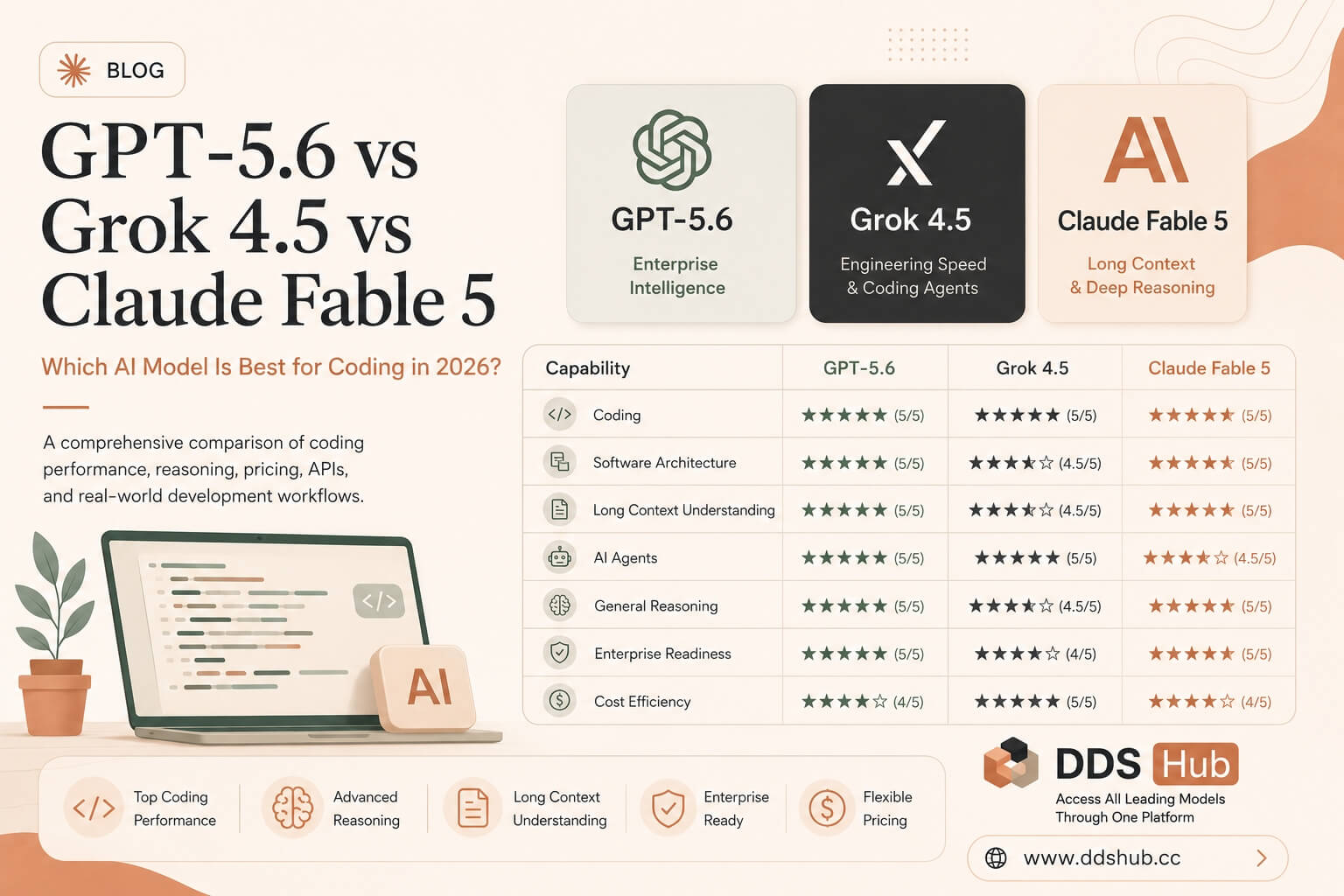
Quick Comparison
| Capability | GPT-5.6 | Grok 4.5 | Claude Fable 5 |
|---|---|---|---|
| Coding | 5/5 | 5/5 | 5/5 |
| Software Architecture | 5/5 | 4.5/5 | 5/5 |
| Long Context Understanding | 5/5 | 4.5/5 | 5/5 |
| AI Agents | 5/5 | 5/5 | 4.5/5 |
| General Reasoning | 5/5 | 4.5/5 | 5/5 |
| Enterprise Readiness | 5/5 | 4/5 | 5/5 |
| Cost Efficiency | 4/5 | 5/5 | 4/5 |
Although all three models perform at the frontier of today's AI landscape, their strengths become much clearer when viewed through the lens of practical software development rather than benchmark rankings alone.
Coding Performance
For developers, coding quality is usually the most important consideration. Fortunately, all three models are capable of generating production-quality code, but they approach software engineering differently.
GPT-5.6 has been positioned by OpenAI as its flagship model family for enterprise knowledge work, software engineering, cybersecurity, and autonomous workflows. The introduction of multiple variants allows organizations to balance intelligence, latency, and operational cost according to different production requirements. Early industry analysis also suggests that GPT-5.6 performs particularly well on coding-agent evaluations while maintaining competitive inference efficiency.
Grok 4.5 takes a more engineering-focused direction. SpaceXAI developed the model alongside Cursor, highlighting coding, agentic programming, and technical knowledge work as its primary strengths. Rather than competing as a general chatbot, Grok 4.5 is designed to accelerate implementation-heavy software development and AI-assisted programming workflows.
Claude Fable 5 continues to be one of the strongest options for repository-scale development. Its ability to maintain long-context understanding makes it particularly valuable for reviewing large codebases, planning architectural changes, and reasoning across multiple files instead of simply generating isolated code snippets. Anthropic has also positioned Fable 5 as a premium model with usage-based pricing that reflects its computational requirements.
| Development Task | Recommended Model |
|---|---|
| Large Repository Analysis | Claude Fable 5 |
| AI Coding Agents | GPT-5.6 or Grok 4.5 |
| Enterprise Software Development | GPT-5.6 |
| Architecture Review | Claude Fable 5 |
| Rapid Engineering Iteration | Grok 4.5 |
Pricing and API Ecosystem
Choosing an AI model involves more than evaluating raw capability. API availability, operating costs, ecosystem maturity, and deployment flexibility often have a greater impact on long-term adoption.
OpenAI now offers GPT-5.6 through a tiered model family, allowing organizations to select different performance levels depending on workload requirements. Grok 4.5 has attracted attention for delivering competitive coding performance with an aggressive pricing strategy, making it an appealing option for cost-sensitive engineering teams. Meanwhile, Anthropic has introduced usage-based billing for Claude Fable 5 due to exceptionally high demand, reinforcing its position as a premium model for advanced reasoning and software engineering.
For developers who regularly switch between multiple AI ecosystems, managing separate provider accounts, authentication methods, and API integrations can become increasingly complex.
Platforms such as DDS Hub simplify this workflow by organizing access through dedicated model groups instead of a unified API key. Each API key belongs to a specific model family—for example, a Claude group key accesses Claude models, while separate groups are available for Codex, GLM, and other supported ecosystems. This group-based routing makes permissions clearer, simplifies billing, and allows teams to adopt different models without maintaining multiple independent integrations.
Which Model Should You Choose?
There is no single winner because each model targets a different type of development workflow.
| If You Need... | Best Choice |
|---|---|
| One model for coding, automation, and enterprise AI | GPT-5.6 |
| Fast engineering iteration and coding agents | Grok 4.5 |
| Long-context reasoning and repository analysis | Claude Fable 5 |
| Large-scale software architecture | Claude Fable 5 |
| Balanced enterprise deployment | GPT-5.6 |
| Cost-conscious engineering teams | Grok 4.5 |
Increasingly, engineering teams are choosing to combine these models rather than replacing one with another. A common workflow is to use Claude Fable 5 for architecture reviews and repository understanding, GPT-5.6 for enterprise automation and implementation, and Grok 4.5 for rapid coding iterations and engineering-focused tasks. This multi-model approach often delivers better productivity than relying exclusively on a single AI assistant.
Conclusion
GPT-5.6, Grok 4.5, and Claude Fable 5 each represent a different vision of frontier AI. GPT-5.6 emphasizes versatility and enterprise-scale deployment, Grok 4.5 focuses on efficient coding and autonomous development workflows, while Claude Fable 5 remains one of the strongest models for long-context reasoning and complex software engineering.
Rather than searching for a universal champion, developers should choose the model that best matches their technical requirements, budget, and workflow. For teams working across multiple AI ecosystems, solutions such as DDS Hub provide a practical way to access different model families through dedicated routing groups, making it easier to build flexible AI development workflows while avoiding the complexity of managing separate provider integrations.
Learn more at www.ddshub.cc.