
GPT-5.6 Sol vs Claude Fable 5: Which AI Coding Model Is Better for Developers?
The competition between OpenAI and Anthropic has become increasingly interesting for developers because the question is no longer simply which model produces better answers. The more important question is which model can actually complete a software engineering task from beginning to end, understand a large codebase, operate tools, recover from errors, write tests, and continue working through a long-running agentic workflow.
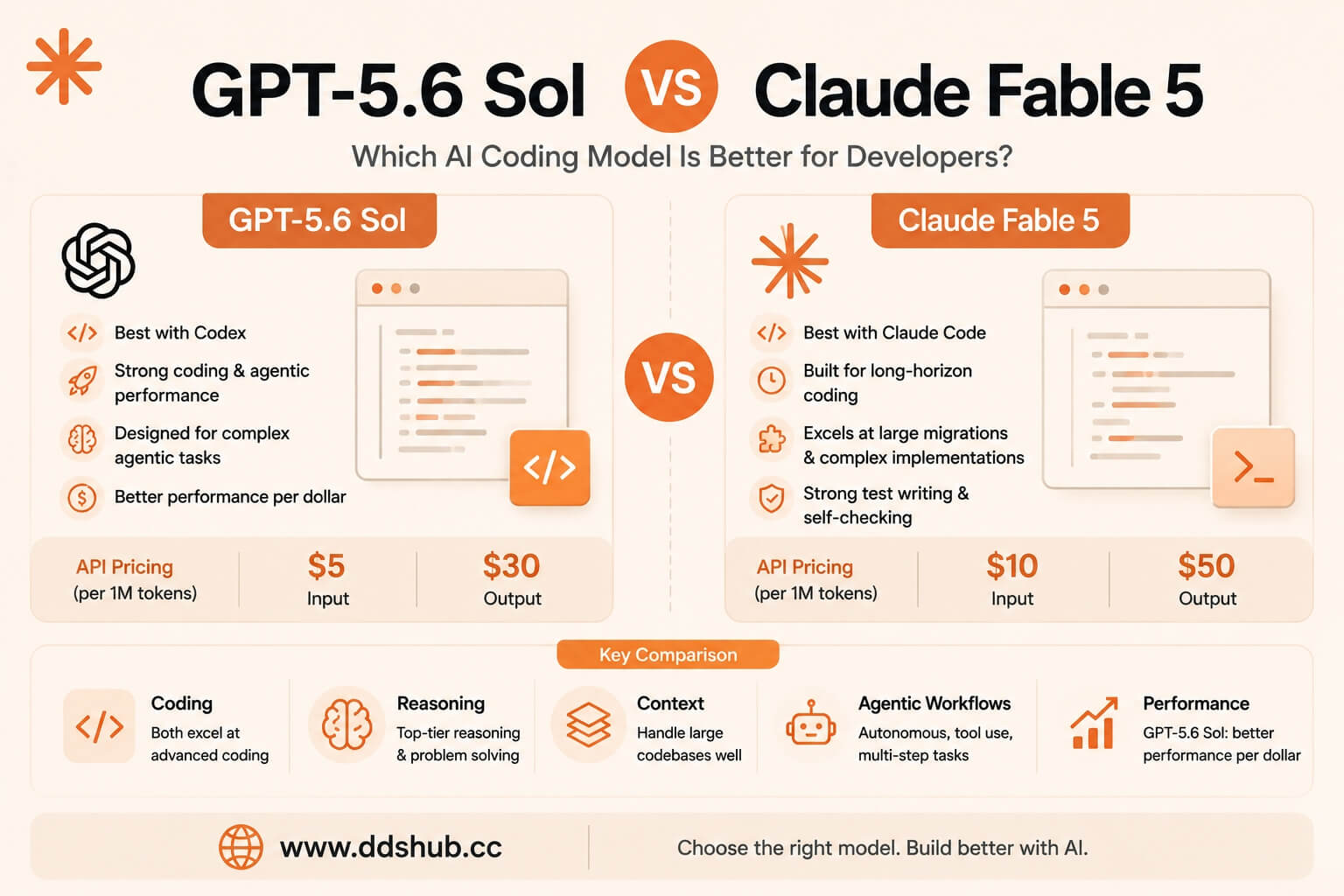
Two of the most interesting models in this category are GPT-5.6 Sol from OpenAI and Claude Fable 5 from Anthropic. Both are positioned as high-end models for demanding reasoning and coding workloads, but they take somewhat different approaches to the developer experience.
GPT-5.6 Sol is the flagship model in OpenAI's GPT-5.6 family and is deeply integrated with the Codex ecosystem, while Fable 5 is Anthropic's most capable widely released model and is specifically positioned for ambitious coding projects, large migrations, complex implementations, and multi-day autonomous sessions.
For developers deciding between GPT-5.6 Sol API vs Claude Fable 5 API, the answer therefore depends not only on the price per million tokens but also on how the model behaves inside its native coding agent.
GPT-5.6 Sol vs Claude Fable 5: API Pricing
At the API level, GPT-5.6 Sol currently costs $5 per million input tokens and $30 per million output tokens. OpenAI's current API pricing page also lists cached-input pricing, which can significantly change the effective cost for applications that repeatedly send the same context.
Claude Fable 5 is priced at $10 per million input tokens and $50 per million output tokens, making its raw API price higher than GPT-5.6 Sol for both input and output tokens. Anthropic's official pricing documentation lists Fable 5 at these rates, alongside its other Claude models.
| Model | Input / 1M tokens | Output / 1M tokens | Relative API Cost |
|---|---|---|---|
| GPT-5.6 Sol | $5 | $30 | Lower |
| Claude Fable 5 | $10 | $50 | Higher |
On the surface, GPT-5.6 Sol is therefore the cheaper model. Input tokens cost roughly half as much as Fable 5, while output tokens cost 40% less.
However, token price alone does not determine the actual cost of an AI coding workflow.
A model that completes a task with fewer attempts, fewer tool calls, less context, or fewer corrective iterations can sometimes be cheaper in practice even when its advertised per-token price is higher. OpenAI specifically positions GPT-5.6 around improved performance per dollar, reporting that it can achieve stronger results with fewer tokens on demanding tasks.
This is one reason developers should compare cost per completed task, rather than only cost per million tokens.
GPT-5.6 Sol: What Is It Designed For?
GPT-5.6 Sol is the highest-capability tier of OpenAI's GPT-5.6 family, with the Sol, Terra, and Luna naming system representing different performance and cost levels.
OpenAI describes Sol as its strongest GPT-5.6 model, targeting coding, knowledge work, science, cybersecurity, and long-horizon agentic tasks. The company also highlights improvements in coding and agentic capabilities, with the model designed to complete more complex tasks while using fewer tokens.
This positioning makes Sol particularly interesting for developers working on tasks where the model needs to reason about a repository rather than simply generate a function.
For example, a developer can ask an agent to investigate a production bug, identify the relevant files, make a change, run tests, inspect the results, and continue iterating until the implementation works. The value of the model in this situation comes from its ability to maintain a coherent plan while interacting with the development environment.
OpenAI has also emphasized agentic capabilities in GPT-5.6's evaluation results, including coding, science, and cybersecurity workloads.
Claude Fable 5: Built for Long-Horizon Coding
Claude Fable 5 takes a similarly ambitious approach but puts particularly strong emphasis on long-running autonomous work.
Anthropic describes Fable 5 as its most capable model for ambitious coding projects, including large migrations, complex implementations, and multi-day autonomous sessions. Anthropic also highlights its ability to write tests, check its own work, implement designs with high fidelity, and use vision to compare results against the intended output.
That positioning is important because traditional coding benchmarks do not fully capture what developers experience when using an AI coding agent.
Writing one correct function is relatively straightforward for a frontier model. A much harder task is something like:
"Migrate this application from the old authentication system to the new architecture, update the database layer, modify the frontend, write tests, run the test suite, fix failures, and verify the final implementation."
This is where long-horizon agent behavior becomes more important than simple code-generation quality.
Fable 5 is explicitly designed around this type of workflow.
Claude Code vs Codex: The Real Comparison
For developers, perhaps the most important part of the comparison is not Fable 5 vs Sol, but rather:
Claude Code vs Codex.
A model can perform extremely well in an isolated API benchmark and still feel very different when embedded inside a coding agent.
Claude Code is Anthropic's terminal-based coding agent, designed to work directly with a developer's local project, files, tools, shell commands, and development workflow. Anthropic has continued expanding Claude Code beyond simple code completion toward more autonomous software engineering.
OpenAI's Codex takes a similar direction. The official Codex CLI is an open-source coding agent that runs locally on a developer's computer and can also be used through supported IDE integrations such as VS Code, Cursor, and Windsurf. OpenAI also provides cloud-based Codex experiences through its broader Codex ecosystem.
This means the comparison is better represented as:
| OpenAI | Anthropic |
|---|---|
| GPT-5.6 Sol | Claude Fable 5 |
| Codex | Claude Code |
| Codex CLI | Claude Code CLI |
| OpenAI API | Anthropic API |
| Codex cloud workflows | Claude autonomous workflows |
Both ecosystems are increasingly moving toward the same idea: the AI model becomes an agent that operates the development environment instead of simply answering questions about code.
GPT-5.6 Sol + Codex
The biggest advantage of GPT-5.6 Sol for OpenAI users is the integration between the model and Codex.
Codex is not simply a chatbot with a terminal attached to it. It is designed as a coding agent that can inspect repositories, modify files, execute commands, and work through development tasks.
This makes GPT-5.6 Sol particularly attractive when the developer wants an agent that can interact with a repository and execute a structured software engineering workflow.
For example, imagine a task such as:
"Find why the checkout API intermittently returns 500, reproduce the issue, inspect the relevant logs and code, implement a fix, add a regression test, and run the affected test suite."
The ideal agent needs to perform several different types of reasoning. It needs to understand the architecture, locate the relevant code, use shell tools, interpret test results, and revise its implementation.
This is precisely the type of workflow where Codex and GPT-5.6 Sol become more interesting than a conventional chat interface.
Claude Fable 5 + Claude Code
Claude Code takes a very similar approach but has developed a particularly strong reputation around repository-level work and long-running coding sessions.
Fable 5's official positioning reinforces this direction. Anthropic describes the model as suitable for large migrations, complex implementations, and multi-day autonomous sessions, while Claude Code provides the environment through which the model can interact with the actual project.
A typical Claude Code workflow might look like:
Developer
   ↓
Claude Code
   ↓
Understand repository
   ↓
Inspect architecture
   ↓
Modify multiple files
   ↓
Run tests
   ↓
Inspect failures
   ↓
Fix implementation
   ↓
Run tests again
   ↓
Review final changes
This workflow makes Fable 5 especially interesting for large repositories where the task cannot be reduced to a single code-generation request.
Anthropic's own description emphasizes that Fable 5 can write its own tests, validate its work, implement designs with high fidelity, and use vision to compare output with the intended result.
Which One Is Better for Coding?
There is no meaningful universal winner.
GPT-5.6 Sol and Fable 5 are both frontier coding models, but their strengths can become more apparent depending on the workflow.
GPT-5.6 Sol is particularly attractive when the developer wants a strong combination of reasoning, coding, tool use, and cost efficiency inside the OpenAI/Codex ecosystem. OpenAI's own published results emphasize its performance-efficiency frontier, while its Codex integration makes it straightforward to turn that intelligence into an executable coding workflow.
Fable 5, on the other hand, is particularly compelling for long-running software engineering tasks where the model needs to maintain context, work through multiple stages, write tests, inspect results, and continue iterating. Anthropic explicitly positions Fable 5 around these long-horizon coding scenarios.
There is also growing evidence that using the two ecosystems together can be valuable rather than choosing one permanently.
A recent controlled study comparing Claude and Codex found an interesting asymmetry in code-review workflows: Claude reviewing Codex-generated code improved the Codex drafts substantially, while Codex reviewing Claude-generated code actually reduced the measured pass rate in that particular benchmark. This does not prove that Claude is universally better, but it suggests that using different models for generation and review can sometimes outperform relying on a single model for every stage.
Fable 5 vs GPT-5.6 Sol for AI Agents
The comparison becomes even more interesting when the goal is building an AI agent rather than simply generating code.
An AI agent typically needs to maintain state, call tools, inspect external information, reason over intermediate results, and recover from failures.
GPT-5.6 Sol is designed for this type of workload, and OpenAI has emphasized its agentic capabilities as one of the major improvements in the GPT-5.6 generation.
Fable 5 is similarly positioned around long-horizon agentic work. Anthropic describes it as being designed for demanding reasoning and long-running autonomous tasks, including coding projects that can continue for multiple days.
The difference is therefore less about whether either model "can build agents" and more about which ecosystem fits the developer's architecture.
If your application is already heavily integrated with OpenAI's Responses API, tools, Codex, and OpenAI infrastructure, GPT-5.6 Sol is a natural choice.
If your workflow is centered around Claude Code, Anthropic's API, and long-running software engineering agents, Fable 5 is an equally natural choice.
Price vs Actual Coding Cost
The API price comparison initially looks straightforward:
GPT-5.6 Sol: $5 input / $30 output per million tokens.
Claude Fable 5: $10 input / $50 output per million tokens.
But AI coding costs are rarely determined by raw token price alone.
Suppose a coding task requires a large repository context and multiple iterations. A model that uses fewer tokens to reach the correct solution can have a lower effective cost even if its output token price is higher.
Conversely, a model with a lower token price can become more expensive if it requires additional iterations, longer context, or more tool calls before the task is completed.
This is why developers building serious AI coding products should measure:
cost per completed task, success rate, average number of tool calls, total tokens, latency, and human intervention.
The right metric is not simply:
"$5 vs $10 input."
The better question is:
"How much does it cost me to get a working result?"
What About Long Context?
Both models are designed for demanding workloads, but their context and agent behavior should be evaluated based on the exact API and workflow rather than assuming that a larger advertised context automatically produces better results.
For coding agents, effective context management is often more important than simply having a large context window.
A good coding agent needs to decide what information matters, what can be discarded, which files should be inspected, and when additional context should be retrieved.
This is one reason modern coding agents increasingly resemble orchestration systems rather than simple chat applications.
Claude Code and Codex both attempt to solve this problem through repository-aware workflows, tool use, context management, and iterative execution.
Which Model Should You Use?
For developers who prioritize API price and performance per dollar, GPT-5.6 Sol currently has a clear advantage on advertised token pricing. Its $5 input and $30 output pricing is materially lower than Fable 5's $10 input and $50 output pricing.
For developers who prioritize long-running autonomous coding, Fable 5 is particularly compelling because Anthropic explicitly designed and positioned it around large migrations, complex implementations, and multi-day coding sessions.
For developers already using Codex, GPT-5.6 Sol is the natural choice because the model and coding agent are part of the same OpenAI ecosystem.
For developers already invested in Claude Code, Fable 5 provides a similarly integrated workflow and is designed specifically for the kind of long-running coding tasks Claude Code is intended to perform.
For teams building serious AI coding products, however, there is another option: use both.
One model can implement a feature while the other reviews the implementation, investigates difficult bugs, or provides an independent architectural perspective. Recent research suggests that cross-model review can be particularly effective when the reviewer and generator have complementary strengths.
GPT-5.6 Sol vs Claude Fable 5: Overall Comparison
| Category | GPT-5.6 Sol | Claude Fable 5 |
|---|---|---|
| API input price | $5 / 1M | $10 / 1M |
| API output price | $30 / 1M | $50 / 1M |
| Coding | Excellent | Excellent |
| Long-horizon agents | Excellent | Excellent |
| CLI ecosystem | Codex | Claude Code |
| Repository work | Excellent | Excellent |
| Autonomous coding | Excellent | Excellent |
| Cost efficiency | Strong advantage | Higher raw token cost |
| Large migrations | Excellent | Strong focus |
| Tool-based workflows | Excellent | Excellent |
| Best ecosystem fit | OpenAI / Codex | Anthropic / Claude Code |
The table should not be interpreted as saying that one model is universally superior. These are both frontier systems, and their practical performance can change depending on the codebase, prompt, tool configuration, context management, and agent harness.
Can DDShub Make the Comparison More Practical?
For developers who want to experiment with both models, the biggest obstacle is often not the model itself but the cost and complexity of managing multiple API providers.
Instead of maintaining separate billing systems and integrations for OpenAI and Anthropic, developers can use an API gateway such as DDShub to access different AI models through a unified API environment.
This is particularly useful for developers who want to compare GPT-5.6, Claude, Codex-oriented workflows, and other coding models without rebuilding their infrastructure every time they switch providers.
DDShub's current model lineup includes Claude, Codex, GLM, Kimi, and other AI models, allowing developers to choose the model based on the actual task rather than locking an entire application to one provider.
For developers who care about API cost, DDShub also provides discounted access to supported model groups, making it possible to evaluate expensive frontier models at a lower effective API cost than purchasing the standard official API directly.
You can check the current models and pricing here: DDShub Models & Pricing
For developers building AI coding applications, the API approach also makes it easier to switch between models during development. A team might use GPT-5.6 Sol for one workload, Fable 5 for another, and a lower-cost model such as GLM or Kimi for routine tasks.
Final Verdict: Sol or Fable 5?
If you only compare the API price, GPT-5.6 Sol wins. At $5 per million input tokens and $30 per million output tokens, it is significantly cheaper than Claude Fable 5's $10 input and $50 output pricing.
If you compare the coding-agent experience, however, the decision becomes much closer.
GPT-5.6 Sol + Codex is an excellent choice for developers who want a highly capable OpenAI-native coding agent with strong reasoning, tool use, and a lower raw API cost.
Claude Fable 5 + Claude Code is particularly attractive for developers working on large codebases, complex migrations, and long-running autonomous software engineering tasks, which is exactly the workload Anthropic highlights when describing Fable 5.
For individual developers, the best choice may simply be the agent that fits their workflow better. For teams building AI coding products, the more interesting strategy may be to stop treating the choice as binary.
The strongest setup may be a multi-model coding workflow in which GPT-5.6 Sol and Fable 5 are used for different stages of development, with one model generating an implementation and another reviewing, testing, or improving it.
In other words, the future of AI coding may not be Claude vs GPT.
It may be Claude + GPT + the right agent harness.
Official Sources
- OpenAI GPT-5.6: OpenAI: GPT-5.6
- OpenAI GPT-5.6 Sol Preview: OpenAI: Previewing GPT-5.6 Sol
- OpenAI API Pricing: OpenAI: API Pricing
- OpenAI Codex: OpenAI Codex GitHub
- Anthropic Claude Fable 5: Anthropic: Claude Fable
- Claude Fable 5 API Documentation: Anthropic: Introducing Claude Fable 5
- Claude API Pricing: Anthropic: Claude API Pricing
- DDShub: DDShub Models & Pricing