
GPT-5.6 Prompt Engineering Guide: Sol vs Terra vs Luna, Use Cases & Best Practices
GPT-5.6 introduces a flexible family of models designed for different workloads rather than a single one-size-fits-all model. Instead of forcing developers to balance intelligence, latency, and cost with a single endpoint, GPT-5.6 offers Sol, Terra, and Luna, each optimized for different scenarios ranging from complex software engineering to lightweight automation. This tiered approach enables engineering teams to select the most appropriate model for each task while improving efficiency and controlling API costs.
Choosing the correct model, however, is only half of the equation. Effective prompt engineering has become one of the most valuable skills for developers using large language models. A well-structured prompt not only improves response quality but also reduces token consumption, minimizes unnecessary iterations, and produces more reliable outputs across coding, documentation, and AI agent workflows.
This guide explains the differences between GPT-5.6 Sol, Terra, and Luna, explores practical prompt engineering techniques, highlights common developer use cases, and discusses how platforms such as DDS Hub can simplify access to GPT-5.6 alongside Claude, Codex, and GLM models through a unified developer platform.
Understanding the GPT-5.6 Model Family
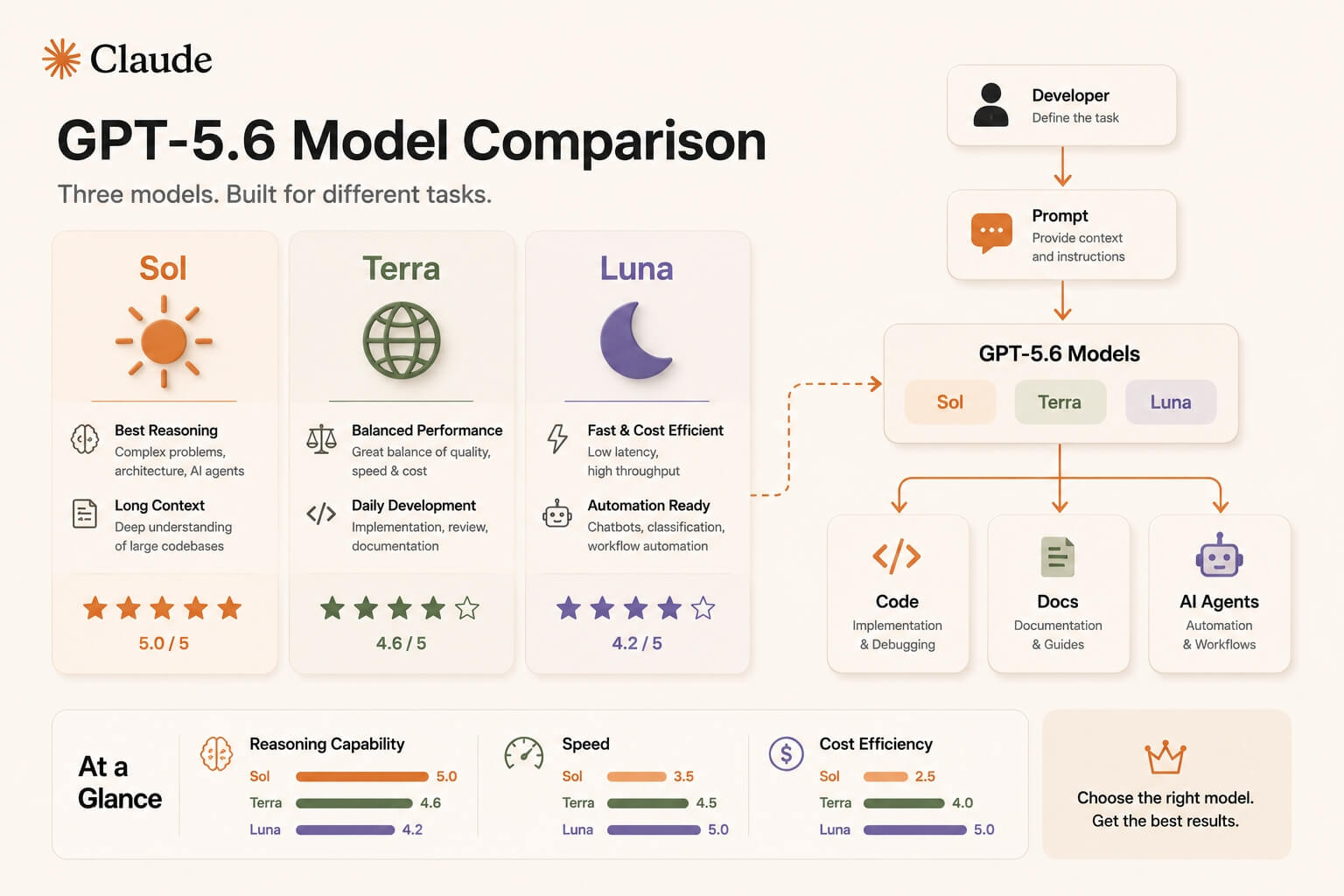
Rather than viewing GPT-5.6 as a single model, developers should think of it as three complementary models that target different engineering requirements. Sol focuses on maximum reasoning capability and long-context analysis, Terra provides an excellent balance between performance and efficiency for everyday development, while Luna emphasizes low latency and cost-effective inference for high-volume applications.
AI Coding Capability Breakdown
| Model | Best For | Speed | Relative Cost | AI Coding Capability |
|---|---|---|---|---|
| GPT-5.6 Sol | Complex reasoning, software architecture, AI agents | Medium | High | 5.0/5 |
| GPT-5.6 Terra | Daily software development, documentation, automation | Fast | Medium | 4.6/5 |
| GPT-5.6 Luna | Chatbots, classification, lightweight workflows | Very Fast | Low | 4.2/5 |
For teams building sophisticated software systems, Sol is typically the preferred choice because of its stronger reasoning and planning capabilities. Terra is often the best option for everyday engineering tasks where response speed and operating costs matter equally, while Luna is particularly suitable for customer support, structured data processing, and other latency-sensitive workloads.
Prompt Engineering Best Practices
Although GPT-5.6 performs well with natural language instructions, prompt quality still has a significant impact on the consistency and usefulness of generated responses. Developers should begin every prompt by clearly defining the model's role, the objective, and the expected output. Providing context before requesting implementation generally produces much better results than asking for code immediately.
For example:
You are a senior backend engineer.

Analyze this repository.

Identify architectural issues.

Recommend improvements.

Generate production-ready implementation code.
Breaking complex requests into multiple stages also improves reliability. Rather than asking the model to analyze, design, implement, document, and test a feature within a single prompt, separating these objectives into sequential conversations usually produces cleaner code and more maintainable solutions.
Another useful practice is explicitly specifying the output format. Whether the desired response should be Markdown, JSON, YAML, SQL, or production-ready source code, clearly defining the expected format reduces ambiguity and makes downstream automation considerably easier.
Choosing the Right GPT-5.6 Model
Each GPT-5.6 variant is optimized for different development scenarios.
| Development Task | Recommended Model | Reason |
|---|---|---|
| Software architecture | GPT-5.6 Sol | Strong reasoning and long-context planning |
| Large repository analysis | GPT-5.6 Sol | Better understanding of complex projects |
| Feature implementation | GPT-5.6 Terra | Excellent balance between quality and speed |
| Code review | GPT-5.6 Terra | Fast and reliable engineering feedback |
| Documentation generation | GPT-5.6 Terra | High-quality technical writing |
| Customer support automation | GPT-5.6 Luna | Low latency and high throughput |
| Text classification | GPT-5.6 Luna | Cost-efficient structured processing |
| Workflow automation | GPT-5.6 Luna | Fast responses for repetitive tasks |
Rather than selecting one model for every workload, many engineering teams combine multiple GPT-5.6 variants. Sol can be responsible for architectural planning, Terra can generate production-ready implementations, and Luna can automate documentation formatting, issue categorization, or customer interactions. This layered approach often delivers better overall productivity while reducing infrastructure costs.
Five Practical Prompt Engineering Tips
Successful AI-assisted development depends more on prompt quality than prompt length. One of the most common mistakes is overwhelming the model with unnecessary instructions while failing to define the actual objective. Instead, developers should focus on describing the desired outcome and providing only the context required to accomplish it.
Another recommendation is to include project-specific constraints such as programming language, framework, coding standards, or architectural requirements. Context significantly improves consistency across large software projects.
Whenever possible, ask GPT-5.6 to explain its reasoning before generating implementation code. This intermediate planning step frequently identifies potential design issues before development begins.
Reusable prompt templates are also worth investing in. Teams that standardize prompts for code reviews, documentation, pull request summaries, and debugging often achieve more consistent outputs while reducing prompt engineering effort across multiple projects.
Finally, remember that shorter conversations generally remain more focused. For long-running coding sessions, periodically summarizing progress and starting a fresh context helps maintain response quality.
Accessing GPT-5.6 with DDS Hub
Many developers today work with multiple AI model families rather than relying exclusively on one provider. A typical engineering workflow may involve GPT-5.6 for software implementation, Claude for repository reasoning, Codex for code completion, and GLM for OpenAI-compatible deployments. Managing separate providers and API credentials quickly becomes cumbersome as projects expand.
DDS Hub simplifies this experience by providing access to multiple AI ecosystems through dedicated model groups. Instead of maintaining independent integrations for every provider, developers can manage their API access from one platform while selecting the appropriate model family for each project.
Unlike platforms that expose one universal API key for every available model, DDS Hub uses a group-based architecture. Each API key belongs to one specific model group, and every group corresponds to a single model family. This design keeps permissions, routing, and billing straightforward while making it easier to manage production environments.
Developers can learn more about supported integrations, API configuration, and developer documentation through the official DDS Hub resources: the DDS Hub Documentation and the DDS Hub Homepage.
Conclusion
GPT-5.6 represents a more flexible approach to modern AI development by offering three specialized models instead of forcing every workload onto a single architecture. Sol delivers maximum reasoning capability for complex software engineering, Terra provides an outstanding balance between quality and efficiency for everyday development, and Luna excels in high-volume, latency-sensitive automation scenarios.
Regardless of which model you choose, prompt engineering remains one of the most effective ways to improve output quality, reduce token consumption, and build reliable AI-assisted development workflows. Clear objectives, structured prompts, reusable templates, and sequential task decomposition consistently outperform lengthy, unstructured instructions.
As more engineering teams adopt multi-model AI strategies, platforms such as DDS Hub make it easier to integrate GPT-5.6 alongside Claude, Codex, and GLM within a single developer ecosystem. By combining the right model with well-designed prompts and an organized API management strategy, developers can build faster, smarter, and more maintainable AI-powered applications.