
GPT-5.6 Luna API Price Drops 80%: GPT-5.6 Terra vs Claude, DeepSeek, GLM and Kimi
The AI API market is entering a new stage where model intelligence is no longer the only factor developers consider. As more companies build AI agents, SaaS products, automation systems, and enterprise applications, the cost of running AI models has become one of the most important decisions.
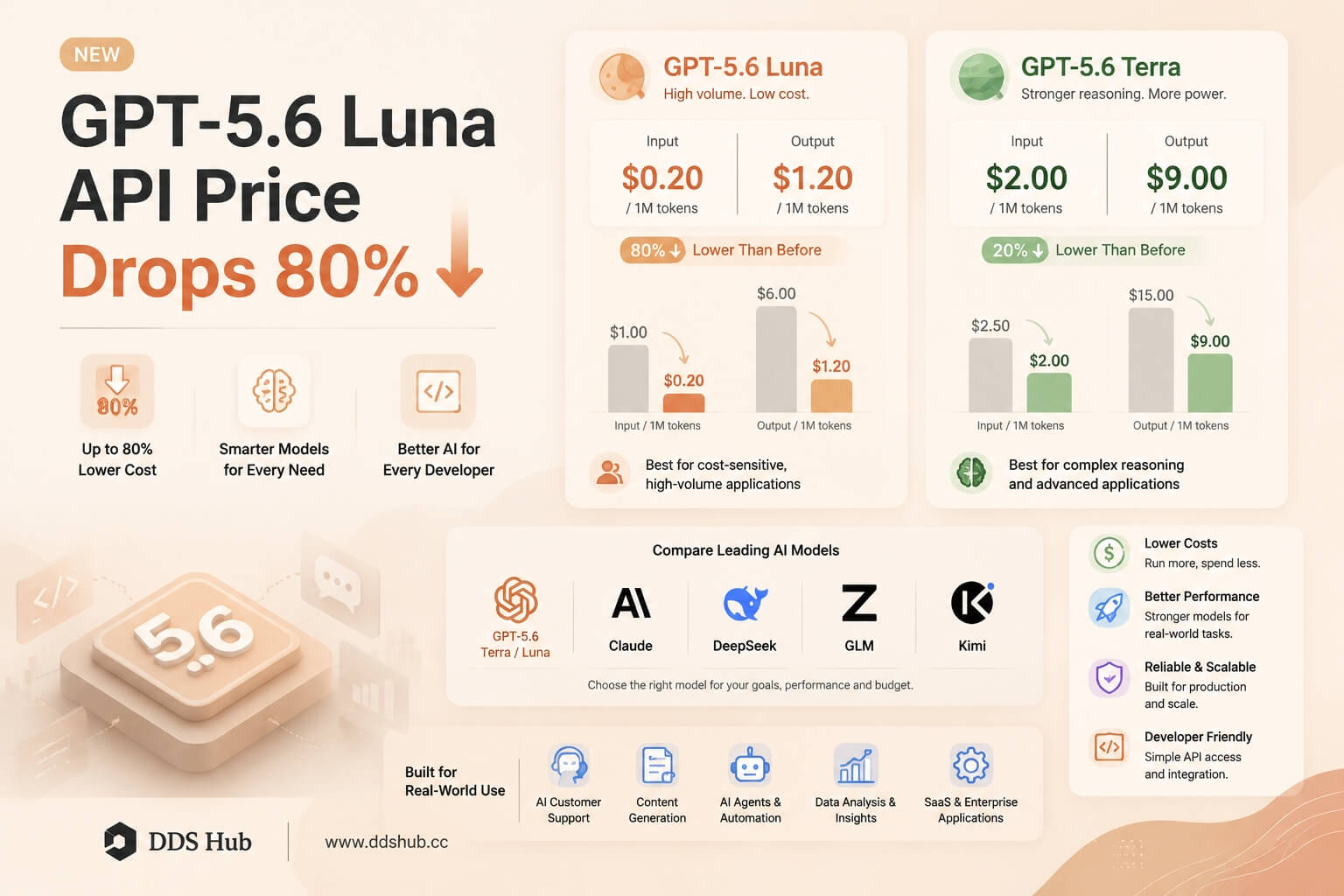
OpenAI's latest GPT-5.6 pricing adjustment has attracted attention from developers worldwide. With GPT-5.6 Luna receiving an approximately 80% API price reduction and GPT-5.6 Terra becoming more affordable, developers now have access to stronger AI capabilities at a lower operating cost.
According to OpenAI's official API documentation and pricing information, GPT-5.6 models are designed for different application scenarios, allowing developers to choose between cost efficiency and advanced reasoning performance.
Official references:
- OpenAI API documentation: https://developers.openai.com/api/docs/models
- OpenAI API pricing: https://openai.com/api/pricing/
For developers comparing AI models, the question is no longer simply:
Which AI model is the most powerful?
The more practical question is:
Which AI model provides the best balance between intelligence, reliability, and API cost?
This is why GPT-5.6 Terra and Luna are now being compared with popular models including Claude, DeepSeek, GLM, and Kimi.
Developers can also access and compare multiple AI models through platforms such as DDS Hub, which provides simplified API access for different AI services.
GPT-5.6 Luna and Terra API Pricing After the Price Reduction
The GPT-5.6 family is designed around different usage scenarios.
GPT-5.6 Luna focuses on affordable, high-volume AI workloads, while GPT-5.6 Terra targets developers who need stronger reasoning capabilities for more complex applications.
GPT-5.6 Luna API Pricing
After the latest price adjustment:
| Model | Input Price | Output Price |
|---|---|---|
| GPT-5.6 Luna | $0.20 / 1M tokens | $1.20 / 1M tokens |
Compared with previous pricing:
| Previous Price | Current Price | |
|---|---|---|
| Input | $1 / 1M tokens | $0.20 / 1M tokens |
| Output | $6 / 1M tokens | $1.20 / 1M tokens |
The reduction makes GPT-5.6 Luna significantly more attractive for developers building applications that require frequent model calls.
For example, an AI customer service platform may process millions of conversations every month. In these scenarios, even a small reduction in token cost can have a meaningful impact on infrastructure expenses.
GPT-5.6 Terra API Pricing
GPT-5.6 Terra is positioned as a balance between advanced intelligence and reasonable API cost.
Current pricing:
| Model | Input Price | Output Price |
|---|---|---|
| GPT-5.6 Terra | $2 / 1M tokens | $9 / 1M tokens |
Compared with previous pricing:
| Previous Price | Current Price | |
|---|---|---|
| Input | $2.5 / 1M tokens | $2 / 1M tokens |
| Output | $15 / 1M tokens | $9 / 1M tokens |
Terra is designed for applications where developers need stronger reasoning, better context understanding, and more reliable performance compared with lightweight models.
What Is GPT-5.6 Luna Used For?
GPT-5.6 Luna is mainly designed for applications where cost efficiency and scalability are critical.
Unlike premium reasoning models that focus on maximum intelligence, Luna focuses on delivering reliable AI performance for large-scale production environments.
AI Customer Support Applications
Customer support is one of the most common AI deployment scenarios.
Companies can use GPT-5.6 Luna to automate conversations, classify support tickets, summarize customer feedback, and provide instant responses.
Because these systems often handle a large number of daily interactions, API cost directly affects business profitability.
A lower-cost model allows companies to deploy AI assistants without dramatically increasing operational expenses.
AI Content Generation and Marketing Automation
Content-related workflows are another strong use case.
GPT-5.6 Luna can support:
- AI writing assistants
- Product description generation
- SEO content workflows
- Marketing automation
- Social media content creation
For these applications, speed and affordability are often more important than maximum reasoning capability.
AI SaaS Products
Many AI startups face the same challenge: how can they provide powerful AI features while keeping user costs sustainable?
GPT-5.6 Luna is suitable for SaaS products such as:
- AI search tools
- Document summarization platforms
- Productivity assistants
- Workflow automation services
Lower API pricing makes it easier for developers to scale AI products to more users.
GPT-5.6 Terra Use Cases
While Luna focuses on efficiency, GPT-5.6 Terra targets more advanced AI applications.
AI Coding Agents
AI coding has become one of the fastest-growing areas for large language models.
Developers use AI coding models for:
- Generating code
- Debugging applications
- Reviewing pull requests
- Understanding large repositories
- Automating development workflows
GPT-5.6 Terra competes directly with models commonly used for coding tasks, including Claude.
Claude has become popular among developers because of its strong programming ability and natural interaction style.
Anthropic's official Claude documentation: https://docs.anthropic.com/
After the GPT-5.6 price reduction, developers now have another option that combines strong reasoning capability with a more competitive API cost structure.
Enterprise AI Assistants
Large organizations increasingly use AI assistants internally.
Common scenarios include:
- Company knowledge search
- Document analysis
- Employee assistants
- Research automation
For enterprise applications, model selection depends not only on intelligence but also:
- API reliability
- Integration flexibility
- Operational cost
GPT-5.6 Terra fits these requirements by providing stronger performance than lightweight models while remaining more affordable than some premium alternatives.
GPT-5.6 Terra vs Claude: Which AI Model Should Developers Choose?
Claude remains one of the most recognized AI models for developers, especially for coding and long-form reasoning.
However, GPT-5.6 Terra's pricing improvement changes the competitive landscape.
| Feature | GPT-5.6 Terra | Claude |
|---|---|---|
| Coding | Strong | Excellent |
| Writing | Strong | Excellent |
| API Cost | More competitive | Usually higher |
| Developer Ecosystem | OpenAI ecosystem | Anthropic ecosystem |
| Enterprise Adoption | Strong | Strong |
Developers who prioritize cost efficiency and ecosystem compatibility may prefer GPT-5.6 Terra.
Developers who mainly focus on advanced coding workflows and writing quality may still prefer Claude.
For users looking for more affordable Claude API access options, DDS Hub provides simplified access to Claude models: https://www.ddshub.cc
GPT-5.6 Luna vs DeepSeek
DeepSeek has gained significant attention because of its low API pricing and strong reasoning performance.
Official DeepSeek API documentation: https://api-docs.deepseek.com/
DeepSeek is especially attractive for developers who prioritize minimizing inference costs.
However, GPT-5.6 Luna provides another balance:
| Feature | GPT-5.6 Luna | DeepSeek |
|---|---|---|
| Cost | Highly competitive | Extremely low |
| Ecosystem | OpenAI ecosystem | Open ecosystem |
| Production Reliability | Strong | Strong |
| Best For | AI applications and SaaS | Cost-focused deployments |
For startups building customer-facing products, ecosystem stability can be just as important as token price.
GPT-5.6 vs GLM
GLM models have become popular among Chinese developers and enterprise users.
Official GLM platform: https://open.bigmodel.cn/
GLM advantages include strong Chinese language support and local enterprise adoption.
GPT-5.6 advantages include:
- Global ecosystem
- Broader developer adoption
- International API compatibility
The best choice depends on application requirements and target users.
GPT-5.6 vs Kimi
Kimi from Moonshot AI is another important competitor, especially in long-context tasks.
Official Kimi API platform: https://platform.moonshot.cn/
Kimi is widely used for:
- Document analysis
- Research assistance
- Knowledge processing
GPT-5.6 competes through broader ecosystem support and flexible application development options.
GPT-5.6 API Cost Comparison: Which Model Should Developers Choose?
The AI model market is becoming more specialized. There is no single model that is perfect for every scenario.
Developers building high-volume applications may find GPT-5.6 Luna attractive because its lower API price helps control operating costs.
Teams building AI agents, coding assistants, or enterprise automation systems may prefer GPT-5.6 Terra because it provides stronger reasoning capabilities.
Claude remains a strong choice for coding and writing-heavy workflows, while DeepSeek, GLM, and Kimi continue to offer competitive alternatives for specific markets.
Conclusion: GPT-5.6 Price Reduction Makes AI Development More Accessible
The GPT-5.6 Luna API price reduction represents a broader trend in the AI industry.
As more developers build AI applications, the competition is moving from pure model capability toward:
intelligence × cost × reliability
GPT-5.6 Luna provides a strong option for affordable AI applications at scale.
GPT-5.6 Terra provides a balanced solution for developers building more advanced AI systems.
Together with alternatives such as Claude, DeepSeek, GLM, and Kimi, developers now have more choices than ever when selecting the right AI model.
For developers who want to compare different AI APIs and build applications with flexible access, DDS Hub provides a convenient platform to explore multiple AI models.
Visit: https://www.ddshub.cc
FAQ
What is GPT-5.6 Luna API price after the discount?
GPT-5.6 Luna API pricing was reduced significantly, with input and output costs becoming approximately 80% lower than previous pricing.
What is GPT-5.6 Terra used for?
GPT-5.6 Terra is suitable for AI coding agents, enterprise assistants, automation workflows, and applications requiring stronger reasoning ability.
GPT-5.6 Terra vs Claude, which is better?
GPT-5.6 Terra offers stronger cost efficiency, while Claude remains highly competitive for coding and writing-focused workflows.
Is GPT-5.6 Luna cheaper than DeepSeek?
GPT-5.6 Luna is highly competitive after the price reduction, although DeepSeek remains one of the lowest-cost AI API options.