
GLM 5.2 Model Capability Analysis: A New Option for AI Coding?
GLM 5.2 is Zhipu AI's next-generation large model, built for code generation, agentic execution, tool calling, long-context understanding, and complex Chinese-English tasks. It has recently drawn attention from AI developers and product teams for one core reason: its capabilities in coding and Agent scenarios keep improving, while the cost of using the GLM 5.2 API stays relatively manageable—making it a fit for teams looking for an alternative to Claude, GPT, and Codex.
If you are an AI Coding user, a SaaS founder, an AI product manager, or an API procurement decision-maker, GLM 5.2 deserves a spot on your evaluation list. It won't necessarily replace Claude or GPT on every task, but in Chinese-language business systems, low-cost Agents, code-assisted development, and content production, it offers a strong value-for-money argument worth discussing.
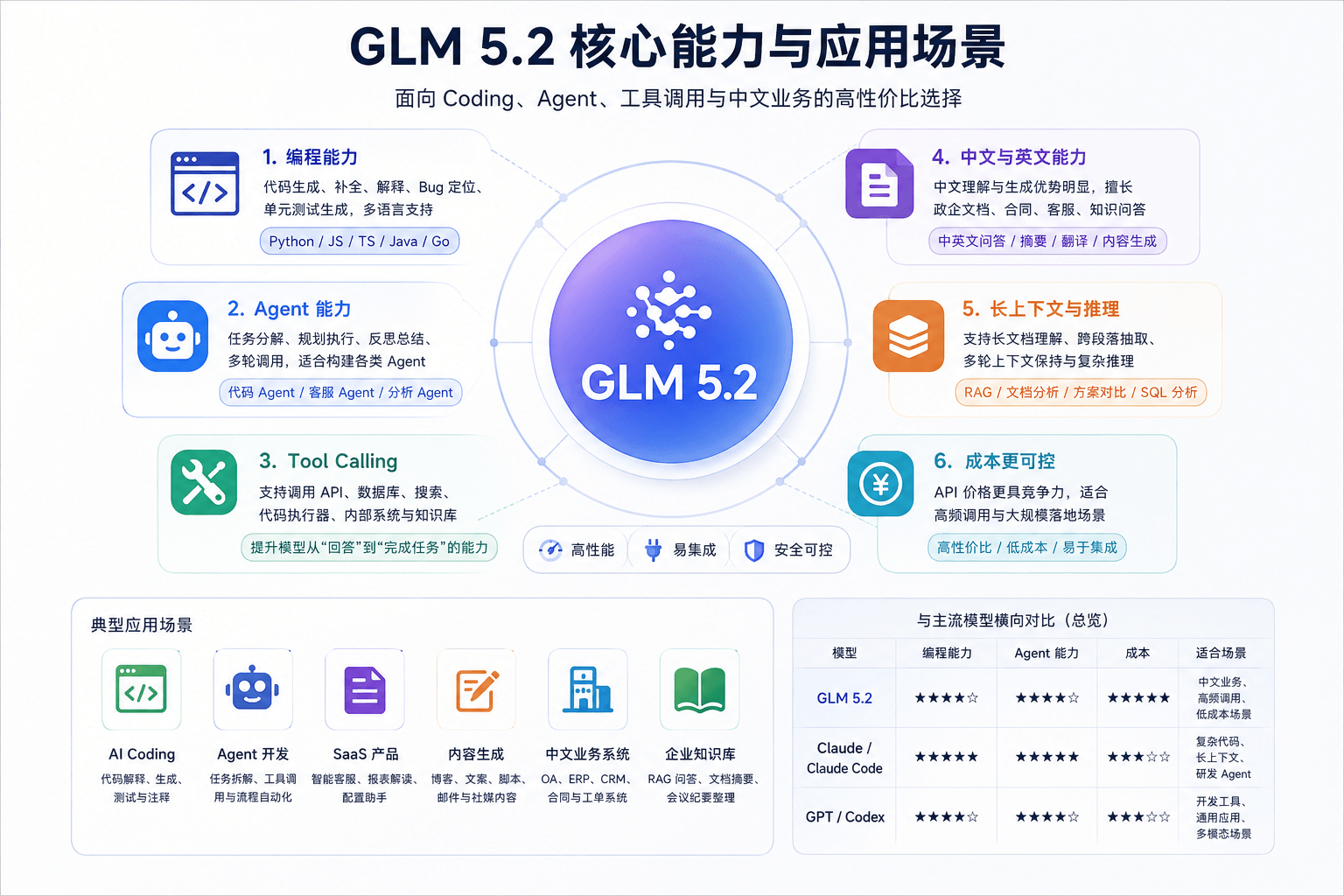
A Look at GLM 5.2's Core Capabilities
According to Zhipu AI's official materials and public descriptions of the model's capabilities, GLM 5.2 continues the GLM series' direction in general reasoning, Chinese understanding, tool calling, and developer ecosystem. For developers, what really matters is not a single benchmark score, but how the model balances Coding, Agent work, Tool Calling, long context, and API cost.
1. GLM 5.2 Coding: A Good Fit for Everyday Development and Code Comprehension
From a GLM 5.2 evaluation standpoint, coding ability is one of its most noteworthy aspects. GLM 5.2's coding strength shows up mainly in code completion, function generation, bug localization, unit test generation, code explanation, and multi-file refactoring suggestions. For common languages such as Python, JavaScript, TypeScript, Java, and Go, it can handle most engineering-assist tasks.
Compared with Claude Code, Codex, or GPT, GLM 5.2 is better suited to teams that are budget-sensitive, have heavy Chinese-language needs, and require a high volume of API calls. For deep refactoring of large codebases, complex system design, and extremely long debugging chains, Claude and GPT remain the safer high-end choices.
2. Agent Capability: Capable of Task Decomposition, but Reliant on Engineering Orchestration
GLM 5.2 supports planning, execution, reflection, and multi-turn calling in agentic scenarios. It can be used to build code Agents, customer-service Agents, data-analysis Agents, and automated operations Agents. Real-world results depend on prompts, tool design, context management, and retry-on-failure mechanisms.
OpenAI emphasizes in its official documentation that models, tools, and development frameworks must work together; Anthropic likewise treats tool use and long context as core capabilities in the Claude documentation. GLM 5.2 occupies a similar position: single-shot response quality matters, but what matters more is whether it can plug reliably into a workflow.
3. Tool Calling: Suited to Connecting APIs, Databases, and Internal Systems
Tool Calling is a key GLM 5.2 capability for enterprise applications. Developers can let the model call search, database queries, order systems, CRM, code executors, or internal knowledge bases. Compared with plain chat, tool calling upgrades the model from "answering questions" to "completing tasks."
In SaaS scenarios, the GLM 5.2 API can connect to user management, report generation, ticket analysis, data Q&A, and automated configuration workflows. Note that the stability of Tool Calling depends not only on the model but also on the JSON Schema, permission controls, logging and tracing, and exception rollback.
4. Chinese and English Capability: Stronger for Chinese-Language Business
The GLM series has long been optimized for Chinese contexts, and GLM 5.2 has a natural advantage in Chinese intent recognition, government and enterprise document understanding, Chinese customer service, Chinese knowledge-base Q&A, contract summarization, and business-process explanation. For SaaS products that mainly serve Chinese users, Chinese capability is often more important than English benchmarks.
On the English side, GLM 5.2 is capable of English reading, summarization, code comments, technical documentation translation, and cross-lingual Q&A. But if your team routinely handles English legal text, overseas developer documentation, or high-difficulty English reasoning tasks, it's still worth testing Claude, GPT, and GLM 5.2 side by side.
5. Long Context and Reasoning: Suited to Knowledge Bases and Complex Documents
Long-context capability determines whether a model can handle complete PRDs, interface documentation, meeting notes, code snippets, and knowledge-base materials. GLM 5.2 performs in a way that fits enterprise applications when it comes to long-document summarization, cross-paragraph information extraction, and multi-turn context retention.
On the reasoning side, it can handle requirement decomposition, solution comparison, SQL analysis, code-logic checking, and multi-step problem solving. But for difficult mathematical proofs, complex algorithm-competition problems, and extreme edge-case reasoning, evaluating it in parallel with GPT and Claude is recommended.
Positioning GLM 5.2 Against Claude and GPT/Codex
The comparison below is an overview and does not represent an absolute conclusion across all tasks. Before any real procurement decision, run a small-scale test with your own codebase, business documents, Agent workflows, and cost model.
| Model | Coding | Agent | Pricing and Cost | Best-Fit Scenarios |
|---|---|---|---|---|
| GLM 5.2 | Good for everyday development, code explanation, test generation, and Chinese-language engineering | Supports tool calling and task decomposition; good for low-cost Agents | Generally better for budget-sensitive teams; GLM 5.2 pricing is competitive | Chinese SaaS, AI Coding, enterprise knowledge bases, content generation |
| Claude / Claude Code | Strong at complex code comprehension, multi-file refactoring, and long-context programming | Reliable Agent behavior; suited to complex workflows | Usually higher cost; best for high-value tasks | Large codebases, R&D Agents, complex document analysis |
| GPT / Codex | Mature ecosystem; good for dev tools, completion, and automated coding | Tightly integrated with the OpenAI tool ecosystem | Clear pricing tiers; choose by model | Developer tools, general AI applications, multimodal products |
TechCrunch, VentureBeat, and The Information have all continued to cover the trends in AI Coding, Agents, and model-price competition in recent years. Discussions among developers on X, Reddit, and Hacker News also show that teams increasingly favor a multi-model strategy: using Claude or GPT for complex tasks, and lower-cost models for high-frequency calls and Chinese-language business tasks.
How to Use the GLM 5.2 API at Low Cost
If your goal is to evaluate the GLM 5.2 API quickly—rather than dealing from scratch with accounts, quotas, and billing across multiple model platforms—consider an aggregated API service. Take DDShub as an example: it supports GLM 5.2 and offers an official discounted price, while also supporting the full Claude lineup and GPT/Codex—making it a fit for teams that need to compare several models in AI Coding scenarios.
The value of this approach is not "locking into one model," but lowering the cost of trial and error. Developers can use the same interface to test GLM 5.2, Claude, GPT, and Codex, comparing response quality, speed, failure rate, and cost on real tasks.
- AI Coding: Use GLM 5.2 for high-frequency code explanation, test generation, and comment tasks.
- Agent development: Hand complex tasks to Claude or GPT, and standard workflows to GLM 5.2.
- SaaS products: Connect to multiple models through a unified API and route dynamically by task.
- Procurement evaluation: Use real call volumes to calculate GLM 5.2 pricing and overall ROI.
Which Scenarios Suit GLM 5.2
AI Coding
GLM 5.2 is a good fit for code explanation, script generation, interface examples, unit tests, log analysis, and common bug localization. For tools like Cursor, Continue, and Cline, if they support a custom API, you can try wiring in GLM 5.2 as an assist model.
Agent Development
In customer-service Agents, data-analysis Agents, code Agents, and operations-automation Agents, GLM 5.2 can take on steps such as task decomposition, tool selection, and result summarization. Pair it with strict tool permissions and output validation.
SaaS Products
SaaS teams can use GLM 5.2 for intelligent customer service, report interpretation, user-behavior analysis, copywriting, and configuration assistants. It suits high-frequency, standardized features with a high proportion of Chinese content.
Content Generation
GLM 5.2 can generate Chinese blogs, product descriptions, short-video scripts, emails, social-media content, and knowledge-base articles. For marketing teams, the priority is establishing templates, fact-checking, and human review processes.
Chinese Business Systems
In OA, ERP, CRM, government and enterprise documents, contract management, and ticketing systems, GLM 5.2's Chinese understanding delivers real value. It can help users search, summarize, fill in, and explain business information.
Enterprise Knowledge Bases
GLM 5.2 can be used for RAG Q&A, document summarization, permission-scoped knowledge retrieval, and meeting-note organization. Enterprises should focus on data isolation, recall quality, source citation, and audit logging.
Conclusion: Is GLM 5.2 a Replacement for Claude/GPT, or a Complement?
GLM 5.2 is better suited as an important complement within a multi-model architecture, rather than a simple replacement for Claude or GPT. Its strengths lie in Chinese-language business, lower cost, API integration, and high-frequency tasks; Claude and GPT's strengths lie in complex reasoning, top-tier Coding, ecosystem maturity, and high-difficulty Agents.
Recommended audiences include budget-sensitive AI Coding users, Chinese SaaS founders, product teams that need a large volume of API calls, and technical leads evaluating multi-model routing. Less suitable audiences include teams that only want the strongest possible code-refactoring ability, teams that need extremely high English reasoning ability, and teams without the engineering capacity to keep an Agent stable.
A more realistic choice is this: use GLM 5.2 for high-frequency Chinese and standardized tasks, and use Claude Code, Codex, or GPT for complex programming and critical reasoning. This keeps costs under control while preserving the product experience.
Frequently Asked Questions (FAQ)
1. Is GLM 5.2 good for programming?
Yes. GLM 5.2 can be used for code explanation, function generation, test writing, and bug analysis. For complex multi-file refactoring, run comparison tests against Claude Code and Codex.
2. Is GLM 5.2 cheaper than Claude?
In most cases, GLM 5.2 pricing is better suited to high-frequency calls. Actual cost depends on context length, output volume, platform discounts, and call scale.
3. Does GLM 5.2 support Agents?
Yes. It can take part in task decomposition, tool calling, and result summarization. Real-world stability depends on tool design, error retries, and permission controls.
4. How do you integrate the GLM 5.2 API?
You can integrate through Zhipu AI's official API, or through an aggregation platform such as DDShub, which makes it easy to test Claude, GPT, and Codex at the same time.
5. Is GLM 5.2 suitable for Cursor?
If Cursor or a related plugin supports a custom OpenAI-compatible interface, you can try connecting GLM 5.2 for code Q&A and assisted generation.
6. How do I choose between GLM 5.2 and GPT?
For Chinese-language business, high-frequency calls, and cost-sensitive scenarios, test GLM 5.2 first; for complex reasoning, multimodal work, and a mature ecosystem, test GPT first.
7. Is GLM 5.2 suitable for enterprise knowledge bases?
It suits Chinese knowledge bases, policy documents, meeting notes, and customer-service Q&A. Combine it with RAG, permission controls, citation tracing, and human spot-checks.
8. Can GLM 5.2 replace Claude Code?
Direct replacement is not recommended. Claude Code is stronger on complex codebases and long-chain development, while GLM 5.2 is better suited to low-cost assist tasks.
9. What are the main risks of GLM 5.2?
The main risks include hallucination, tool-call failures, unstable complex reasoning, and missed code edge cases. Run evaluations and log monitoring before going live.
10. Should SaaS teams procure the GLM 5.2 API?
If your product has Chinese-language scenarios, high-frequency calls, and cost pressure, it's worth evaluating. Run parallel tests against Claude and GPT using real business data.