
GLM 5.2 vs Codex: Which AI Coding Model Is Better in 2026?
AI-assisted software development has evolved from simple code completion into full-scale engineering workflows. Modern AI models can now generate code, fix bugs, understand repositories, write tests, review pull requests, and even act as autonomous coding agents.
Among the most discussed models for developers today are GLM 5.2 and Codex. While Codex is widely recognized for its software engineering capabilities and integration into coding workflows, GLM 5.2 has emerged as a strong alternative thanks to its multilingual support, lower API costs and growing ecosystem.
For startups, SaaS companies and independent developers, choosing the right coding model can significantly affect productivity and operating costs.
In this guide, we'll compare GLM 5.2 and Codex across coding quality, developer experience, agent capabilities, pricing and real-world use cases.
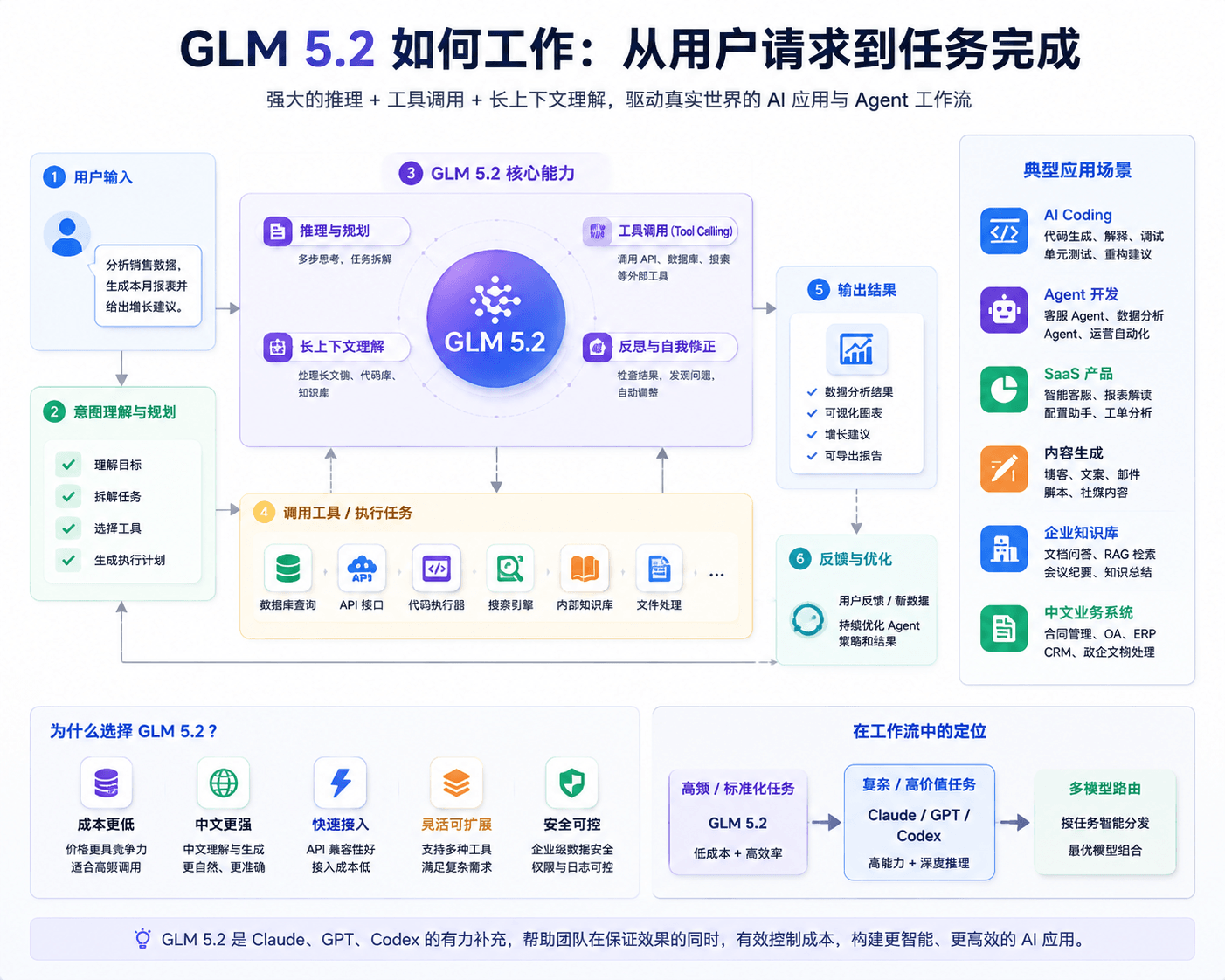
Understanding the Two Models
What Is GLM 5.2?
GLM 5.2 is a large language model developed by Zhipu AI.
The model focuses on:
- Coding assistance
- Tool calling
- AI agents
- Enterprise workflows
- Chinese and English language tasks
GLM 5.2 is increasingly used by teams seeking a balance between performance and affordability.
What Is Codex?
Codex is OpenAI's coding-focused model family designed specifically for software development tasks.
Codex is optimized for:
- Code generation
- Repository analysis
- Software engineering workflows
- Multi-file modifications
- Agent-driven coding
Unlike general-purpose models, Codex is heavily focused on developer productivity.
Coding Performance Comparison
For most teams, coding quality remains the most important evaluation metric.
GLM 5.2 Coding Ability
GLM 5.2 performs well on common development tasks:
- Python development
- JavaScript and TypeScript
- Backend APIs
- SQL generation
- Bug fixing
- Documentation
It can handle day-to-day engineering work effectively and provides strong multilingual explanations.
Strengths
- Fast response speed
- Good code quality
- Strong Chinese-language support
- Cost-effective deployment
Weaknesses
- Less effective on very large projects
- Weaker repository-level reasoning
- Smaller developer ecosystem
Codex Coding Ability
Codex was designed specifically for software engineering.
It excels at:
- Repository understanding
- Multi-file edits
- Complex debugging
- Architecture-level changes
- Large codebase analysis
Many developers use Codex for advanced coding workflows because it understands project structure more effectively than most general-purpose models.
Strengths
- Exceptional software engineering capabilities
- Strong repository awareness
- Better project-level reasoning
- Advanced coding agents
Weaknesses
- Higher operational costs
- Less optimized for multilingual business tasks
Coding Quality Comparison
| Category | GLM 5.2 | Codex |
|---|---|---|
| Code Generation | Very Good | Excellent |
| Debugging | Very Good | Excellent |
| Unit Test Creation | Very Good | Excellent |
| Refactoring | Good | Excellent |
| Repository Understanding | Good | Excellent |
| Large Project Analysis | Good | Excellent |
| Documentation | Very Good | Excellent |
| Chinese Coding Support | Excellent | Moderate |
Codex remains the stronger coding-focused model overall, but GLM 5.2 provides excellent value relative to its cost.
Developer Workflow Experience
Coding models are not just evaluated by code quality. Developer experience matters equally.
Working With GLM 5.2
Developers commonly use GLM 5.2 for:
- AI assistants
- Internal tooling
- Coding help
- Enterprise workflows
- Customer-facing AI features
The model is easy to integrate into business applications and works particularly well in multilingual environments.
Working With Codex
Codex is built for developers first.
Typical use cases include:
- AI pair programming
- Agent-based development
- Repository-wide code modifications
- Automated code review
- Development automation
For engineering teams working on large products, Codex often feels more specialized.
Agent Development Comparison
The rise of AI agents has changed how developers evaluate models.
Modern coding agents need to:
- Read code
- Call tools
- Execute workflows
- Manage context
GLM 5.2 for Agents
GLM 5.2 supports:
- Function calling
- Structured outputs
- Workflow automation
- Tool integration
This makes it suitable for:
- Business automation
- Support agents
- Workflow assistants
- Knowledge management systems
For many startups, these capabilities are more than sufficient.
Codex for Agents
Codex shines when agents need to:
- Modify codebases
- Analyze repositories
- Generate production-ready code
- Perform multi-step software engineering tasks
This specialization makes Codex particularly attractive for AI coding products.
Agent Comparison Table
| Feature | GLM 5.2 | Codex |
|---|---|---|
| Tool Calling | Strong | Excellent |
| Coding Agents | Strong | Excellent |
| Workflow Automation | Strong | Excellent |
| Repository Agents | Good | Excellent |
| Business Automation | Excellent | Very Good |
Chinese and Multilingual Support
This is one area where GLM 5.2 clearly stands out.
GLM 5.2 Language Strengths
GLM 5.2 performs exceptionally well for:
- Chinese documentation
- Chinese customer support
- Bilingual development teams
- Regional business applications
Many organizations serving Asian markets benefit significantly from this capability.
Codex Language Support
Codex is optimized primarily for:
- English programming environments
- Technical documentation
- Software engineering workflows
Although it supports multiple languages, its strongest performance remains in English-centric development scenarios.
Cost Comparison
For startups and SaaS companies, pricing often determines long-term viability.
A model that is slightly weaker but significantly cheaper may provide better business value.
GLM 5.2 Cost Advantage
GLM 5.2 offers:
- Lower API costs
- Better scalability
- Reduced infrastructure spending
This makes it attractive for:
- Startups
- High-volume products
- Customer-facing AI systems
Codex Cost Considerations
Codex delivers premium performance, but organizations typically pay more for that capability.
The additional cost may be justified when:
- Developer productivity is critical
- Engineering complexity is high
- Code quality directly impacts revenue
Accessing Both Models Efficiently
Many companies avoid relying on a single model.
Instead, they combine:
- GLM 5.2 for cost-efficient workloads
- Codex for advanced coding tasks
- Claude for reasoning-heavy workflows
Platforms such as DDS Hub provide access to multiple models through a unified API layer.
This approach allows teams to:
- Compare model performance
- Reduce vendor lock-in
- Optimize infrastructure costs
- Experiment with different AI coding workflows
As AI development becomes more competitive, flexibility increasingly becomes a strategic advantage.
Which Model Should You Choose?
Choose GLM 5.2 If
You need:
- Lower API costs
- Strong Chinese support
- Business automation
- Scalable AI applications
GLM 5.2 is particularly attractive for startups and companies targeting multilingual markets.
Choose Codex If
You need:
- Advanced software engineering
- Repository-level reasoning
- AI coding agents
- Development-focused workflows
Codex remains one of the strongest options for engineering teams.
Final Verdict
The competition between GLM 5.2 and Codex is not simply a battle of benchmarks.
The better model depends on the problem you're solving.
Codex remains the stronger option for:
- Complex coding
- Large repositories
- Software engineering workflows
- AI coding agents
GLM 5.2 excels at:
- Cost efficiency
- Chinese-language support
- Enterprise automation
- High-volume deployments
For many organizations, the smartest approach is not choosing one model over the other. Instead, it is combining both and assigning each model to the workloads where it performs best.
As AI development continues to evolve, teams that optimize both performance and cost will gain the greatest competitive advantage.
FAQ
Is GLM 5.2 better than Codex?
For pure software engineering tasks, Codex is generally stronger. GLM 5.2 offers better cost efficiency and multilingual support.
Which model is cheaper?
GLM 5.2 is typically more affordable than Codex.
Which model is better for startups?
GLM 5.2 is often a better choice for budget-conscious startups.
Is Codex better for coding?
Yes. Codex is specifically optimized for software engineering workflows.
Does GLM 5.2 support coding agents?
Yes. GLM 5.2 supports tool calling and agent-based workflows.
Which model is better for Chinese developers?
GLM 5.2 generally provides stronger Chinese-language support.
Can both models be used together?
Yes. Many teams combine GLM 5.2 and Codex to optimize performance and costs.
What is the best AI coding model in 2026?
For advanced engineering, Codex is among the strongest choices. For cost efficiency and multilingual use cases, GLM 5.2 remains highly competitive.