
GLM 5.2 vs Claude: Which AI Model Is Better for Developers?
As AI development becomes increasingly competitive, developers are constantly looking for the right balance between performance, reliability and cost. Claude has established itself as one of the strongest AI models for coding and reasoning, while GLM 5.2 has emerged as a fast-growing alternative with strong multilingual capabilities and attractive pricing.
For many teams, the question is no longer whether AI should be part of the development workflow. The real question is which model provides the best return on investment.
In this comparison, we'll analyze GLM 5.2 and Claude from a developer's perspective, covering coding performance, agent capabilities, language support, API costs and real-world use cases.
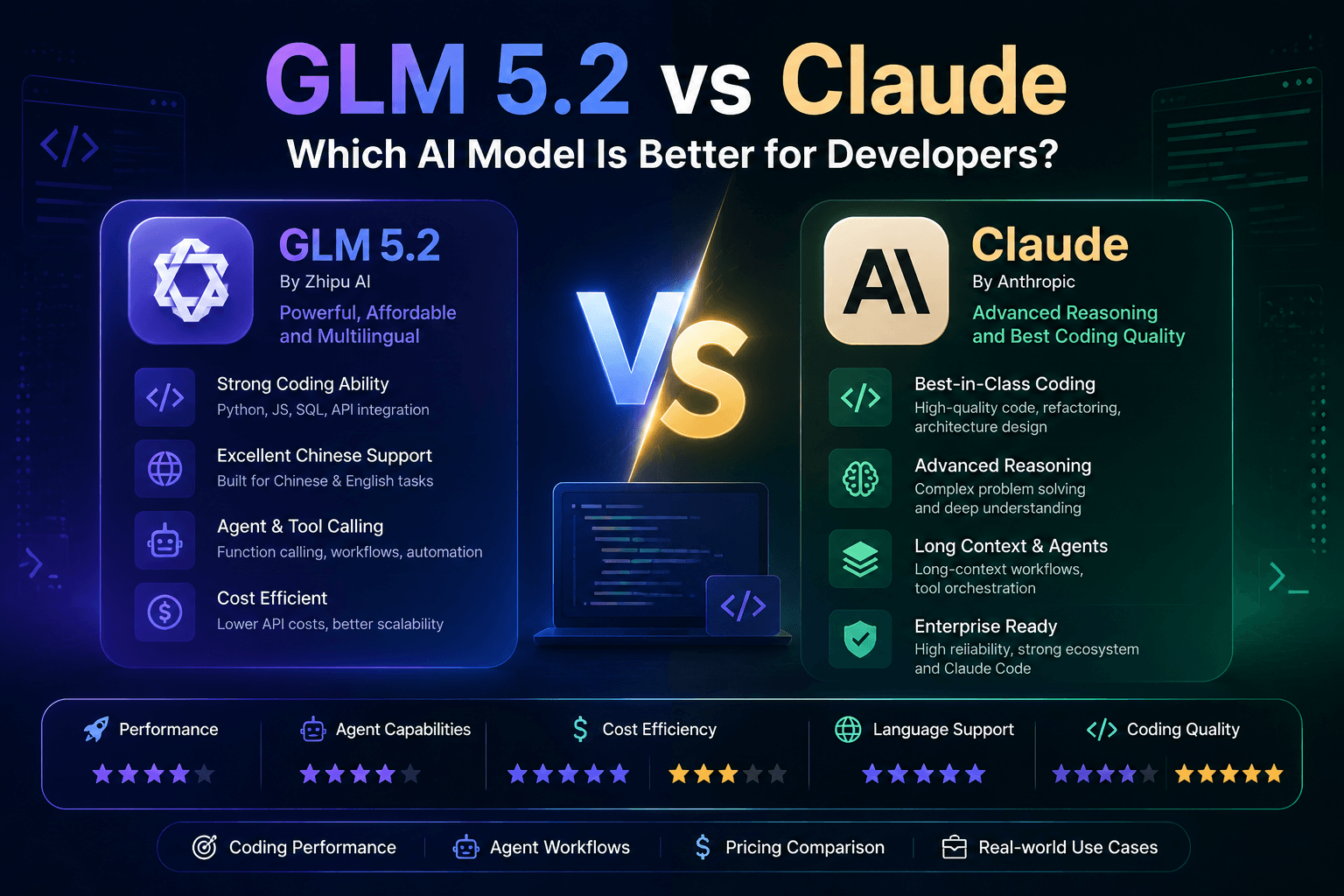
Understanding the Two Models
Before comparing performance, it's important to understand the different philosophies behind these models.
What Is GLM 5.2?
GLM 5.2 is developed by Zhipu AI and is designed to support:
- Coding assistance
- Agent workflows
- Tool calling
- Chinese and English language tasks
- Enterprise AI applications
The model has gained attention because it offers strong performance while remaining relatively affordable compared to premium international models.
What Is Claude?
Claude is developed by Anthropic and has become one of the most popular AI models for developers.
Its strengths include:
- Advanced reasoning
- Software engineering assistance
- Long-context processing
- AI agent workflows
- Claude Code integration
Many developers consider Claude one of the best coding-focused large language models available today.
Coding Performance Comparison
For most developers, coding quality is the most important factor.
GLM 5.2 Coding Performance
GLM 5.2 performs well in:
- Python generation
- JavaScript development
- SQL queries
- API integration
- Debugging
- Code explanations
The model is capable of producing clean and usable code for most business applications.
It is particularly effective when developers require bilingual support or need explanations in Chinese.
Typical Strengths
- Fast code generation
- Good documentation writing
- Strong Chinese-language coding support
- Cost-efficient for high-volume usage
Common Limitations
- Less effective on very large repositories
- Slightly weaker architectural reasoning
- Smaller ecosystem
Claude Coding Performance
Claude is widely used for advanced software engineering tasks.
Developers frequently rely on Claude for:
- Large-scale refactoring
- Architecture design
- Repository analysis
- Multi-file modifications
- Complex debugging
The introduction of Claude Code has further strengthened its position among professional developers.
Typical Strengths
- Exceptional code quality
- Strong reasoning
- Better understanding of large codebases
- Advanced engineering workflows
Common Limitations
- Higher API costs
- Less cost-effective for large deployments
- Strongest performance often comes from premium models
Coding Comparison Table
| Feature | GLM 5.2 | Claude |
|---|---|---|
| Code Generation | Very Good | Excellent |
| Debugging | Very Good | Excellent |
| Repository Understanding | Good | Excellent |
| Architecture Design | Good | Excellent |
| Refactoring | Good | Excellent |
| Documentation Writing | Very Good | Excellent |
| Chinese Coding Support | Excellent | Good |
| Cost Efficiency | Excellent | Moderate |
For pure coding quality, Claude still maintains an advantage. However, GLM 5.2 offers impressive value considering its lower operational cost.
Agent Development Capabilities
Modern AI applications increasingly rely on agents rather than simple chat interfaces.
Developers now expect models to:
- Call tools
- Execute workflows
- Interact with APIs
- Process multiple tasks
GLM 5.2 for Agents
GLM 5.2 supports:
- Function calling
- Structured outputs
- Tool integration
- Multi-step workflows
This makes it suitable for:
- Customer support agents
- Internal automation
- Knowledge assistants
- SaaS workflows
Many startups can successfully build production-grade agents using GLM 5.2.
Claude for Agents
Claude has become one of the leading models for agent development.
It excels at:
- Complex planning
- Multi-step reasoning
- Tool orchestration
- Long-context workflows
Claude's ability to maintain context across lengthy interactions makes it particularly effective for sophisticated agents.
Agent Comparison
| Category | GLM 5.2 | Claude |
|---|---|---|
| Tool Calling | Strong | Excellent |
| Workflow Planning | Strong | Excellent |
| Long-Term Context | Strong | Excellent |
| Structured Outputs | Strong | Excellent |
| Cost Efficiency | Excellent | Moderate |
For simple and medium-complexity agents, GLM 5.2 is often sufficient.
For highly advanced autonomous systems, Claude typically performs better.
Language Support
This is one area where GLM 5.2 has a significant advantage.
Chinese Language Tasks
GLM 5.2 was built with strong Chinese capabilities.
It performs well in:
- Business writing
- Customer service
- Technical documentation
- Chinese coding explanations
For companies serving Chinese-speaking users, this can be a major advantage.
English Language Tasks
Claude remains one of the strongest English-language models available.
It often delivers:
- More natural writing
- Better nuanced reasoning
- Stronger technical communication
For global products targeting English-speaking markets, Claude generally has an edge.
Pricing and Cost Considerations
Performance matters, but cost often determines whether a project is financially sustainable.
Many startups discover that AI infrastructure costs can grow rapidly as usage scales.
GLM 5.2 Cost Advantage
GLM 5.2 is attractive because it offers:
- Lower API costs
- Better scalability for startups
- Reduced operational expenses
For teams processing millions of tokens daily, the savings can become substantial.
Claude Cost Considerations
Claude offers premium performance, but premium performance comes at a premium price.
Organizations often choose Claude when:
- Quality is the highest priority
- Development speed matters more than cost
- Enterprise reliability is critical
The decision frequently depends on whether the performance gains justify the additional expense.
How Developers Access Both Models
Many development teams avoid locking themselves into a single provider.
Instead, they test multiple models and route requests based on workload requirements.
For example:
- Claude for advanced coding
- GLM 5.2 for high-volume processing
- Specialized models for specific tasks
Platforms such as DDS Hub make this easier by providing unified access to:
- GLM 5.2
- Claude models
- Codex models
This allows teams to compare performance, optimize costs and switch models without rebuilding infrastructure.
For organizations experimenting with different AI coding workflows, this flexibility can be extremely valuable.
Which Model Should You Choose?
Choose GLM 5.2 If
You need:
- Lower API costs
- Strong Chinese language support
- Scalable AI deployments
- Cost-efficient automation
GLM 5.2 is particularly attractive for startups and businesses operating in Chinese-speaking markets.
Choose Claude If
You need:
- The highest coding quality
- Advanced reasoning
- Claude Code integration
- Complex agent workflows
Claude remains one of the strongest options for professional software engineering teams.
Final Verdict
The comparison between GLM 5.2 and Claude is not simply about which model is "better."
Instead, it's about choosing the right model for the right workload.
Claude remains the stronger option for:
- Advanced coding
- Complex reasoning
- Large-scale software engineering
GLM 5.2 stands out for:
- Cost efficiency
- Chinese language understanding
- Enterprise deployment
- High-volume AI applications
For many organizations, the best strategy is not choosing one model over the other. Instead, it's combining both models and using each where it delivers the most value.
As AI infrastructure becomes increasingly important, flexibility and cost optimization may matter just as much as raw benchmark performance.
FAQ
Is GLM 5.2 better than Claude?
Not overall. Claude generally performs better in coding and reasoning, while GLM 5.2 offers better cost efficiency and Chinese language support.
Is GLM 5.2 cheaper than Claude?
Yes. In most deployment scenarios, GLM 5.2 is more affordable than Claude.
Which model is better for coding?
Claude typically produces higher-quality code, especially for complex software engineering tasks.
Is GLM 5.2 good enough for startups?
Absolutely. Many startups can achieve excellent results with GLM 5.2 while keeping infrastructure costs under control.
Which model is better for Chinese users?
GLM 5.2 generally performs better on Chinese-language tasks.
Can both models be used together?
Yes. Many teams use GLM 5.2 for cost-sensitive workloads and Claude for premium coding tasks.
Does GLM 5.2 support AI agents?
Yes. GLM 5.2 supports tool calling, structured outputs and workflow automation.
Is Claude Code better than GLM 5.2?
For coding-focused workflows, Claude Code remains one of the strongest developer tools available.