
GLM 5.2 Review: Can It Compete with Claude and Codex?
Artificial intelligence models are improving rapidly, and developers now have more choices than ever before. While Claude and Codex remain popular options for AI coding and agent development, China's GLM 5.2 has started attracting attention due to its strong coding performance, multilingual capabilities, and lower operating costs.
For startups, independent developers, and enterprises looking to reduce AI infrastructure expenses, GLM 5.2 presents an interesting alternative. But how does it compare with leading overseas models such as Claude and Codex? Is it powerful enough for real-world coding tasks? And when should you choose GLM 5.2 over other models?
In this review, we'll examine GLM 5.2's capabilities, compare it with Claude and Codex, and discuss where it fits into modern AI development workflows.
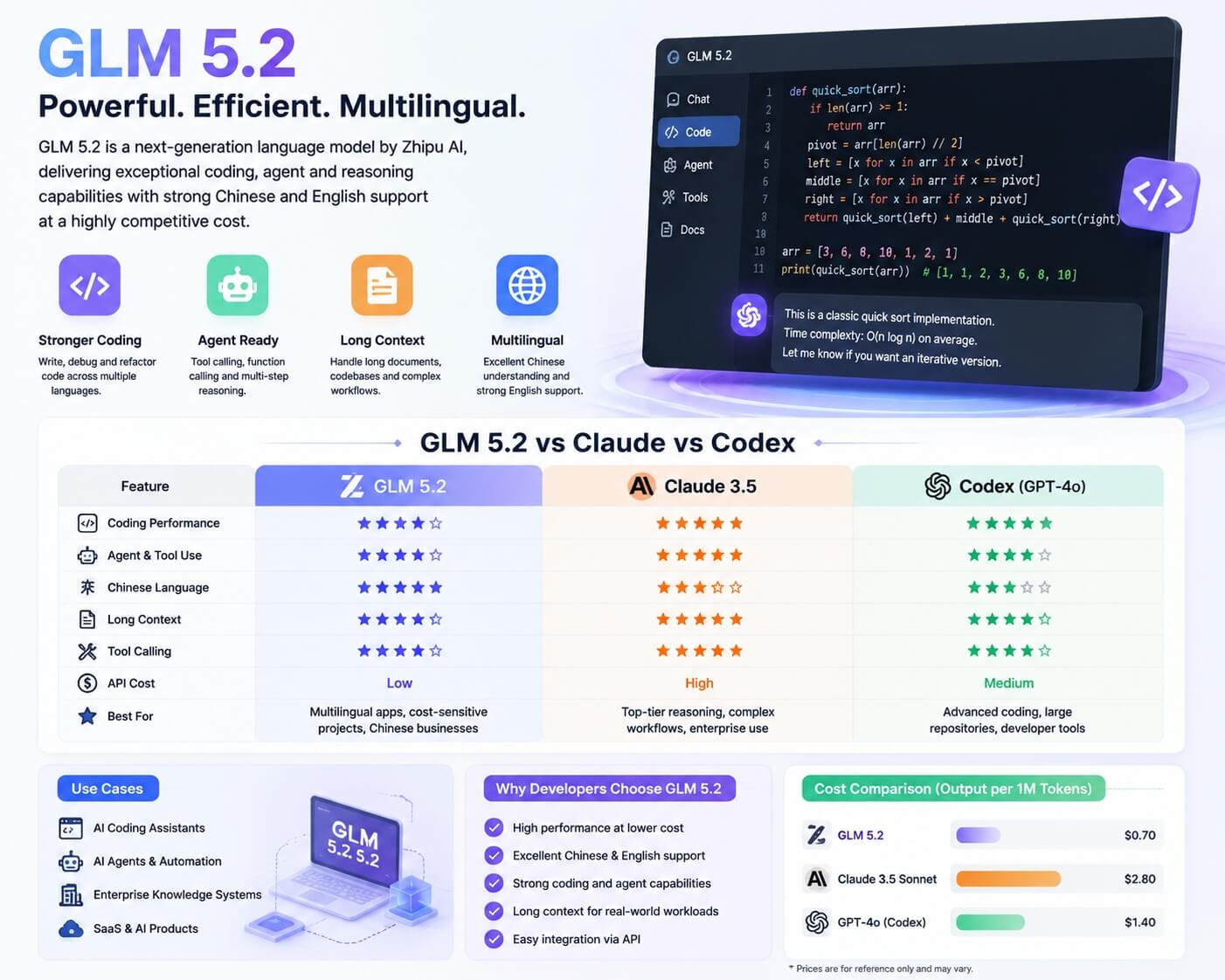
What Is GLM 5.2?
GLM 5.2 is a large language model developed by Zhipu AI. The GLM series has evolved significantly over the past few years, with a growing focus on:
- AI coding
- Agent workflows
- Tool calling
- Chinese language understanding
- Enterprise applications
- Cost-efficient API deployment
Unlike many models that focus primarily on English-language tasks, GLM has been designed with strong multilingual support and particularly strong Chinese-language performance.
For many developers in Asia, this makes GLM 5.2 a practical option for building AI products that require both Chinese and English capabilities.
GLM 5.2 Core Capabilities
Coding Performance
One of the biggest improvements in GLM 5.2 is coding ability.
The model can assist with:
- Python development
- JavaScript and TypeScript
- React applications
- Backend APIs
- SQL queries
- Code debugging
- Documentation generation
In practical tests, GLM 5.2 performs well on common software development tasks such as:
- Function generation
- Refactoring
- Bug fixing
- Unit test creation
For small and medium-sized projects, many developers may find the output quality comparable to premium international models.
Strengths
- Fast response speed
- Strong Chinese coding explanations
- Lower inference costs
- Good support for structured outputs
Limitations
- Slightly weaker on extremely large codebases
- Less mature ecosystem compared to Claude Code
- Fewer third-party integrations
Agent Capabilities
Modern AI systems increasingly rely on agents rather than simple chat interactions.
GLM 5.2 includes support for:
- Function calling
- Tool usage
- Multi-step reasoning
- Workflow automation
This makes it suitable for:
- AI assistants
- Customer support automation
- Research agents
- Data analysis workflows
For many business applications, GLM 5.2 provides enough reasoning ability to handle structured tasks without requiring the most expensive frontier models.
Long Context Processing
Long-context handling is becoming essential for AI development.
Developers frequently need models to process:
- Large documents
- Knowledge bases
- Code repositories
- Product documentation
GLM 5.2 performs well in long-document scenarios and can maintain context across large inputs. This is particularly useful for enterprise deployments where document understanding is a key requirement.
Chinese Language Understanding
This is arguably GLM 5.2's strongest advantage.
Compared with many Western models, GLM demonstrates:
- Better Chinese grammar understanding
- More natural Chinese writing
- Better handling of local terminology
- Stronger support for Chinese business content
For companies serving Chinese-speaking customers, this advantage can be significant.
GLM 5.2 vs Claude
Claude remains one of the most popular AI models among developers, especially after the success of Claude Code.
Let's compare the two.
| Category | GLM 5.2 | Claude |
|---|---|---|
| Coding | Strong | Excellent |
| Agent Workflows | Strong | Excellent |
| Chinese Language | Excellent | Good |
| English Language | Good | Excellent |
| Long Context | Strong | Excellent |
| Tool Calling | Strong | Excellent |
| API Cost | Lower | Higher |
| Enterprise Adoption | Growing | Mature |
When GLM 5.2 Is Better
Choose GLM 5.2 when:
- You need strong Chinese support
- Cost is a major concern
- You're building domestic products
- You need large-scale API deployment
When Claude Is Better
Choose Claude when:
- You work primarily in English
- You need advanced coding assistance
- You use Claude Code extensively
- You require top-tier reasoning performance
For many startups, the decision often comes down to balancing performance and cost.
GLM 5.2 vs Codex
Codex has become increasingly popular among developers focused on AI-assisted programming.
Let's compare.
| Category | GLM 5.2 | Codex |
|---|---|---|
| Coding Quality | Strong | Excellent |
| CLI Experience | Limited | Excellent |
| Repository Understanding | Good | Excellent |
| Agent Development | Strong | Strong |
| Chinese Support | Excellent | Moderate |
| Cost Efficiency | Excellent | Moderate |
| Learning Curve | Easy | Moderate |
Advantages of GLM 5.2
- Lower operational costs
- Better multilingual support
- Strong Chinese performance
- Good value for startups
Advantages of Codex
- Better coding specialization
- Stronger software engineering workflows
- Better support for large repositories
- More mature developer tooling
Developers focused entirely on coding may still prefer Codex. However, teams building multilingual AI products may find GLM 5.2 more practical.
How Developers Can Use GLM 5.2
GLM 5.2 is suitable for a wide range of applications.
AI Coding Assistants
Developers can use GLM 5.2 to:
- Generate code
- Explain code
- Review pull requests
- Create tests
AI Agents
GLM 5.2 works well for:
- Research agents
- Knowledge retrieval
- Task automation
- Internal productivity tools
Enterprise Knowledge Systems
Organizations can use GLM 5.2 for:
- Document search
- Internal chatbots
- FAQ systems
- Workflow automation
SaaS Products
Many startups are integrating GLM 5.2 into:
- Customer support tools
- Content platforms
- Data analysis products
- AI-powered dashboards
Accessing GLM 5.2 APIs Cost-Effectively
For many teams, model performance is only part of the equation. API costs can become a significant expense as usage scales.
A common approach is to use a unified API provider that supports multiple models under a single platform.
DDS Hub provides access to:
- GLM 5.2
- Claude models
- Codex models
This allows development teams to:
- Compare models easily
- Switch between providers
- Reduce API expenses
- Simplify infrastructure management
For teams testing different coding models, a unified access layer can significantly reduce operational complexity.
Who Should Use GLM 5.2?
GLM 5.2 is particularly suitable for:
Startups
Teams looking to control AI infrastructure costs while maintaining strong performance.
Chinese Businesses
Organizations serving Chinese-speaking users or processing Chinese-language content.
SaaS Builders
Developers creating AI-powered products that require multilingual capabilities.
AI Agent Developers
Teams building workflow automation and tool-using agents.
Is GLM 5.2 Worth Using?
The answer depends on your priorities.
If your primary goal is obtaining the absolute best coding model available today, Claude and Codex still maintain an advantage in several advanced software engineering scenarios.
However, GLM 5.2 offers a compelling combination of:
- Strong coding performance
- Excellent Chinese understanding
- Agent-friendly architecture
- Competitive pricing
- Enterprise readiness
For many businesses and developers, especially those operating in multilingual environments, GLM 5.2 provides one of the best cost-to-performance ratios currently available.
Rather than replacing Claude or Codex entirely, GLM 5.2 is often best viewed as another powerful tool in a modern AI stack.
FAQ
Is GLM 5.2 good for coding?
Yes. GLM 5.2 performs well in code generation, debugging, testing and software development workflows.
Is GLM 5.2 cheaper than Claude?
In most scenarios, GLM 5.2 API costs are lower than comparable Claude models.
Can GLM 5.2 be used for AI agents?
Yes. GLM 5.2 supports tool calling, workflow automation and multi-step agent tasks.
Is GLM 5.2 better than Codex?
Not necessarily. Codex generally performs better for advanced software engineering tasks, while GLM 5.2 offers stronger multilingual support and lower costs.
Does GLM 5.2 support Chinese?
Yes. Chinese language understanding is one of GLM 5.2's strongest capabilities.
Can GLM 5.2 work with coding assistants?
Yes. It can be integrated into many AI coding workflows and development tools.
Is GLM 5.2 suitable for startups?
Absolutely. Its cost efficiency makes it attractive for startups with limited AI budgets.
Where can I access GLM 5.2 APIs?
Developers can access GLM 5.2 through official channels or unified API platforms that provide access to multiple AI models.