
GLM 5.2 API Guide: How Developers Build AI Coding Agents with a 1M Context Model
AI coding is moving beyond simple code completion.
Modern developers are increasingly using AI models as engineering assistants that can understand entire repositories, analyze complex systems, refactor existing code, and complete multi-step development tasks.
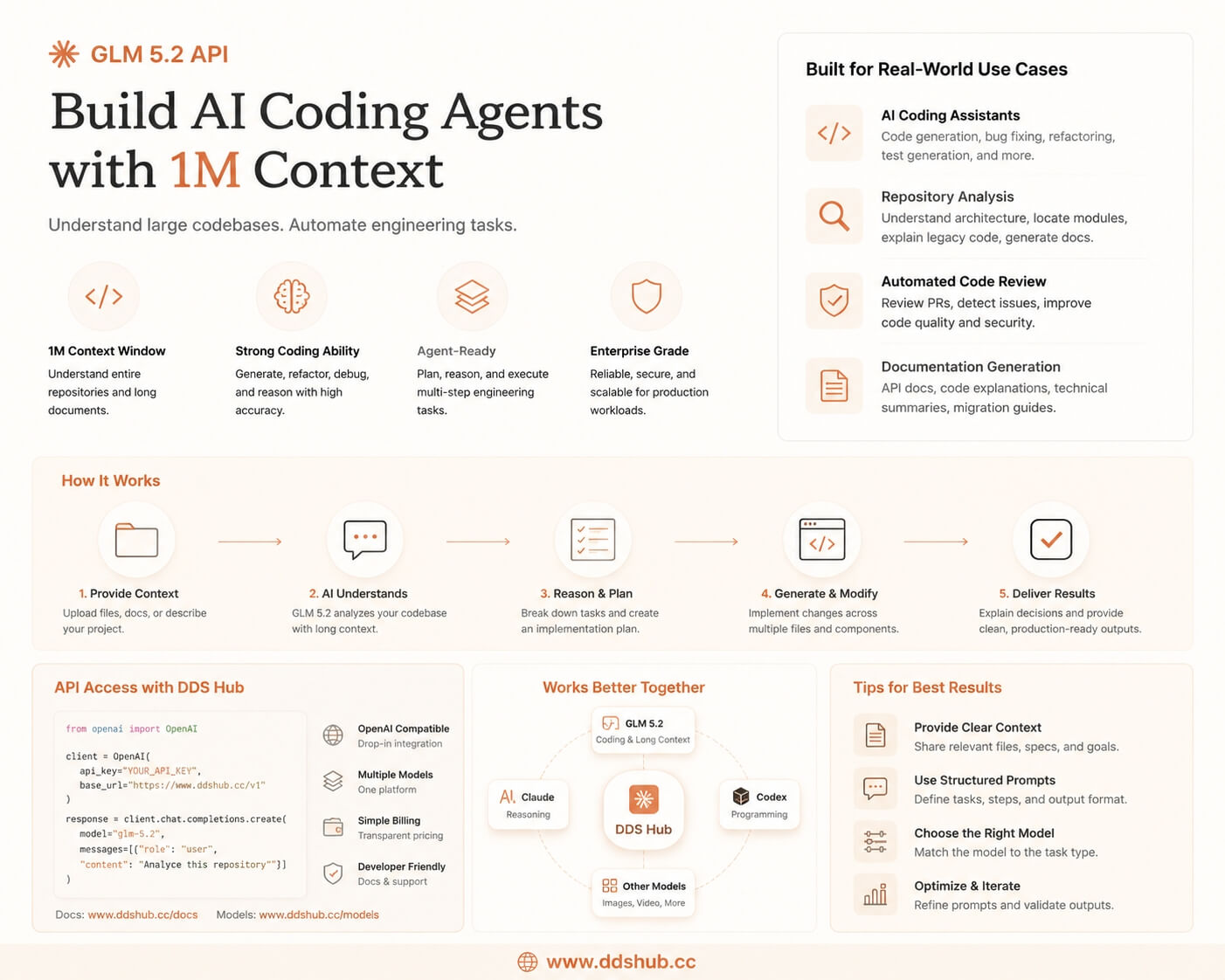
However, these workflows require more than generating short code snippets. AI coding agents need strong reasoning ability, large context windows, and the ability to process large amounts of project information.
This is where GLM 5.2 becomes interesting.
Designed for advanced coding and agent-based workflows, GLM 5.2 focuses on long-context understanding, software engineering tasks, and scalable AI development scenarios.
In this guide, we will explore what makes GLM 5.2 different, how developers can use it for AI coding agents, practical use cases, and how to access GLM 5.2 API through DDS Hub.
What Is GLM 5.2?
GLM 5.2 is part of the GLM model family designed for general AI tasks, with a strong focus on coding, reasoning, and enterprise applications.
Unlike traditional chat-based models, modern coding models need to handle much larger amounts of information.
A developer working on a real software project may need an AI assistant to understand:
- Multiple source files
- Project architecture
- Documentation
- Database structures
- API definitions
- Existing code patterns
This requires a model that can maintain context over long conversations and large codebases.
GLM 5.2 is designed for these scenarios, making it suitable for AI coding assistants and agent workflows.
Why Long Context Matters for AI Coding
One of the biggest challenges in AI programming is context limitation.
A small coding task may only require a few lines of context.
However, real engineering tasks often involve:
- Thousands of files
- Large repositories
- Complex dependencies
- Long technical documents
A model with a larger context window can analyze more project information before generating suggestions.
This enables more advanced use cases such as:
- Repository-level understanding
- Large-scale refactoring
- Debugging across multiple files
- Architecture recommendations
For AI coding agents, context length is not just a technical specification. It directly affects how much of the project the model can understand.
GLM 5.2 for AI Coding Agents
AI coding agents represent the next stage of developer productivity.
Instead of asking:
"Write a function."
Developers can ask:
"Analyze this repository, identify performance issues, and improve the architecture."
This requires an AI model that can:
- Understand existing code
- Reason about changes
- Generate implementation plans
- Modify multiple components
- Explain technical decisions
GLM 5.2 can support these workflows by providing stronger context understanding and coding capabilities.
Real-World GLM 5.2 API Use Cases
1. AI Coding Assistants
The most obvious application is building AI coding assistants.
Examples:
- Code generation
- Bug fixing
- Code explanation
- Refactoring suggestions
- Test generation
A developer can provide project context and allow the AI assistant to help throughout the development process.
2. Repository Analysis
Large companies often have years of accumulated code.
Understanding an unfamiliar codebase can take weeks.
AI agents powered by long-context models can help developers:
- Understand architecture
- Locate important modules
- Explain legacy code
- Generate documentation
This is especially useful for enterprise software projects.
3. Automated Code Review
AI-powered code review systems can analyze:
- Pull requests
- Security issues
- Code quality
- Potential bugs
Instead of only checking syntax, advanced models can evaluate whether changes make sense within the broader application.
4. Developer Documentation Generation
Many software projects suffer from incomplete documentation.
GLM 5.2-powered tools can automatically generate:
- API documentation
- Code explanations
- Technical summaries
- Migration guides
This helps teams maintain better engineering knowledge.
GLM 5.2 vs Traditional Coding Assistants
Traditional autocomplete tools focus mainly on predicting the next line of code.
Modern AI coding agents are different.
They focus on:
- Understanding intent
- Reasoning about systems
- Planning solutions
- Executing multi-step tasks
This requires stronger models with:
- Better reasoning
- Larger context windows
- Improved code understanding
GLM 5.2 fits this new generation of AI-assisted development.
How to Use GLM 5.2 API with DDS Hub
DDS Hub provides API access to GLM models through an OpenAI-compatible interface.
Developers can integrate GLM 5.2 into existing applications using familiar API formats.
Base URL:
https://www.ddshub.cc/v1Model:
glm-5.2Example:
from openai import OpenAI

client = OpenAI(
    api_key="YOUR_API_KEY",
    base_url="https://www.ddshub.cc/v1"
)

response = client.chat.completions.create(
    model="glm-5.2",
    messages=[
        {
            "role": "user",
            "content": "Analyze this repository and explain the architecture."
        }
    ]
)

print(response.choices[0].message.content)
Documentation is available in the DDS Hub API Docs and the DDS Hub Models page.
Why Developers Use GLM 5.2 Through DDS Hub
Building AI applications often requires multiple models.
A modern development workflow may combine:
- GLM 5.2 for cost-efficient coding tasks
- Claude models for complex reasoning
- Codex models for programming workflows
Managing multiple providers separately can increase complexity.
DDS Hub provides:
- Unified API access
- Simplified billing
- Multiple AI models in one platform
- Easier integration for developers
This allows teams to experiment with different models and choose the best option for each task.
Optimizing GLM 5.2 API Usage
Using a powerful coding model does not mean every request needs maximum resources.
Developers can improve efficiency by:
Providing Clear Context
Instead of sending unnecessary files, provide:
- Relevant source code
- Required specifications
- Expected output format
Using Structured Prompts
Example:
You are a senior software engineer.

Task:
Review this authentication module.

Goals:
1. Identify security issues.
2. Suggest improvements.
3. Provide updated code examples.
Clear instructions help the model produce more useful responses.
Combining Models Strategically
Different models have different strengths.
For example:
- Large reasoning tasks → advanced reasoning models
- Routine coding → efficient coding models
- Image generation → image models
Using the right model for each task improves both performance and cost efficiency.
The Future of AI Coding with Long Context Models
Software development is becoming increasingly collaborative between humans and AI.
Future coding assistants will not only generate code but also understand entire software systems, maintain projects, and assist with complex engineering decisions.
Models with large context windows and strong coding abilities will become an important foundation for these workflows.
GLM 5.2 represents this transition from simple AI autocomplete toward more capable AI engineering assistants.
Final Thoughts
GLM 5.2 provides developers with a powerful option for building AI coding assistants, repository analysis tools, and automation systems.
Its focus on coding capability and long-context understanding makes it suitable for modern software development workflows where AI needs to understand more than a single code snippet.
For developers building AI-powered products, accessing GLM 5.2 through an API platform like DDS Hub provides a practical way to integrate advanced coding intelligence while maintaining flexibility across different AI models.
As AI coding continues to evolve, choosing the right model strategy will become just as important as choosing the right development tools.