
DeepSeek V4 Pro 0813 vs Kimi K3 vs GLM 5.2: Which AI Coding Model Is Best?
The AI coding model market has become much more competitive in 2026. Developers no longer have to choose only between proprietary models such as Claude and GPT. A new generation of open-weight models, including DeepSeek V4 Pro 0813, Kimi K3 and GLM 5.2, is increasingly capable of handling complex software engineering, long-context reasoning and autonomous coding tasks.
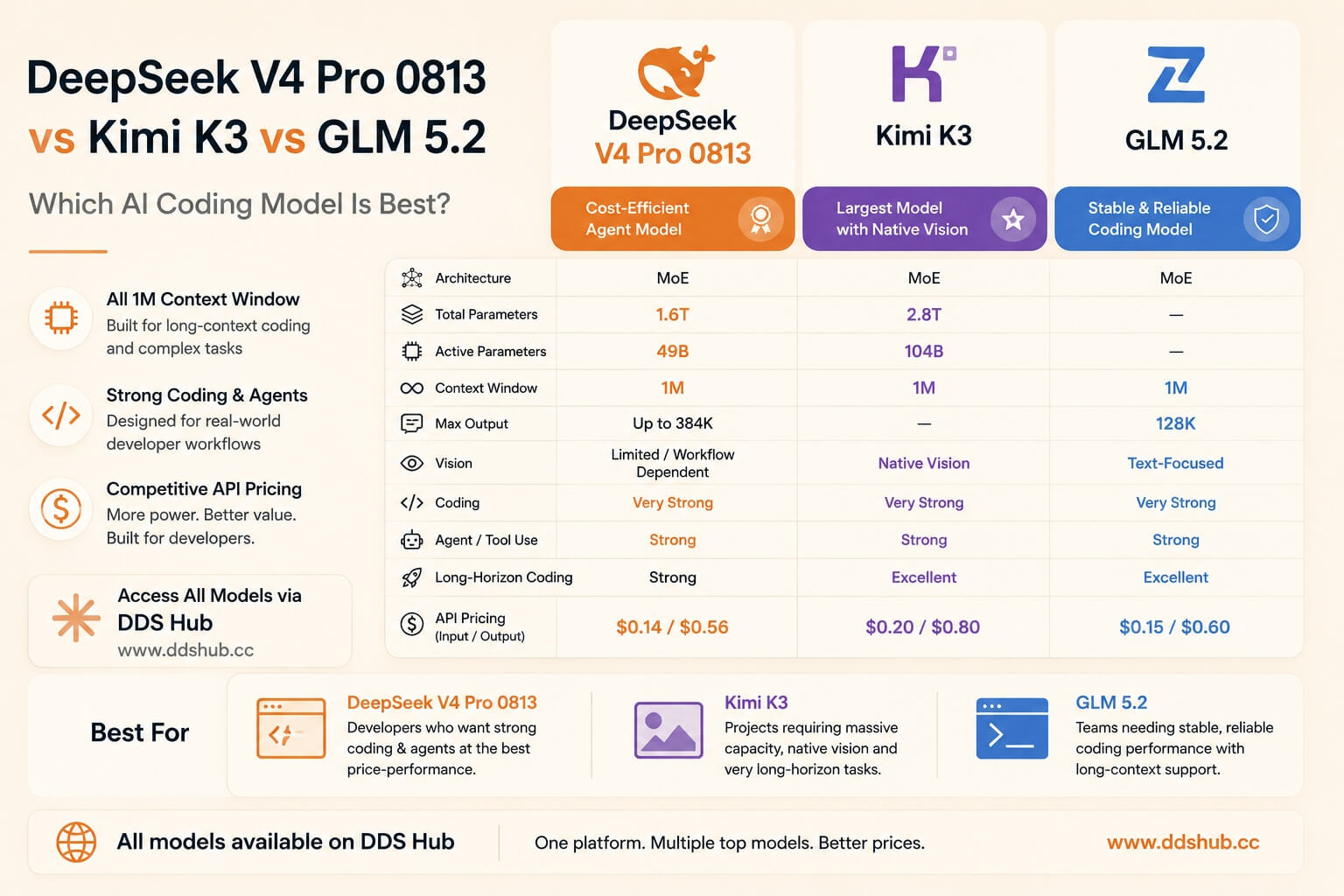
All three models are particularly interesting because they target similar workloads while taking different technical approaches. DeepSeek V4 Pro focuses heavily on reasoning efficiency and agentic coding, Kimi K3 combines a massive 2.8-trillion-parameter architecture with native vision and long-horizon capabilities, while GLM 5.2 emphasizes stable 1M-token context and long-running software engineering tasks.
So which one should developers actually use?
The answer depends less on the headline parameter count and more on the type of work you need the model to complete.
DeepSeek V4 Pro 0813 vs Kimi K3 vs GLM 5.2 at a Glance
| Feature | DeepSeek V4 Pro 0813 | Kimi K3 | GLM 5.2 |
|---|---|---|---|
| Architecture | MoE | MoE | MoE |
| Total Parameters | 1.6T | 2.8T | Not publicly emphasized |
| Active Parameters | 49B | 104B | — |
| Context Window | 1M | 1M | 1M |
| Max Output | Up to 384K | — | 128K |
| Vision | Limited / workflow dependent | Native vision | Text-focused |
| Coding | Very strong | Very strong | Very strong |
| Agent Tasks | Strong | Strong | Strong |
| Long-Horizon Coding | Strong | Excellent | Excellent |
| Open Weights | Yes | Yes | Yes |
| API Availability | Yes | Yes | Yes |
DeepSeek officially describes V4 Pro as a 1.6T-total-parameter, 49B-active MoE model with a 1M context window. Kimi K3 is a 2.8T-parameter MoE model with 104B activated parameters, native vision and a 1M-token context window. GLM 5.2 also provides a 1M context window and up to 128K output tokens, with a strong focus on long-running coding-agent workloads.
The first important conclusion is therefore quite simple: all three models are designed for large-context, complex workloads rather than basic chatbot use.
DeepSeek V4 Pro 0813: The Cost-Efficient Agent Model
DeepSeek V4 Pro 0813 is the newest model in this comparison and arguably the most interesting from a price-to-capability perspective.
The model uses a 1.6T-parameter MoE architecture with 49B active parameters and a 1M-token context window. DeepSeek has also specifically optimized V4 for agentic coding and integration with tools such as Claude Code, OpenCode and other coding environments.
The 0813 release is particularly notable because DeepSeek has moved V4 Pro from preview status into the official model line while improving its agent benchmarks.
Independent evaluations show a more nuanced picture. Artificial Analysis gives the 0813 model an Intelligence Index score around 53, significantly above V4 Flash's 40, although it remains behind the strongest proprietary models. Reuters also reports that DeepSeek V4 Pro improved substantially over the preview version and is now available through the API, web and app.
This means DeepSeek V4 Pro is not necessarily the universal winner in raw intelligence. Its strength is the combination of strong reasoning, coding capability, long context and extremely competitive inference economics.
For developers running large numbers of coding or agent requests, that combination can be more important than winning every benchmark.
Kimi K3: The Largest Model in the Comparison
Kimi K3 takes a very different approach.
With 2.8 trillion total parameters and 104 billion activated parameters, K3 is substantially larger than DeepSeek V4 Pro. It also supports native visual understanding and a 1M-token context window. Moonshot describes K3 as a frontier model designed for long-horizon coding, knowledge work, reasoning and agentic workflows.
The architecture is also different. Kimi K3 uses Kimi Delta Attention (KDA) together with Attention Residuals and Stable LatentMoE. Moonshot says these techniques improve scaling efficiency while allowing the model to operate at trillion-parameter scale.
K3 has received particularly strong attention in coding-related evaluations. Reuters reported that the model was competitive with leading US models in advanced reasoning and long-horizon coding, while independent coverage highlighted its strong performance in frontend coding.
K3 also has an interesting advantage over the other two models in this comparison: native vision.
For developers building agents that need to understand screenshots, UI layouts, diagrams, logs or visual references alongside source code, this can make K3 particularly attractive.
GLM 5.2: Built Around Long-Horizon Software Engineering
GLM 5.2 takes a somewhat different position.
Instead of emphasizing the largest possible parameter count, Zhipu focuses heavily on long-horizon engineering reliability.
The official GLM 5.2 documentation describes the model as a flagship foundation model for long-running tasks, with a 1M context window, 128K maximum output, function calling, structured output and multiple reasoning modes.
This is particularly relevant for coding agents.
According to Zhipu's published evaluation, GLM 5.2 sits between Claude Opus 4.7 and Opus 4.8 on several long-horizon software engineering benchmarks. On FrontierSWE, Zhipu reports that GLM 5.2 trails Opus 4.8 by approximately 1%, while outperforming GPT-5.5 and Opus 4.7 in the same evaluation.
These are vendor-reported results, so they should not be treated as an independent ranking. Nevertheless, they highlight what GLM 5.2 is optimized for: large repositories, long-running engineering tasks and end-to-end delivery.
The official documentation even describes workflows in which GLM 5.2 can independently handle requirements analysis, architecture design, frontend and backend implementation, testing, debugging and deployment across a single long-running task.
Coding Performance: Which Model Is Actually Better?
This is where the comparison becomes more interesting.
DeepSeek V4 Pro 0813 is particularly attractive when the priority is cost-efficient reasoning and agent execution. Its published results show strong performance on coding and terminal-oriented benchmarks, while independent evaluations indicate that it offers an unusually strong capability-to-cost ratio.
Kimi K3 appears particularly strong in complex coding, frontend development and long-horizon agent tasks. Its 2.8T architecture and 1M context provide a substantial foundation, while its native vision capability gives it an advantage for workflows involving screenshots and visual interfaces.
GLM 5.2 is especially interesting for developers who care about long-running repository-level engineering. Its official benchmark claims put it close to Claude Opus 4.8 on FrontierSWE, while its tooling support includes function calling, streaming tool calls, structured output and adjustable reasoning effort.
In practical terms, there is no obvious winner across every category.
A developer working primarily with backend repositories may prefer one model, while a frontend engineer working heavily with screenshots may benefit more from Kimi K3. Someone building a long-running coding agent may find GLM 5.2 particularly attractive, while a team optimizing the cost of thousands of agent tasks may prefer DeepSeek V4 Pro.
Long Context: All Three Models Are Competitive
One of the easiest comparisons is also one of the least useful.
All three models provide approximately 1M-token context, so context length alone does not differentiate them very much.
The real question is how effectively each model uses that context.
A million-token context can contain a huge software repository, but simply being able to ingest the repository does not guarantee that the model will correctly identify the relevant files, maintain architectural consistency or remember important requirements after many tool calls.
This is why long-horizon benchmarks are becoming more important.
GLM 5.2 explicitly focuses on context stability and reducing goal drift during long tasks. DeepSeek has introduced attention mechanisms designed to make 1M-token inference more efficient. Kimi K3 uses KDA and related architectural techniques to improve information processing at large context lengths.
For real-world coding, effective context utilization matters more than the advertised context window.
API Pricing: The Cost Difference Matters
Pricing is one of the biggest reasons developers are interested in these models.
DeepSeek V4 Pro's newly announced pricing is $1.32 per million input tokens and $3.96 per million output tokens during peak pricing, with lower off-peak pricing. DeepSeek's new pricing structure is scheduled to take effect in August 2026.
Kimi K3's commonly listed API pricing is around $3 per million cache-miss input tokens and $15 per million output tokens, with significantly cheaper cached input.
For GLM 5.2, Zhipu's official API pricing is ¥8 per million input tokens and ¥28 per million output tokens, with cache-hit pricing of ¥2 per million tokens.
| Model | Input | Output | Context |
|---|---|---|---|
| DeepSeek V4 Pro 0813 | $1.32/M (peak) | $3.96/M (peak) | 1M |
| Kimi K3 | ~$3/M | ~$15/M | 1M |
| GLM 5.2 | ¥8/M | ¥28/M | 1M |
Note: the DeepSeek figures are peak pricing; off-peak rates are lower. Pricing schedules can change, so developers should verify the provider's current pricing before production deployment.
This is where DeepSeek has a clear advantage in raw API economics.
However, token price should not be confused with cost per successful task.
A model that costs twice as much per million tokens but completes a complex engineering task in half as many attempts may ultimately be cheaper. For coding agents, success rate, output length, retries, tool calls and caching can all have a greater effect on the final bill than the headline input price.
Which Model Should Developers Choose?
If your priority is maximum cost efficiency, DeepSeek V4 Pro 0813 is extremely compelling. Its combination of 1M context, strong reasoning and agent capabilities makes it a natural candidate for high-volume coding and automation workloads.
If you need advanced coding plus visual understanding, Kimi K3 deserves serious consideration. Its native vision capability and strong long-horizon coding performance make it particularly interesting for frontend development, UI agents and multimodal engineering workflows.
If your focus is long-running software engineering, GLM 5.2 is one of the strongest open-weight options available. Its 1M context and emphasis on project-level engineering make it well suited to large repositories and autonomous coding workflows.
There is also a fourth option: use all three.
Modern AI applications increasingly benefit from model routing. A platform can use DeepSeek for cost-sensitive tasks, Kimi for visual or complex coding workflows, and GLM for long-running engineering tasks. This approach avoids forcing every request through the same expensive model.
Use Kimi K3 and GLM 5.2 at 20% Off with DDS Hub
For developers who want to compare these models through APIs, managing multiple providers can quickly become inconvenient. Different API endpoints, billing systems, authentication methods and pricing models create additional operational overhead.
This is where DDS Hub provides a practical alternative.
DDS Hub currently offers Kimi K3 and GLM 5.2 at 20% off the standard API price, allowing developers to test and deploy these models at a lower cost. The platform also provides access to other popular models, including Claude and Codex, making it easier to compare different coding models without building separate integrations for every provider.
For example, a development team could use Kimi K3 for visual frontend tasks, GLM 5.2 for long-running repository work, and Claude or Codex for other coding workflows. This type of multi-model setup can be more flexible than committing the entire development stack to a single provider.
Explore Kimi K3, GLM 5.2 and other models on DDS Hub
The 20% discount on Kimi K3 and GLM 5.2 is especially useful for developers who want to benchmark models using their own repositories rather than relying exclusively on public benchmark scores.
Final Verdict: DeepSeek V4 Pro vs Kimi K3 vs GLM 5.2
DeepSeek V4 Pro 0813, Kimi K3 and GLM 5.2 represent three different approaches to the same emerging market: powerful, open-weight AI models designed for coding, reasoning and agents.
DeepSeek V4 Pro 0813 stands out for its cost-performance ratio and efficient agentic inference. Its 1.6T-parameter architecture, 49B active parameters and 1M context make it a powerful choice for developers who need large-scale AI coding without paying frontier-model prices.
Kimi K3 pushes model scale much further, reaching 2.8T total parameters and 104B active parameters. Its native vision capabilities and strong coding performance make it particularly interesting for multimodal development and long-horizon engineering.
GLM 5.2 focuses heavily on long-running engineering reliability. Its 1M context, strong coding benchmarks and extensive coding-agent support make it a compelling option for developers working with large repositories and complex software projects.
There is no single model that wins every workload.
The more useful question for developers is whether a model can complete the task reliably, quickly and at a reasonable cost.
That is also why multi-model API platforms are becoming increasingly important. With access to DeepSeek, Kimi, GLM, Claude and Codex, developers can choose the right model for the right task instead of treating model selection as a permanent decision.
For developers looking to compare DeepSeek V4 Pro 0813, Kimi K3 and GLM 5.2 through APIs, DDS Hub provides a convenient starting point, with Kimi K3 and GLM 5.2 currently available at 20% off.
Visit DDS Hub and compare available AI models
FAQ
Which model is best for AI coding: DeepSeek V4 Pro 0813, Kimi K3 or GLM 5.2?
There is no single winner. DeepSeek V4 Pro 0813 offers the best cost-to-capability ratio for high-volume coding and agent workloads, Kimi K3 is strongest for complex and frontend coding thanks to its native vision, and GLM 5.2 is optimized for long-running, repository-level software engineering.
Which of these models has the largest context window?
All three provide approximately 1M tokens of context. Because context length is effectively the same, effective context utilization matters more than the advertised window.
Which model is the cheapest per token?
DeepSeek V4 Pro 0813 has the lowest listed token price at $1.32 per million input tokens and $3.96 per million output tokens during peak hours, with lower off-peak rates. However, cost per successfully completed task can differ from cost per token.
Does Kimi K3 support image input?
Yes. Kimi K3 supports native visual understanding, which makes it useful for workflows involving screenshots, UI layouts, diagrams and other visual references alongside source code.
Can I access Kimi K3 and GLM 5.2 at a discount?
Yes. DDS Hub currently offers Kimi K3 and GLM 5.2 at 20% off the standard API price, alongside access to other models such as Claude and Codex through a single integration.