
DeepSeek V4 Pro 0813 API: Parameters, Benchmarks, Pricing and Coding Performance
DeepSeek has officially launched the DeepSeek V4 Pro 0813 version, bringing its latest flagship model into general availability and significantly raising the bar for open-weight AI models. The release is particularly interesting for developers because V4 Pro is not simply designed as a general-purpose chatbot. Its architecture, long-context capabilities, coding performance, and agentic tool use make it increasingly relevant to AI coding assistants and autonomous development workflows.
The new model arrives at an important point in the AI market. Developers now have access to a growing number of powerful coding models, including Claude, GPT, Codex, Kimi, GLM and DeepSeek. The question is no longer simply which model is the most powerful. For API users, the more practical question is which model provides the best combination of reasoning capability, coding performance, context length, latency and API cost.
DeepSeek V4 Pro 0813 is particularly interesting because it combines an enormous 1.6-trillion-parameter architecture with only 49 billion activated parameters per token and a one-million-token context window.
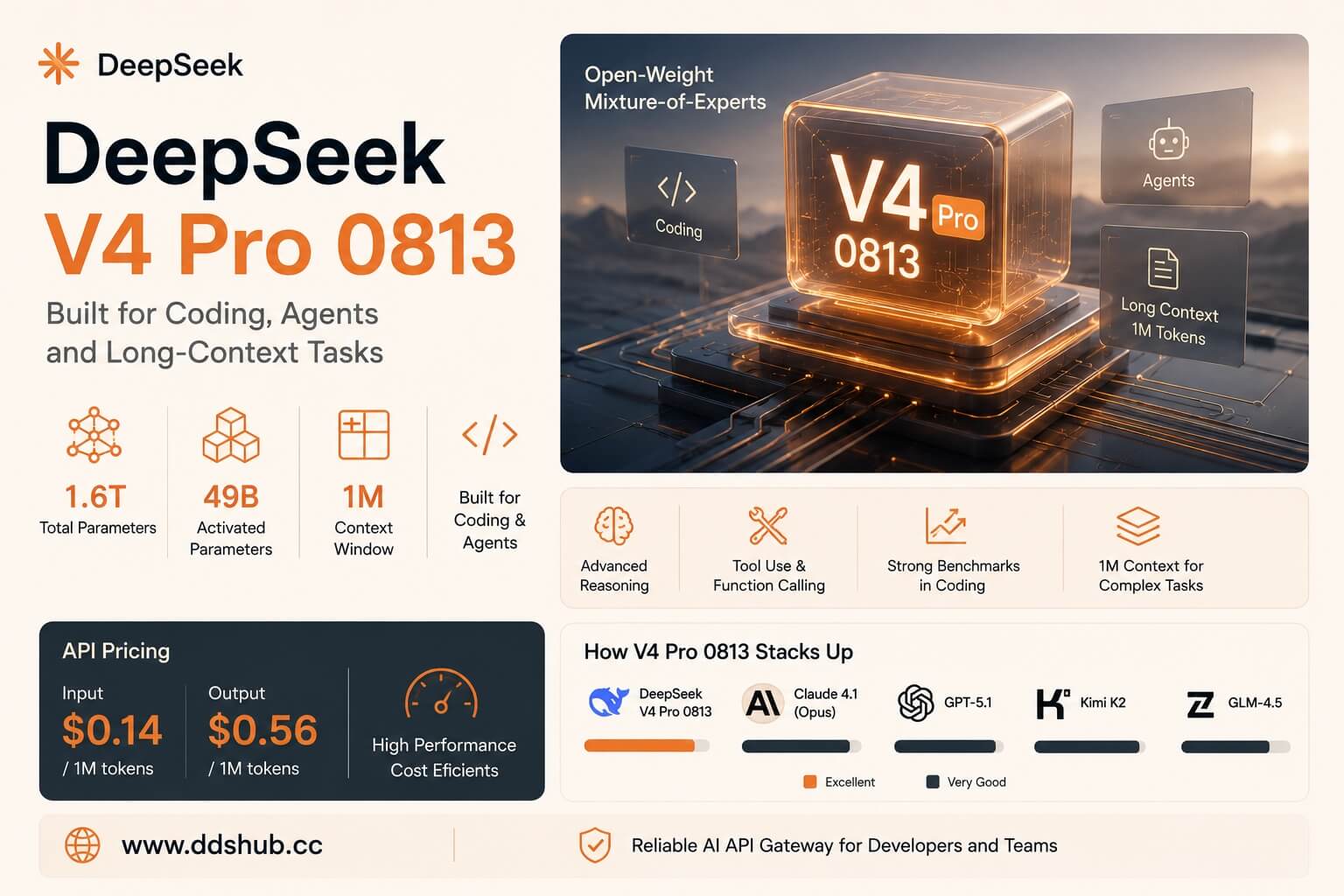
DeepSeek V4 Pro 0813 Parameters and Architecture
DeepSeek V4 Pro uses a Mixture-of-Experts (MoE) architecture with approximately 1.6 trillion total parameters and 49 billion activated parameters. It supports a 1-million-token context window, placing it among the models designed specifically for very large documents, repositories and long-running agent sessions.
| Specification | DeepSeek V4 Pro |
|---|---|
| Architecture | Mixture of Experts |
| Total Parameters | 1.6T |
| Activated Parameters | 49B |
| Context Window | 1M tokens |
| Model Type | Open-weight |
| Reasoning | Non-Think / Think / Max |
| Primary Use Cases | Coding, reasoning, agents, long-context tasks |
The distinction between total and activated parameters is important. A 1.6T-parameter model does not mean that the entire 1.6T parameter set is used for every token. The MoE architecture activates a smaller subset of experts during inference, allowing DeepSeek to build a much larger overall model while keeping the computation required for each token significantly lower than a comparable dense model.
DeepSeek also introduced architectural improvements including Compressed Sparse Attention (CSA) and Heavily Compressed Attention (HCA) to improve the efficiency of million-token contexts. According to DeepSeek's technical report, V4 Pro requires substantially less inference FLOPs and KV-cache memory than DeepSeek V3.2 under the 1M-token setting.
This matters particularly for AI agents. Long-running agents frequently accumulate source code, tool results, documentation and previous actions. A large context window is therefore not merely a marketing number; it can directly affect how much information an agent can maintain during a complex task.
What Makes the 0813 Version Important?
The most interesting part of V4 Pro is not the parameter count. It is the model's emphasis on agentic coding and tool use.
DeepSeek's V4 documentation highlights enhanced agentic capabilities, world knowledge and reasoning, while the model's benchmark results show strong performance across coding and tool-use evaluations.
The official release also comes with broader API compatibility. Developers can use V4 Pro through DeepSeek's API ecosystem, while the model has increasingly been integrated into modern coding-agent workflows.
This puts DeepSeek in direct competition with models that developers already use for AI coding, including Claude through Claude Code, GPT models through Codex, and Kimi and GLM for coding and long-context applications.
The significance of V4 Pro 0813 is therefore that DeepSeek is no longer positioning itself only as a low-cost alternative. It is trying to compete at the agent and engineering workflow level.
DeepSeek V4 Pro Coding Performance
The published benchmark results show that V4 Pro is particularly strong in coding and reasoning.
In the maximum reasoning configuration, V4 Pro reports a 93.5 score on LiveCodeBench, a 3206 Codeforces rating, and 80.6% on SWE-bench Verified. It also reaches 67.9% on Terminal-Bench 2.0, which is particularly relevant for developers evaluating models in tool-driven environments.
| Benchmark | DeepSeek V4 Pro Max |
|---|---|
| MMLU-Pro | 87.5 |
| GPQA Diamond | 90.1 |
| LiveCodeBench | 93.5 |
| Codeforces | 3206 |
| SWE-bench Verified | 80.6% |
| Terminal-Bench 2.0 | 67.9% |
| MRCR 1M | 83.5 |
These results should still be interpreted carefully. Benchmarks are useful for understanding the general capability of a model, but they do not guarantee identical performance on a developer's real repository.
Agent benchmarks depend heavily on the model configuration, reasoning budget, tools, prompts, environment and harness. An 80.6% SWE-bench score does not mean that every real-world software engineering task will be solved with the same success rate.
However, the overall pattern is significant: V4 Pro is competitive not only in traditional reasoning benchmarks but also in software engineering, terminal interaction and long-context tasks.
Why the 1M Context Window Matters for Coding
Large context is particularly useful when an AI coding agent needs to understand a complex repository.
Imagine a project containing thousands of source files, extensive documentation, configuration files, test suites and historical implementation details. A model with a small context window may need to repeatedly retrieve and discard information, increasing the chance of losing important architectural details.
V4 Pro's 1M-token context provides considerably more room for repository-level reasoning.
This makes the model interesting for tasks such as large-scale refactoring, repository analysis, debugging complex dependencies, reviewing large pull requests and working with long technical documentation.
The technical design of V4 also specifically targets the efficiency problem of long context. DeepSeek's documentation reports that its hybrid attention architecture can substantially reduce the computational and memory requirements of 1M-token inference compared with its previous generation.
For AI coding agents, this may ultimately be more important than simply increasing the raw parameter count.
DeepSeek V4 Pro API Pricing
Pricing is one area where the V4 Pro story has changed significantly.
DeepSeek announced a new pricing structure for its V4 models that introduces different peak and off-peak rates. The new pricing is scheduled to take effect on August 17, 2026. Reuters reports that V4 Pro will cost up to $1.32 per million input tokens and $3.96 per million output tokens during peak pricing, making it considerably more expensive than V4 Flash.
This is an important development because DeepSeek's reputation has historically been closely associated with extremely low API prices.
The new pricing does not necessarily make V4 Pro expensive compared with every competing frontier model. Instead, it suggests that DeepSeek is moving toward a more conventional commercial model in which advanced reasoning and agent capabilities carry a premium.
For developers, this means that price per million tokens should not be the only metric.
A better question is how much it costs to complete an actual task.
If one model requires five attempts to complete a coding task while another completes it in two, the cheaper token price does not necessarily translate into a cheaper production workflow.
DeepSeek V4 Pro vs Claude, GPT, Kimi and GLM
The AI coding market is becoming increasingly multi-model.
Claude remains particularly attractive for developers who rely on Claude Code and want strong repository-level coding and reasoning. GPT models have a broad ecosystem around Codex, tool calling and general-purpose agent workflows. Kimi has become an important option for long-context and Chinese-language workloads, while GLM offers another competitive choice for developers looking for cost-effective reasoning and coding models.
DeepSeek V4 Pro occupies an interesting position between these models.
| Model | Strongest Use Cases | Main Advantage |
|---|---|---|
| DeepSeek V4 Pro | Coding agents, long-context reasoning | Open-weight + strong coding + 1M context |
| Claude | Complex coding and agent workflows | Strong coding ecosystem |
| GPT / Codex | General reasoning and software engineering | Broad agent and tool ecosystem |
| Kimi | Long-context and Chinese workloads | Strong context and cost-performance |
| GLM | Coding and cost-sensitive applications | Competitive pricing and Chinese-language capability |
Rather than asking which model is universally better, developers should consider using different models for different workloads.
A complex architecture task might justify a frontier model such as Claude or GPT. A long-context repository analysis might be a strong use case for V4 Pro. A Chinese-language workflow could benefit from Kimi or GLM. High-volume tasks may be routed to a lower-cost model.
This is why multi-model API platforms are becoming increasingly relevant.
DeepSeek V4 Pro for AI Coding Agents
V4 Pro's strongest use case may ultimately be AI agents rather than traditional chat applications.
A coding agent needs to understand requirements, inspect files, call tools, modify code, run tests, analyze failures and continue iterating. The model therefore needs more than strong text generation. It needs reasoning, context retention and reliable tool interaction.
DeepSeek has explicitly emphasized agentic coding in the V4 release, and independent analysis of the model also highlights its suitability for long-running agent workloads. Hugging Face's analysis of V4 describes the million-token context as particularly relevant to agents because long-running coding sessions can otherwise run into context and memory limitations.
This makes V4 Pro worth evaluating alongside Claude Code and Codex for developers building autonomous coding workflows.
The important point is that model performance and agent performance are not exactly the same thing. The surrounding harness, tools and prompts can have a significant effect on the final result.
Where DDS Hub Fits Into the DeepSeek V4 Pro Ecosystem
For developers experimenting with multiple AI coding models, managing separate API providers can quickly become inconvenient. Each provider may have a different API format, billing system, model naming convention and account structure.
This is one reason DDS Hub provides a multi-model API platform covering models such as Claude, Codex, GLM and Kimi.
Instead of committing an entire application to one model, developers can compare models according to actual workload, API price and performance. Claude can handle one class of coding tasks, Codex another, while GLM and Kimi can provide additional alternatives for cost-sensitive or Chinese-language applications.
DeepSeek V4 Pro 0813 is a natural addition to this multi-model strategy because of its combination of long context, coding performance and agentic capabilities.
DDS Hub is preparing DeepSeek V4 Pro API access, with discounted pricing planned once the model is officially available on the platform.
This means developers who already use DDS Hub for Claude, Codex, GLM or Kimi can eventually evaluate DeepSeek V4 Pro without having to redesign their entire API workflow around another provider.
For developers building AI applications, coding assistants or agent platforms, DDS Hub provides a unified way to experiment with multiple AI models and select the model that makes the most sense for each workload.
Is DeepSeek V4 Pro 0813 Worth Trying?
For developers interested in AI coding, the answer is yes.
The model combines an unusually large 1.6T-parameter MoE architecture with 49B active parameters, a 1M-token context window, strong published coding benchmarks and a clear focus on agentic workflows.
The main question is not whether V4 Pro is capable. The benchmark results make it clear that it is a serious frontier-level contender.
The more interesting question is whether its performance justifies its API cost for a particular workload, especially after DeepSeek's August pricing changes.
For developers building AI coding agents, the best strategy may be to benchmark V4 Pro against Claude, GPT, Kimi and GLM using real tasks rather than relying exclusively on public benchmark scores.
A model that delivers the best cost per successfully completed task may be more valuable than the model with the highest benchmark score.
Final Thoughts
DeepSeek V4 Pro 0813 represents a significant step in the evolution of open-weight AI models.
Its 1.6T total parameters, 49B activated parameters and 1M-token context window give it a substantial technical foundation, while its coding and agent benchmarks demonstrate that the model is designed for much more than conventional chat.
The introduction of higher API pricing also signals a change in the market. DeepSeek is no longer competing purely through extremely cheap inference. V4 Pro is increasingly competing on the combination of capability, long-context performance, coding and agentic workflows.
For developers, this creates more choices.
Claude remains a strong option for advanced coding workflows. GPT and Codex provide a broad agent ecosystem. Kimi and GLM offer competitive alternatives for specific workloads. DeepSeek V4 Pro now adds another serious option, particularly for developers who care about long context, coding agents and open-weight models.
The most practical strategy may therefore be a multi-model one.
Instead of asking "Which AI model is the best?", developers should ask:
"Which model gives me the best result for this task at an acceptable cost?"
As DeepSeek V4 Pro 0813 becomes more widely available through APIs and third-party platforms, that comparison is likely to become one of the most interesting parts of the AI coding market in 2026.