
Claude API vs Codex API vs Kimi K3 API: Which Coding Model Is Worth Your Money?
AI coding has changed from simple autocomplete into a complete software engineering workflow.
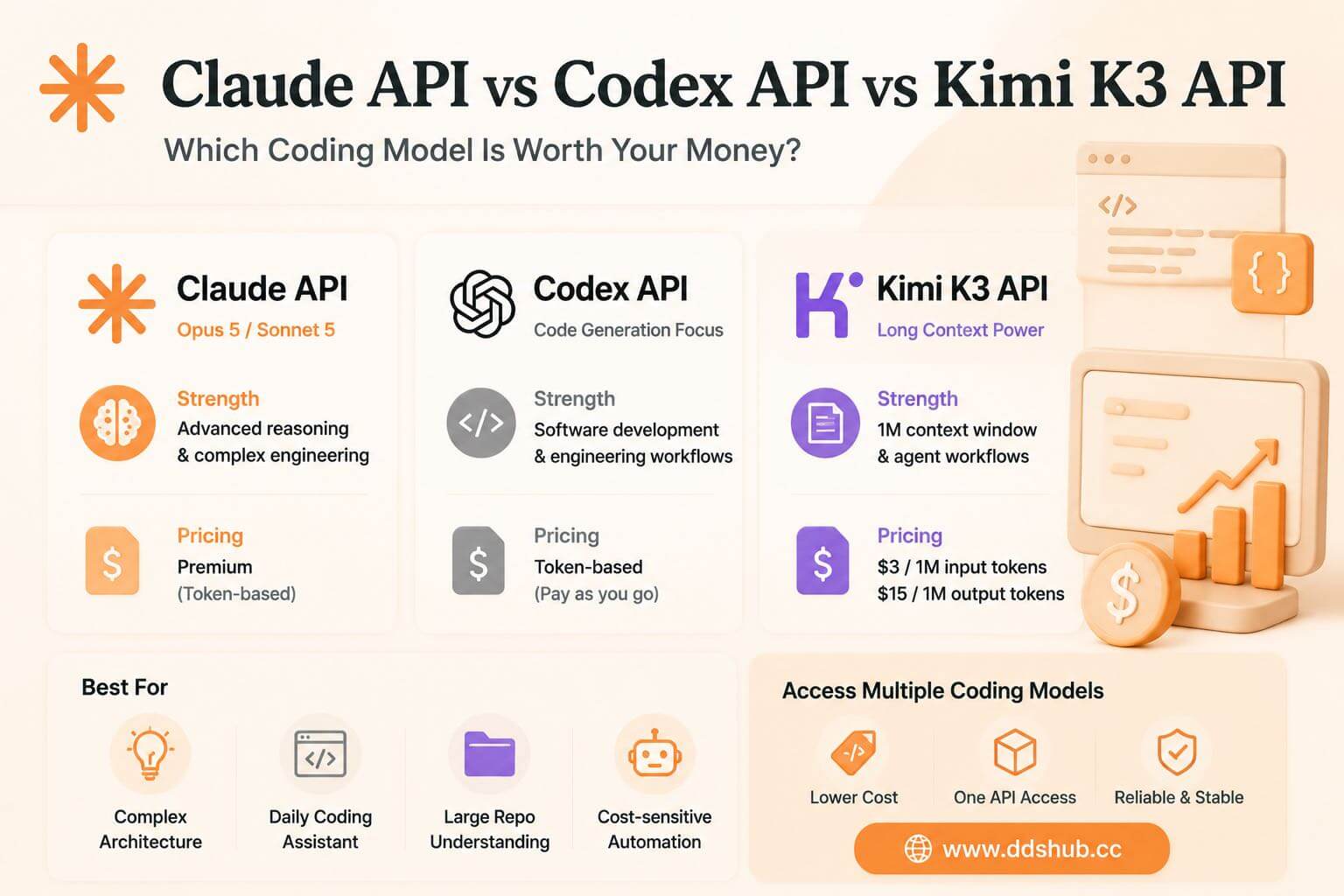
Developers today use AI models to understand repositories, generate production code, review pull requests, debug complex systems, and power autonomous coding agents. However, as AI coding applications become more advanced, API cost has become one of the biggest challenges.
A coding agent does not only generate a few lines of code. It may analyze thousands of files, maintain long conversations, execute tools, review changes, and repeatedly refine solutions. These workflows can consume millions of tokens every month.
Because of this, choosing the right coding model is no longer only about benchmark performance. Developers increasingly care about the relationship between coding capability, API pricing, and total cost efficiency.
The key question becomes:
Between Claude API, Codex API, and Kimi K3 API, which coding model provides the best value for developers?
AI Coding API Pricing Comparison
The cost difference between coding models can become significant when applications scale.
The following table compares the public API pricing structure of several popular coding models.
| Model | Input Price (per 1M tokens) | Output Price (per 1M tokens) | Best Scenario |
|---|---|---|---|
| Claude Opus 5 | Premium pricing | Premium pricing | Complex reasoning, architecture |
| Claude Sonnet 5 | Mid-range | Mid-range | General coding assistant |
| Codex | Token-based pricing | Token-based pricing | Code generation and engineering |
| Kimi K3 | $3 | $15 | Long-context coding and agents |
Kimi K3 officially uses token-based pricing, charging approximately $3 per million input tokens, $0.30 per million cached input tokens, and $15 per million output tokens. It also supports a 1 million token context window, making it suitable for large repositories and long-context coding workflows.
Codex usage has also moved toward token-based pricing models through OpenAI's updated Codex rate card, where usage is calculated according to input tokens, cached input tokens, and output tokens.
Anthropic's Claude API follows the same general token-based billing approach, with pricing depending on the selected Claude model.
The important point is that the cheapest token price does not always mean the lowest total cost. Coding agents often spend most of their budget on context processing, tool calls, and repeated iterations.
Claude API: Premium Coding Intelligence for Complex Engineering
Claude has become one of the most popular AI coding models because it performs strongly in reasoning-heavy tasks.
For example, when working on a large software system, developers often need AI to answer questions such as:
"Why does this architecture fail under high traffic?"
"How should this authentication system be redesigned?"
"Which approach creates the most maintainable codebase?"
These problems require more than code generation. They require understanding trade-offs, security implications, and long-term engineering decisions.
Claude is therefore commonly used for:
- Architecture design
- Code review
- Debugging complex issues
- Technical documentation
- AI engineering agents
The downside is that premium reasoning capability usually comes with higher API costs, especially when used continuously inside coding agents.
For teams using Claude heavily, cost optimization becomes essential.
Codex API: Optimized for Software Development Tasks
Codex focuses specifically on software engineering workflows.
Unlike general-purpose AI assistants, coding-focused models are designed around programming tasks such as:
- Writing functions
- Editing files
- Generating tests
- Refactoring code
- Supporting developer tools
For companies building AI coding products, Codex can be an efficient choice because the majority of workloads are directly related to software development.
However, similar to Claude, the final cost depends heavily on how the model is integrated.
A simple code generation request may be inexpensive, while an autonomous coding agent that repeatedly analyzes repositories and executes tools can consume significantly more tokens.
Kimi K3 API: Cost-Effective Long Context Coding
Kimi K3 has become increasingly attractive for developers building coding agents because of its long-context capability.
According to Moonshot AI's technical information, Kimi K3 supports a 1 million token context window and focuses on long-horizon coding, reasoning, and agent workflows.
This creates advantages for scenarios such as:
- Understanding large repositories
- Analyzing enterprise documentation
- Building internal developer assistants
- Running research and coding agents
For example, instead of repeatedly summarizing a large codebase, developers can provide broader context directly to the model.
This capability can reduce engineering complexity and improve the effectiveness of AI coding systems.
Which Coding Model Has the Best Cost Performance?
There is no single winner because different models optimize different parts of the workflow.
| Scenario | Recommended Model |
|---|---|
| Complex architecture decisions | Claude |
| Daily programming assistance | Codex |
| Large repository understanding | Kimi K3 |
| Cost-sensitive automation | GLM |
A professional AI coding platform may combine several models instead of relying on one.
For example:
- A developer asks Kimi K3 to understand a large repository.
- Claude analyzes the architecture.
- Codex generates implementation changes.
- GLM handles repetitive tasks.
This approach reduces the need to pay premium prices for every request.
Why Developers Are Looking for Cheaper Coding APIs
The biggest hidden cost of AI coding is not always the model price.
It is the workflow.
Coding agents consume tokens through:
- Long conversations
- Repository context
- Tool execution
- Multiple reasoning steps
Research on AI agent workloads shows that agent-based coding tasks can consume substantially more tokens than ordinary coding conversations, making cost optimization increasingly important for production systems.
Therefore, developers are increasingly adopting:
- Model routing
- Prompt caching
- Context optimization
- Multi-model API platforms
DDShub: Access Multiple Coding Models Through One API
Managing Claude API, Codex API, Kimi K3 API, and GLM API separately creates additional complexity.
Developers need to maintain different API keys, billing accounts, and integrations.
DDShub provides a unified API platform that supports multiple AI models, including:
- Claude
- Codex
- Kimi K3
- GLM
This allows developers to select the best model for each coding task while keeping one API workflow.
For teams focused on reducing AI infrastructure costs, DDShub provides discounted API access compared with direct official pricing.
Current examples:
| Model | DDShub Pricing |
|---|---|
| Claude API | Starting from approximately 20% of official pricing |
| Kimi K3 API | Approximately 80% of official pricing |
| Codex / GLM | Available through DDShub model groups |
- Website: https://www.ddshub.cc
- Models: https://www.ddshub.cc/models
- Documentation: https://www.ddshub.cc/docs
Final Thoughts
The best coding model is not always the most powerful one.
Claude provides excellent reasoning for complex engineering problems.
Codex offers strong software development capabilities.
Kimi K3 provides strong value for long-context coding and AI agents.
For modern AI applications, the winning strategy is increasingly based on combining multiple models instead of relying on one provider.
Developers who optimize model selection, API pricing, and infrastructure design can build better AI coding systems while keeping operational costs under control.