
Claude vs Codex vs GLM vs Kimi: Which AI Model Should Developers Choose in 2026?
The AI model landscape is changing faster than ever.
A few years ago, developers mainly compared AI models by asking which one could generate better answers. Today, AI models are becoming the foundation of software systems. Developers are using them to build coding assistants, autonomous agents, enterprise automation platforms, and AI-powered products.
This shift has changed the way developers evaluate models.
The strongest model is not always the best choice.
A model that performs extremely well on complex reasoning may not be the most cost-effective choice for processing millions of requests. A model optimized for coding may not be the best option for analyzing large business documents.
In 2026, developers are increasingly choosing models based on specific workloads.
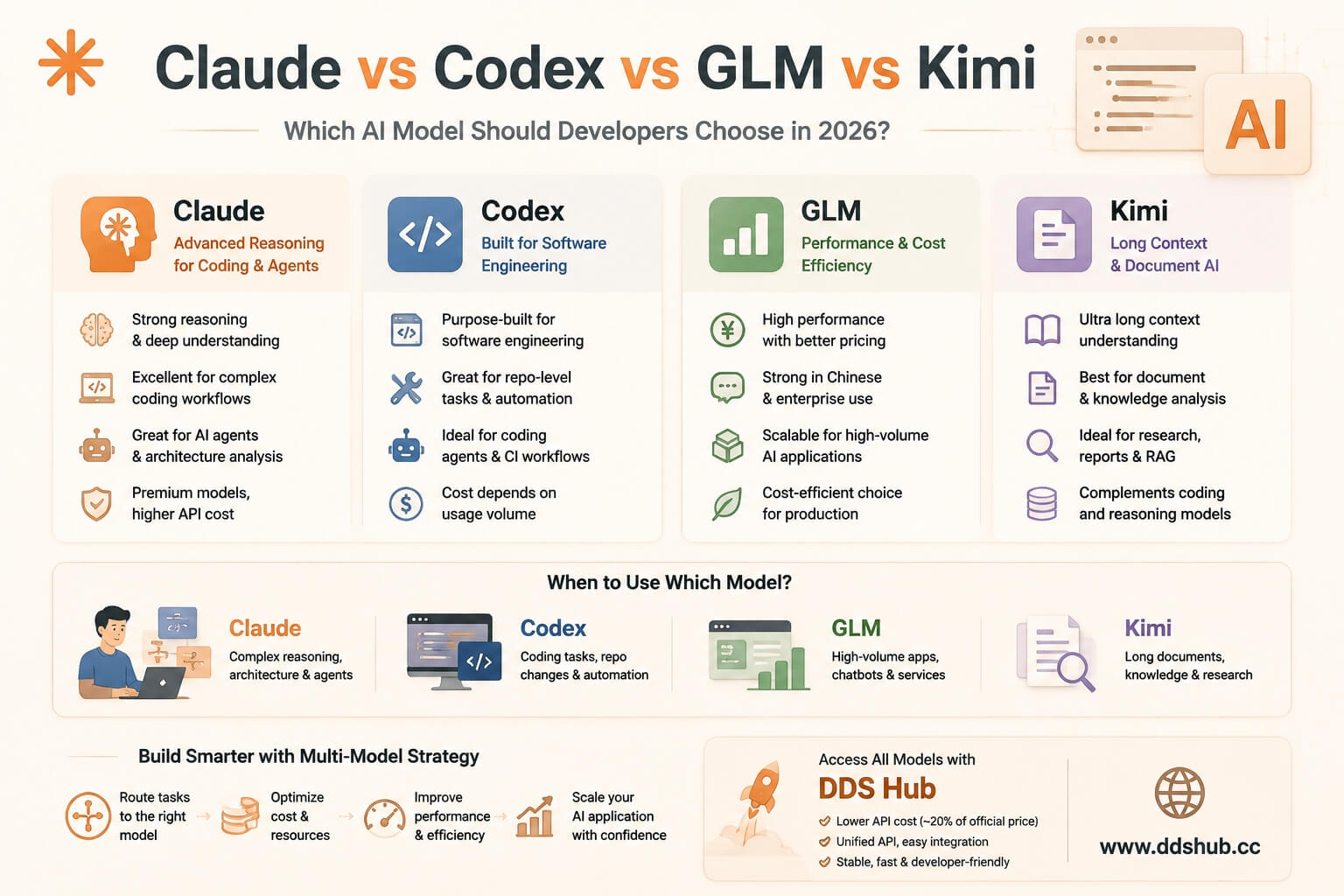
Among the most widely used AI models are Anthropic's Claude, OpenAI's Codex, Z.ai's GLM, and Moonshot AI's Kimi.
Each model has a different strength.
- Claude focuses on reasoning and complex coding workflows.
- Codex focuses on software engineering tasks.
- GLM focuses on efficiency and scalable AI applications.
- Kimi focuses on long-context understanding and document intelligence.
Why Developers Are Moving From Single Models to Multi-Model AI Systems
Early AI applications usually relied on one model.
A company would choose one provider and send every request through the same API.
This approach becomes inefficient as applications grow.
A production AI agent may handle many different tasks. It may need to understand a large codebase, generate code changes, analyze technical documentation, summarize information, and process user requests.
These tasks require different capabilities.
Using a flagship model for every request is similar to using a high-performance server for every small operation. It works, but it increases unnecessary costs.
Modern AI systems are moving toward a model routing approach.
Instead of asking "Which model is the strongest?", developers ask:
"Which model is the best fit for this task?"
Claude: Advanced Reasoning for Coding and AI Agents
Claude has become one of the most popular AI models among developers, especially after the growth of Claude Code.
Official Claude platform: https://www.anthropic.com/api
Claude's biggest advantage is its ability to understand complex context.
For software development, this means Claude can analyze large repositories, understand relationships between different components, and provide higher-level architectural suggestions.
A developer might ask:
"Analyze this repository and explain the authentication system. Identify potential security issues and suggest improvements."
This type of task requires more than code generation. It requires understanding the overall structure of a project.
Claude is especially suitable for AI coding assistants, architecture analysis, and complex agent workflows.
The challenge is cost.
Premium Claude models provide strong capability, but large-scale applications need careful API cost management.
Codex: Designed Around Software Engineering
Codex takes a different approach.
Instead of focusing only on general reasoning, Codex is designed around programming workflows.
For developers, this means Codex is particularly useful when AI needs to directly interact with software projects.
A typical workflow might involve a developer creating a request:
"Add authentication support to this application."
The AI agent analyzes the existing code, modifies relevant files, creates tests, and helps verify the implementation.
This makes Codex a strong choice for AI programming assistants and automated development workflows.
However, autonomous coding introduces a new challenge.
The more independent an AI agent becomes, the more context it needs to process. Repository analysis, debugging cycles, and repeated improvements can quickly increase token usage.
GLM: Balancing Performance and Cost
GLM has become increasingly popular among developers who need strong AI capability while controlling infrastructure costs.
Not every application requires the most expensive reasoning model.
For example, a company operating a customer support platform may process millions of daily requests. Many of these requests do not require advanced reasoning.
A cost-efficient model can handle routine tasks while premium models are reserved for more complex problems.
GLM is particularly attractive for Chinese-language applications, enterprise deployments, and high-volume AI services where cost efficiency is important.
Kimi: Long Context for Knowledge-Heavy Applications
Kimi stands out because of its long-context capability.
Many enterprise AI applications are not limited by reasoning ability. They are limited by how much information the model can process.
Consider an AI system analyzing:
- Large technical documents
- Research materials
- Internal company knowledge
- Product specifications
In these scenarios, understanding large amounts of information is essential.
Kimi is designed for these document-heavy workflows.
Rather than replacing coding-focused models, Kimi works as a strong complement in applications where information retrieval and understanding are the main challenges.
Claude vs Codex vs GLM vs Kimi Comparison
| Category | Claude | Codex | GLM | Kimi |
|---|---|---|---|---|
| Coding | Excellent | Excellent | Good | Good |
| AI Agent | Excellent | Excellent | Good | Good |
| Long Context | Excellent | Good | Good | Excellent |
| Cost Efficiency | Medium | Medium | Excellent | Excellent |
| Enterprise Applications | Excellent | Excellent | Excellent | Good |
The comparison shows an important trend.
There is no single model that dominates every category.
The future of AI development is based on combining models.
Example: Building an AI Coding Agent With Multiple Models
Imagine a company building an AI coding assistant for software teams.
The product allows developers to describe tasks such as:
- "Add a payment system."
- "Improve database performance."
- "Find the cause of this production bug."
At first, the team considers using one powerful model for everything.
However, they discover that different stages of the workflow require different capabilities.
The first stage is understanding the existing project.
The AI agent needs to analyze thousands of lines of code, understand architecture decisions, and identify potential risks. Claude is a strong choice for this reasoning stage.
After the plan is created, the next step is implementation.
The agent needs to modify files, generate functions, and create tests. Codex can handle this programming-focused stage efficiently.
During development, the agent may need to read large amounts of technical documentation. Kimi becomes useful because of its long-context processing ability.
Meanwhile, many smaller tasks happen in the background, such as summarizing logs, classifying issues, and formatting responses. GLM can handle these cost-sensitive workloads.
This type of architecture allows companies to build more capable AI systems while controlling expenses.
AI API Pricing: Why Model Selection Matters
As AI applications move from experiments into production, API cost becomes a major consideration.
The final cost of an AI application is not determined only by the model price.
It also depends on how the model is used.
A system that sends every request to a premium reasoning model will naturally become expensive.
A smarter approach is combining different models based on task complexity.
- Complex reasoning can use Claude.
- Coding workflows can use Codex.
- Large document processing can use Kimi.
- High-volume requests can use GLM.
This allows developers to maintain strong performance while reducing unnecessary API spending.
Building Multi-Model Applications With DDS Hub
Managing several AI providers can become complicated.
Each provider has different APIs, pricing systems, and authentication methods.
DDS Hub provides a unified API platform that allows developers to access multiple AI models through a consistent interface.
Developers can combine Claude, Codex, GLM, and Kimi depending on their application's requirements.
For example, an AI coding platform can use Claude for planning, Codex for implementation, Kimi for documentation analysis, and GLM for high-volume requests.
This approach helps developers build flexible AI systems without maintaining multiple independent integrations.
- DDS Hub: https://www.ddshub.cc
- Models: https://www.ddshub.cc/models
- API: https://www.ddshub.cc/v1
Final Thoughts
Claude, Codex, GLM, and Kimi represent different directions in AI development.
Claude provides advanced reasoning and complex workflow capabilities.
Codex focuses on software engineering.
GLM provides cost-efficient AI infrastructure.
Kimi specializes in long-context understanding.
The future of AI development will not be about finding one perfect model.
Instead, successful AI applications will combine multiple models and use each one where it performs best.
For developers building AI agents, coding assistants, and enterprise applications, choosing the right model strategy is becoming just as important as choosing the model itself.