
Claude vs Codex vs GLM: Which AI Coding Model Should Developers Choose in 2026?
Large language models have evolved from simple chatbots into powerful development tools capable of writing production code, reviewing pull requests, debugging complex systems, and even acting as autonomous coding agents. Today, developers no longer ask whether AI can help them write software — they ask which model is best for their workflow.
Three model families dominate many modern coding discussions:
- Claude by Anthropic
- Codex by OpenAI
- GLM by Zhipu AI
Each model excels in different areas. Claude is known for long-context reasoning and software architecture, Codex is deeply integrated into OpenAI's coding ecosystem, while GLM has become an increasingly capable and affordable choice, especially for developers targeting Chinese-language applications.
Rather than declaring a single winner, this guide explains the strengths, limitations, and ideal use cases of each model so you can choose the right tool for your projects.
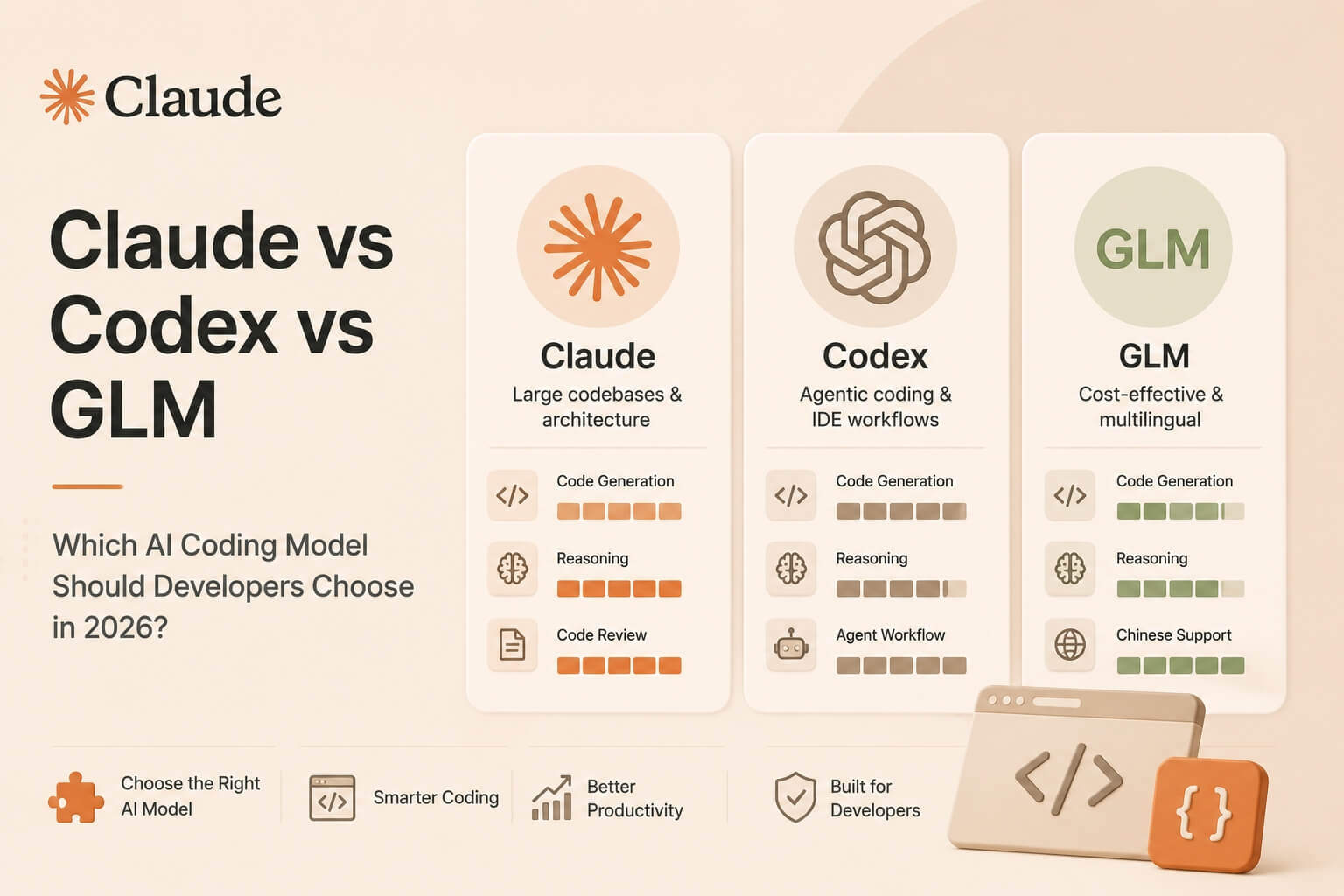
At a Glance
| Feature | Claude | Codex | GLM |
|---|---|---|---|
| Best For | Large codebases & architecture | Agentic coding & IDE workflows | Cost-effective development |
| Long Context | Excellent | Very Good | Good |
| Code Generation | 5/5 | 5/5 | 4.5/5 |
| Code Review | 5/5 | 5/5 | 4/5 |
| Reasoning | 5/5 | 4.5/5 | 4.5/5 |
| Chinese Support | Good | Good | Excellent |
| API Availability | Yes | Yes | Yes |
| OpenAI Compatible | No | Native | Yes (OpenAI-compatible implementations available) |
| Typical Cost | Higher | Medium | Lower |
Claude: Exceptional for Large-Scale Software Engineering
Claude has earned a strong reputation among professional developers because of its ability to understand extremely large codebases and maintain context across long conversations.
Modern Claude models excel at:
- software architecture
- repository analysis
- debugging complex systems
- documentation generation
- code refactoring
- test generation
Anthropic continues to position Claude as a model optimized for reasoning and software engineering. Developers can learn more from the official Anthropic API documentation.
Claude is particularly effective when working with:
- enterprise repositories
- monorepos
- backend services
- infrastructure code
- technical documentation
AI Coding Capability
| Capability | Score |
|---|---|
| Code Generation | 5/5 |
| Debugging | 5/5 |
| Architecture Reasoning | 5/5 |
| Refactoring | 5/5 |
| Documentation | 5/5 |
Codex: Built for AI Coding Agents
Codex has evolved far beyond the original Codex models introduced several years ago. Today's Codex family is designed around agentic software development and integrates tightly with developer tooling in the OpenAI ecosystem.
Official resources: OpenAI Codex.
Codex performs especially well in:
- autonomous coding
- iterative editing
- pull request generation
- repository navigation
- CLI-assisted development
For developers already using OpenAI tooling, Codex often provides a familiar and efficient workflow.
AI Coding Capability
| Capability | Score |
|---|---|
| Code Generation | 5/5 |
| Debugging | 4.5/5 |
| Architecture | 4.5/5 |
| Agent Workflow | 5/5 |
| IDE Integration | 5/5 |
GLM: High Value with Strong Multilingual Performance
GLM has improved rapidly over the past year and is becoming an increasingly attractive option for teams that need capable coding assistance while controlling costs.
Official model information is available from Zhipu AI.
GLM stands out because it offers:
- strong Chinese language understanding
- competitive programming performance
- OpenAI-compatible API support
- lower inference costs
It is particularly suitable for:
- startups
- internal tools
- educational projects
- multilingual applications
AI Coding Capability
| Capability | Score |
|---|---|
| Code Generation | 4.5/5 |
| Debugging | 4/5 |
| Architecture | 4/5 |
| Chinese Coding | 5/5 |
| Cost Efficiency | 5/5 |
Performance Comparison
| Category | Claude | Codex | GLM |
|---|---|---|---|
| Coding | 5/5 | 5/5 | 4.5/5 |
| Long-context Reasoning | 5/5 | 4.5/5 | 4/5 |
| Agent Tasks | 4.5/5 | 5/5 | 4/5 |
| Documentation | 5/5 | 4.5/5 | 4/5 |
| Chinese Understanding | 4/5 | 4/5 | 5/5 |
| API Ecosystem | 5/5 | 5/5 | 5/5 |
| Cost Efficiency | 3.5/5 | 4/5 | 5/5 |
Which Model Should You Choose?
Your choice should depend on your workflow rather than benchmark scores.
| Scenario | Recommended Model |
|---|---|
| Enterprise software architecture | Claude |
| AI coding agents | Codex |
| Chinese applications | GLM |
| Large repository analysis | Claude |
| Autonomous development | Codex |
| Budget-conscious teams | GLM |
| Multilingual products | GLM + Claude |
| Production engineering | Claude + Codex |
Many engineering teams now combine multiple models instead of relying on just one. For example, Claude may be used for architectural planning, Codex for implementation and iterative editing, and GLM for multilingual support or cost-sensitive workloads.
Accessing Multiple AI Models Efficiently
One challenge developers quickly encounter is that each AI provider has its own platform, billing system, API format, and authentication flow. Managing separate accounts and integrations can become cumbersome, especially for teams experimenting with different models.
DDS Hub simplifies this process by providing access to multiple AI model ecosystems through dedicated model groups. Instead of maintaining separate workflows for each provider, developers can create an API key for the specific model group they need and integrate it into their applications or coding tools.
DDS Hub currently supports dedicated groups for:
| Model Family | Available Groups |
|---|---|
| Claude | Claude Stable, Claude Discount, Claude Max Pool |
| Codex | Codex External API, Codex for Claude Code, Codex Basic |
| GLM | GLM (OpenAI-compatible), GLM for Claude Code |
Each API key belongs to a single group, ensuring predictable routing and clear separation between different model families. For example, a Claude group API key can access Claude models, while a Codex group API key is used for Codex models.
Developers can choose groups based on stability, pricing, and intended usage, making it easier to balance cost and performance across different projects.
Learn more at https://www.ddshub.cc.
Final Thoughts
There is no universally "best" AI coding model. Claude, Codex, and GLM each excel in different areas and are often complementary rather than competing choices.
Claude remains an outstanding option for reasoning, large repositories, and architecture. Codex shines in agentic development and coding workflows, while GLM offers impressive value, particularly for multilingual development and cost-conscious teams.
As AI-assisted software development continues to evolve, the most productive developers are increasingly those who know which model to use for which task, rather than relying on a single model for every problem. Platforms like DDS Hub make this multi-model approach easier by providing flexible access to dedicated Claude, Codex, and GLM groups, allowing teams to choose the right model for each stage of development.