
Claude Pro vs Max 5x vs Max 20x: What Developers Should Know Before Subscribing
Claude has evolved from a general-purpose AI assistant into a serious development platform. With Claude Code, extended thinking, research features, Cowork, and increasingly capable models, many developers now use Claude throughout the working day rather than only for occasional conversations.
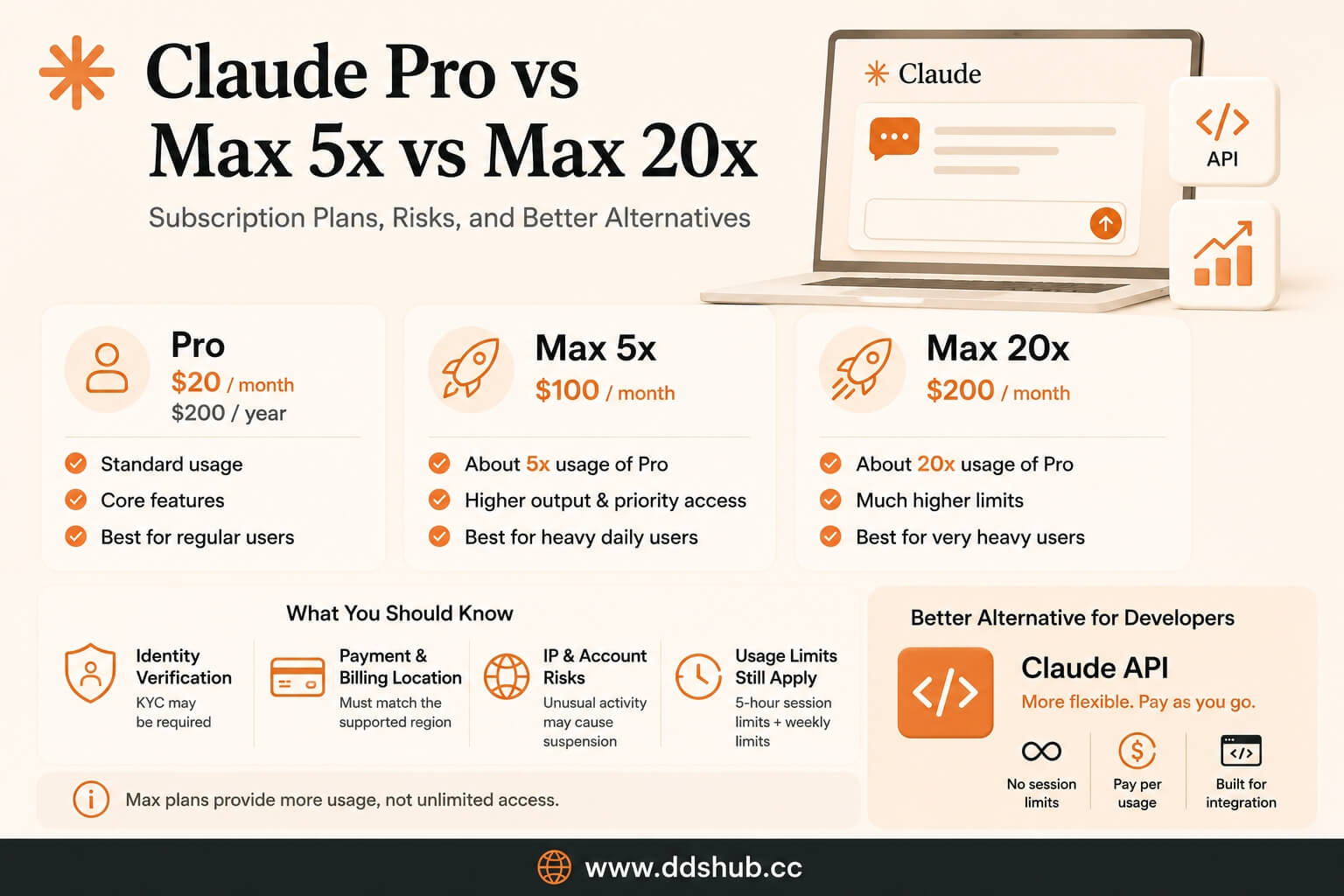
That has made Claude's paid plans increasingly important. Anthropic currently offers Pro, Max 5x, and Max 20x for individual users, with the Max tiers designed for people who need substantially more usage than Pro. The current web pricing is $20 per month for Pro, $100 per month for Max 5x, and $200 per month for Max 20x. Pro can also be purchased annually for $200, while Max plans are currently monthly subscriptions. Anthropic describes Max 5x and Max 20x as providing approximately five times and twenty times the usage of Pro per five-hour session, respectively.
For developers using Claude Code heavily, however, the subscription price is only one part of the decision. Payment compatibility, billing location, identity verification, account safeguards, usage limits, and the difference between a consumer subscription and API access can all affect the practicality of the setup.
Claude Pro, Max 5x, and Max 20x: What's the Difference?
The easiest way to understand the three plans is to think about them as different levels of consumer access rather than completely different Claude products.
| Plan | Current Price | Relative Usage | Best For |
|---|---|---|---|
| Claude Pro | $20/month or $200/year | Standard | Regular Claude users and developers |
| Claude Max 5x | $100/month | About 5x Pro | Heavy daily Claude and Claude Code users |
| Claude Max 20x | $200/month | About 20x Pro | Very heavy Claude and Claude Code usage |
All three paid plans provide access to Claude's core capabilities, while Max is specifically designed for users who work with Claude much more frequently. Max also provides higher output limits and priority access during high-traffic periods. Anthropic's official comparison page notes that paid plans remain subject to usage limits, including rolling five-hour session limits and additional weekly limits.
This distinction matters for developers because paying $200 for Max 20x does not mean buying unlimited Claude usage. The plan provides substantially more capacity, but Anthropic still applies usage controls.
For users who regularly hit Pro limits while working with Claude Code, Max 5x may be enough. Max 20x is designed for users who want much more room for continuous daily usage, but it is still not equivalent to an unlimited API account.
Claude Max Does Not Mean Unlimited Claude Code
One of the most common misconceptions surrounding Claude Max is that paying for the highest subscription tier removes usage restrictions.
It does not.
Anthropic explicitly states that Max provides 5x or 20x the usage of Pro per five-hour session, while paid plans can also have weekly limits. Anthropic has also introduced usage credits and usage bundles that allow eligible users to continue using Claude after reaching included plan limits.
This creates an important difference between "more usage" and "unlimited API access."
For a developer who occasionally uses Claude Code, Pro may provide sufficient capacity. For someone running long coding sessions every day, Max 5x or Max 20x can provide considerably more room. But if the objective is to integrate Claude into an application and let software make requests programmatically, a subscription is not the same thing as API infrastructure.
Anthropic also states that paid Claude subscriptions and the Claude API are separate products, so a Pro or Max subscription should not be interpreted as including unlimited API usage.
The Real Challenge: Getting and Keeping a Subscription Working
For users in supported markets, subscribing to Claude can be relatively straightforward. However, the process becomes more complicated when the user's payment information, billing address, location, or identity information does not align with Anthropic's requirements.
This is where many users encounter problems that have nothing to do with Claude's model performance.
Anthropic's own support documentation states that account creation from an unsupported location can result in account bans, while violations of the Terms of Service or repeated violations of the Usage Policy can also lead to account suspension or termination.
This does not mean that using a particular IP address automatically causes an account to be banned. Anthropic does not publish a simple rule such as "this IP type equals a ban." Instead, location and account activity form part of a broader eligibility and safeguards environment.
That distinction is important because many unofficial guides oversimplify the issue by claiming that changing an IP address is enough to make an account safe. There is no reliable basis for treating IP switching as a guarantee of account stability.
KYC and Identity Verification
Identity verification is another factor developers should understand before relying heavily on a Claude subscription.
Anthropic currently has an official identity verification process. Its documentation states that, when identity verification is required, users may need to provide an original physical government-issued photo ID, such as a passport, driver's license, or national identity card. Screenshots, scans, photocopies, and digital IDs are not accepted for that verification process.
Payment verification can also occur independently of identity verification. Anthropic has a dedicated help article explaining that some users may be asked to verify their payment method before continuing to use Claude.
This means that a user should not assume that successfully purchasing Pro or Max guarantees that no further verification will occur.
For developers who depend on Claude every day, this introduces a practical consideration: an account may become an important part of the workflow, while the underlying subscription remains subject to the provider's account, payment, location, and safeguards processes.
Payment Methods Matter More Than Many Users Expect
Claude subscriptions currently rely primarily on supported credit and debit card payments. Anthropic's billing documentation states that credit and debit cards are accepted for purchases, while some business and API billing arrangements can also support ACH transfers. PayPal and Venmo are not accepted payment methods.
The payment card itself is not simply a mechanism for charging the subscription fee. Its billing information can also become part of the account's billing profile.
Anthropic states that for Pro and Max plans, the billing address is automatically associated with the billing address of the payment method. It also recommends that the payment method's billing address match the relevant billing information.
This is why users sometimes encounter payment failures even when a card technically supports international transactions. Anthropic lists unsupported billing locations, mismatched billing addresses, failed 3D Secure authentication, unsupported payment methods, and insufficient funds among the common causes of declined payments.
For users whose actual billing location and available payment method do not align with the supported setup, subscription management can therefore become considerably more complicated.
What About IP Addresses?
IP address is often discussed in relation to Claude account stability, but it is important to separate documented facts from speculation.
Anthropic officially confirms that account creation from an unsupported location can lead to enforcement action. However, the company does not publicly provide a detailed scoring system explaining exactly how IP reputation, residential versus datacenter IPs, VPN usage, payment origin, identity, and account behavior are weighted against one another.
Therefore, it would be misleading to claim that a particular IP address automatically causes a Claude account to be banned.
The practical issue is consistency.
If an account is created and paid for using information associated with one country, while its access repeatedly appears to originate from another unsupported location, that creates a more complicated account environment than a normal subscription from a supported market.
For users who rely on Claude for professional development, the important question is therefore not "Which IP should I use?" but rather "Does my access method comply with the provider's supported regions, billing requirements, and terms?"
How Payment, KYC, IP, and Location Can Interact With Account Risk
It is useful to think of account stability as a combination of factors rather than a single trigger.
| Factor | What Anthropic Officially Documents | Potential Practical Impact |
|---|---|---|
| Supported location | Unsupported-location account creation can lead to enforcement | High |
| Payment method | Supported cards and billing requirements apply | High |
| Billing address | Should correspond to the payment method and eligible location | High for payment |
| Payment verification | Anthropic may require payment-method verification | Medium to High |
| Identity verification | Some users may be asked for government-issued ID | Medium to High |
| IP / access location | Location eligibility matters, but detailed IP scoring is not public | Context dependent |
| Usage Policy | Repeated violations can result in bans | High |
| Terms of Service | Violations can result in suspension or termination | High |
The important takeaway is that there is no officially published formula saying that one factor alone causes an account ban.
Instead, Anthropic's documentation shows that safeguards can involve location, Terms of Service, Usage Policy, payment verification, and identity verification. Users who operate outside supported conditions therefore face more uncertainty than users whose account, payment, and location information naturally align.
Subscription vs API: Which Is Better for Developers?
For personal use, a Claude subscription can be extremely convenient. You pay a fixed monthly amount and receive a defined level of access to Claude's applications and features.
For software developers building products, the economics are different.
An API allows the application itself to make model requests, making it suitable for SaaS applications, internal automation, AI agents, coding platforms, and other programmatic workflows. API usage is metered according to consumption rather than being tied to a personal Claude subscription.
The distinction becomes particularly important when a developer wants to build an application rather than simply use Claude manually.
| Requirement | Claude Pro / Max | Claude API |
|---|---|---|
| Interactive Claude usage | Strong | Not the primary purpose |
| Claude Code | Yes | Can be integrated programmatically |
| Fixed monthly subscription | Yes | No |
| Pay based on API consumption | No | Yes |
| Build SaaS products | Limited | Designed for this |
| Build custom AI agents | Limited | Strong |
| Programmatic model access | Not the main model | Yes |
For heavy individual Claude Code users, Max may still make sense. For developers building software around Claude, API access is usually a more natural architecture.
Why Some Developers Prefer an API Platform
The problem with relying entirely on consumer subscriptions is that the subscription account becomes the center of the workflow.
You have to maintain the account, payment method, billing information, supported location, and access environment. If any part of that setup becomes problematic, the workflow can be interrupted.
An API platform changes the architecture.
Instead of depending on a personal Claude subscription for every development workflow, developers can integrate their applications with an API endpoint and pay based on actual usage.
This is particularly useful for teams that need to use multiple models rather than Claude alone.
DDShub as an Alternative to Claude Subscriptions
DDShub provides a different approach for developers who primarily care about API access, predictable usage, and multi-model development rather than maintaining a personal Claude Pro or Max subscription.
Through DDShub, developers can access Claude and other popular models through an API-oriented platform, including Codex, GLM, and Kimi. This makes it possible to build coding tools, AI agents, automation systems, and other applications without making a personal Claude Pro or Max subscription the central dependency.
The key advantage is architectural rather than simply financial: instead of trying to maintain a high-usage consumer subscription, developers can use an API workflow that is designed around programmatic access.
DDShub also offers discounted pricing for supported Claude API groups, with some Claude access priced at approximately 20% of the official API price, depending on the specific model and group.
Developers can view the current model list and pricing directly on the platform rather than relying on an individual subscription's usage allowance.
When Should You Choose Pro, Max 5x, Max 20x, or an API?
If you use Claude occasionally for writing, research, or coding assistance, Pro is generally the most reasonable starting point at $20 per month.
If Claude has become part of your daily development workflow and you regularly hit Pro's limits, Max 5x at $100 per month provides substantially more usage.
If you are a very heavy Claude user and spend much of the day working with Claude Code or other Claude features, Max 20x at $200 per month is the highest individual usage tier currently offered by Anthropic.
However, if your primary objective is to build an application, operate an AI agent, integrate Claude into a SaaS product, or manage multiple coding models, an API-based solution is usually more appropriate than trying to stretch a consumer subscription beyond its intended use.
Final Thoughts
Claude Pro, Max 5x, and Max 20x are useful products, but they solve a different problem from an API platform.
The subscription plans are designed around individual users who interact directly with Claude, with Max providing substantially higher usage than Pro. The current prices are $20 per month for Pro, $100 per month for Max 5x, and $200 per month for Max 20x. Even Max 20x remains subject to usage controls rather than providing unlimited Claude access.
For users outside supported markets or with payment and billing information that does not naturally match the supported requirements, additional complexity can arise. Anthropic's documentation confirms that unsupported-location account creation, Terms of Service violations, and Usage Policy violations can lead to enforcement, while payment-method and identity verification can also be required in some situations.
This is why developers should distinguish between buying a Claude subscription and building on Claude through an API.
For individual users who simply want more Claude usage, Pro or Max may be appropriate. For developers who need programmatic access, multi-model workflows, and a solution that does not depend on maintaining a personal high-usage Claude subscription, an API platform such as DDShub can be a more practical alternative.
- Explore DDShub: https://www.ddshub.cc
- Explore available models: https://www.ddshub.cc/models
Official Sources
The current Claude plan comparison and pricing are available from Anthropic's official pricing page. The official Help Center also provides documentation covering Max usage, payment verification, billing addresses, identity verification, and account safeguards.