
Claude Opus 5 vs Fable 5: Which AI Coding Model Should Developers Choose?
The role of AI in software development is changing quickly.
Early AI coding assistants were mainly designed to complete small pieces of code, explain syntax, or generate simple functions. However, as models become more capable, developers are starting to use AI systems as engineering partners that can understand entire repositories, analyze existing architectures, modify multiple files, and participate in long-running development workflows.
This shift has created a new competition among AI model providers. The question is no longer simply whether a model can write code. Instead, developers are asking whether an AI model can understand a complex software system, make reliable decisions, and complete tasks with minimal human intervention.
Within the Claude ecosystem, two potential directions have attracted significant attention: a frontier-level model such as Fable 5, designed for maximum intelligence and autonomous workflows, and a more practical high-performance model such as Opus 5, designed to bring advanced reasoning capabilities to everyday development.
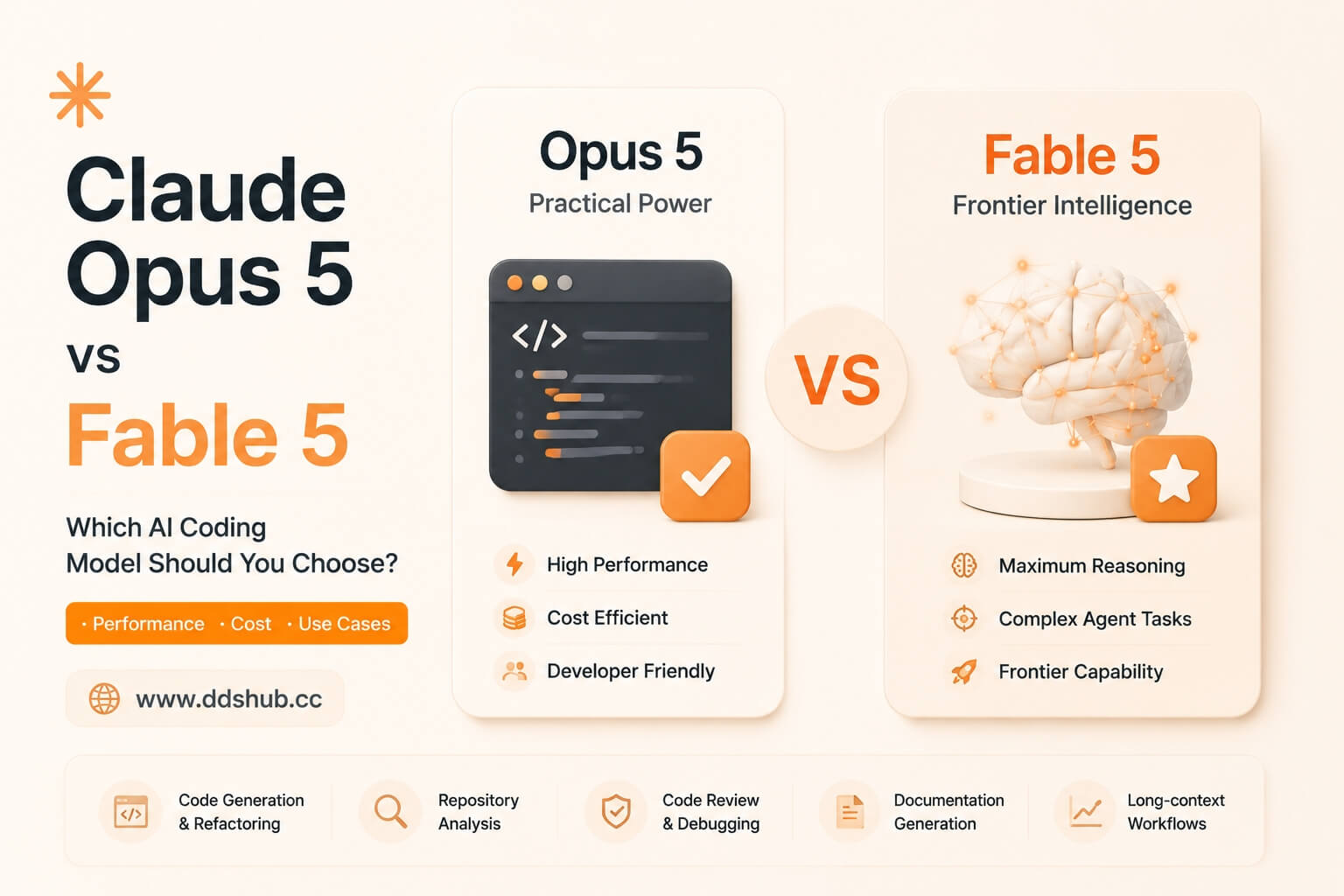
The key question for developers is not which model is universally better, but rather which model provides the right balance between intelligence, reliability, and operating cost.
The Evolution From AI Coding Assistants to AI Engineering Agents
Traditional coding assistants usually operate within a limited context. A developer writes a function, asks for a suggestion, and receives a generated answer.
Modern AI engineering agents work differently.
They need to understand the relationship between different parts of a project. A real software task might involve reviewing thousands of lines of code, understanding dependencies, identifying potential problems, planning a solution, and then modifying several files without breaking existing functionality.
This requires three important capabilities:
First, the model needs strong reasoning ability because software engineering involves trade-offs rather than simple answers.
Second, the model needs a large context window because important information is often distributed across many files and documents.
Third, the model needs consistent performance during long conversations because agent workflows often involve dozens of interactions.
These requirements are why developers increasingly evaluate models such as Claude Opus and other frontier coding models based on real engineering performance rather than traditional benchmark scores alone.
Understanding Claude Fable 5: The Frontier AI Engineering Model
Fable 5 represents the direction of maximum AI capability.
Models in this category are designed for the most demanding scenarios where developers want the AI system to perform complex reasoning and complete longer autonomous tasks.
For example, an enterprise team may want an AI agent to analyze a large legacy application, understand the existing architecture, propose a migration strategy, and help implement the changes.
These tasks require more than code generation. The model must understand business requirements, evaluate possible solutions, and maintain consistency across a large project.
The advantage of a frontier model is its ability to handle ambiguous problems.
When requirements are unclear or when a project requires architectural decisions, stronger reasoning capability becomes increasingly valuable.
However, this capability usually comes with higher operating costs. For many development teams, using the most powerful model for every request is not always the most efficient approach.
Understanding Claude Opus 5: The Practical High-Performance Choice
Opus 5 represents another important direction in AI development: making advanced intelligence more accessible for daily usage.
Most developers do not spend every day solving extremely complex architectural problems. A large percentage of their workflow involves:
- Understanding existing code
- Writing new features
- Reviewing pull requests
- Debugging issues
- Generating documentation
- Improving code quality
For these scenarios, a highly capable but more efficient model can provide better overall productivity.
The advantage of Opus 5 is not necessarily that it replaces frontier models in every situation. Instead, its value comes from offering a strong balance between performance and cost.
For individual developers, startups, and teams building AI-powered products, this balance can be more important than achieving the highest possible benchmark score.
Claude Opus 5 vs Fable 5: Capability Comparison
| Category | Opus 5 | Fable 5 |
|---|---|---|
| Main purpose | High-performance development assistant | Frontier autonomous AI agent |
| Coding ability | Excellent for daily engineering | Designed for the hardest engineering tasks |
| Reasoning | Advanced | Maximum capability |
| Long-running tasks | Strong | Stronger |
| Cost efficiency | Better | Higher cost |
| Best use case | Developers and product teams | Enterprise and complex agent workflows |
Coding Performance: Which Model Is Better for Developers?
For software engineering, the most important question is not whether a model can generate code, but whether it can generate the right code within the context of a real project.
A strong coding model should understand existing patterns, respect architectural decisions, and avoid introducing unnecessary complexity.
Fable 5 would likely be more suitable for situations where the AI agent needs to operate with a high level of independence. Examples include large-scale code migration, complex system design, and advanced automation workflows.
Opus 5 would likely be the better choice for most daily development activities because developers often need speed, reliability, and cost control rather than maximum intelligence for every interaction.
For example, building a new feature, reviewing code, fixing bugs, or generating tests usually does not require the most expensive model available.
Context Window and AI Coding
Context has become one of the most important factors in AI coding performance.
A developer working on a modern application may have:
- Thousands of source files
- Technical documentation
- Database schemas
- API specifications
- Existing development discussions
The more project information an AI model can understand, the better it can assist with complex tasks.
This is why long-context models are becoming increasingly important for coding agents.
However, context size alone does not guarantee better results. The model must also understand which information matters and how different pieces of information relate to each other.
A large context window combined with strong reasoning is what enables AI agents to move from simple assistants toward genuine development partners.
How Should Developers Choose Between Opus 5 and Fable 5?
There is no single answer for every developer.
Teams building enterprise automation systems or autonomous coding agents may benefit from using the most powerful available model because the value of solving difficult problems can outweigh the additional cost.
However, developers building applications, SaaS products, or internal tools often need a more balanced approach.
A practical strategy is to use different models for different tasks.
For example, a development workflow might use a high-performance model for architecture decisions and complex debugging while using a more cost-efficient model for everyday coding, documentation, and iteration.
This approach is becoming increasingly common as developers move from choosing one AI model to building a multi-model workflow.
Managing AI Coding Costs With Multi-Model Strategies
One of the biggest challenges in AI development is controlling token usage.
A powerful model can generate excellent results, but using it for every request can significantly increase operating costs.
Developers can reduce costs by improving prompt quality, providing only relevant context, and selecting models based on task complexity.
For example, a simple code explanation does not require the same reasoning capability as a complete application redesign.
The future of AI development will likely involve intelligent model routing, where different models handle different categories of work.
Using Claude and Other AI Models Through DDS Hub
For developers building AI-powered products, managing multiple AI providers can become complicated.
Different projects may require different models:
- Claude models for advanced reasoning and coding workflows
- Codex models for programming tasks
- GLM models for cost-sensitive applications
DDS Hub provides developers with access to multiple AI models through a unified API platform, allowing teams to test different models and choose the right option for each workload.
Instead of maintaining multiple integrations, developers can use a consistent API workflow.
DDS Hub API endpoint:
https://www.ddshub.cc/v1Full documentation is available in the DDS Hub Documentation, and supported models are listed on the DDS Hub Models page.
For developers experimenting with AI coding agents, this approach makes it easier to compare different models and optimize both performance and cost.
The Future of AI Coding Models
The competition between models like Opus 5 and Fable 5 reflects a larger trend in software development.
The future is unlikely to be dominated by a single "best" AI model.
Instead, developers will combine different models depending on:
- Task difficulty
- Required accuracy
- Response speed
- Budget constraints
Frontier models will continue pushing the boundaries of what AI agents can accomplish, while efficient high-performance models will become the foundation of everyday development workflows.
The most successful developers will not simply choose the strongest model. They will learn how to combine AI models effectively and build workflows that maximize productivity.
Final Thoughts
Claude Opus 5 and Fable 5 represent two different approaches to the future of AI coding.
Fable 5 focuses on maximum intelligence and complex autonomous workflows, while Opus 5 represents a more practical balance between capability and efficiency.
For most developers, the right choice depends on the type of work being performed.
The future of AI-assisted development will not be about replacing developers with a single model. Instead, it will be about creating flexible workflows where humans and multiple AI systems collaborate to build better software.
Platforms such as DDS Hub help developers explore this multi-model future by providing easier access to different AI models through a unified API experience.