
Claude Opus 5: Everything We Know So Far (Rumors, Expected Features & Release Timeline)
For developers who closely follow frontier AI models, one question appears almost every week:
When will Anthropic release Claude Opus 5?
Although Anthropic has not officially announced Claude Opus 5, the company has released enough products, research, and infrastructure updates over the past year to give developers a reasonable picture of where its flagship models are heading.
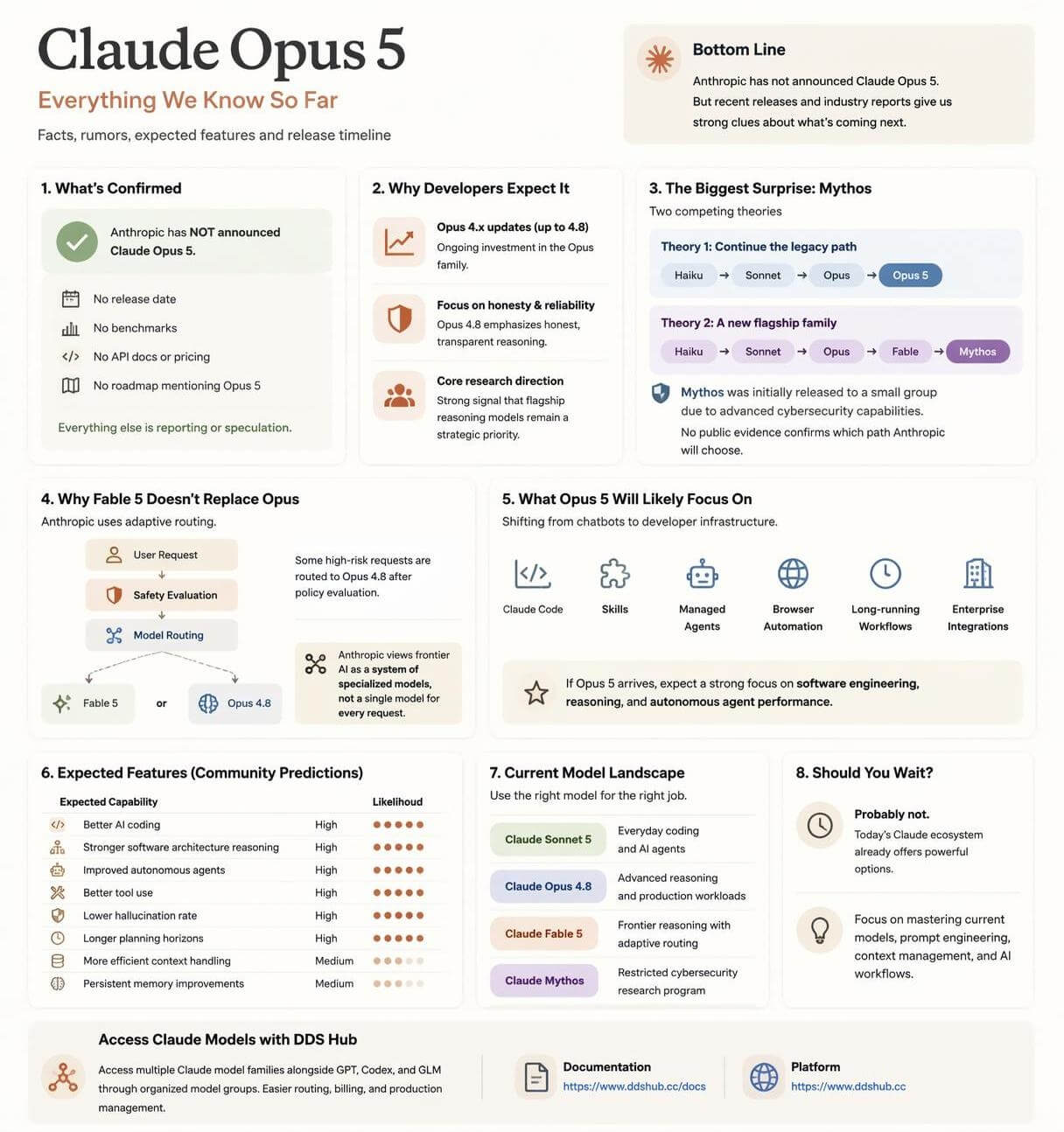
Recent launches—including Opus 4.8, Fable 5, Claude Code, and the highly restricted Mythos program—suggest that Anthropic's priorities are shifting away from traditional chatbot benchmarks toward long-running AI agents, software engineering, and trustworthy reasoning. At the same time, industry reports and public discussions have fueled speculation that the next flagship model could arrive either as Claude Opus 5 or under an entirely new name.
This article separates confirmed facts from industry rumors and explores what developers should realistically expect.
What Has Anthropic Officially Confirmed?
The most important fact is also the simplest:
Anthropic has not announced Claude Opus 5.
There is currently:
- no official release date;
- no published benchmark;
- no API documentation;
- no pricing;
- no public roadmap referring to an Opus 5 model.
Everything beyond this point should therefore be interpreted as either industry reporting or community speculation, not an official product announcement.
Why Developers Expect an Opus 5
Although no announcement exists, Anthropic has continued investing heavily in its flagship model family.
Over the past year the company has continued releasing Opus 4.x updates instead of discontinuing the product line. Reuters reported that Opus 4.8 focuses on improving honesty, transparency, and reliable reasoning rather than simply chasing benchmark scores, indicating that Opus remains a core research direction rather than a legacy model.
For many developers this is the strongest signal that Anthropic still considers flagship reasoning models strategically important.
The Biggest Surprise: Mythos
Ironically, the strongest evidence about Anthropic's future may not mention Opus 5 at all.
Instead, multiple reports introduced a new family called Mythos.
According to Reuters, Mythos was initially released only to a small group of trusted organizations because of its advanced cybersecurity capabilities before broader access resumed with additional safeguards.
That has created two competing theories inside the AI community.
Theory 1 — Anthropic simply continues the existing naming convention.
Haiku
  ↓
Sonnet
  ↓
Opus
  ↓
Opus 5
Theory 2 — Instead of releasing an "Opus 5," Anthropic introduces Mythos as its long-term flagship family.
Haiku
  ↓
Sonnet
  ↓
Opus
  ↓
Fable
  ↓
Mythos
Today there is no public evidence confirming which roadmap Anthropic will ultimately choose.
Why Fable 5 Doesn't Replace Opus
One misconception is that Fable 5 completely replaced Opus.
Available reporting suggests the reality is more nuanced.
Following Fable 5's rollout, Anthropic implemented additional safety protections and routing behavior. Reuters reported that some higher-risk requests are redirected to Opus 4.8 after policy evaluation rather than always being handled directly by Fable 5.
A simplified architecture looks like this:
User Request
      ↓
Safety Evaluation
      ↓
Model Routing
      ↓
Fable 5   or   Opus 4.8
This suggests that Anthropic increasingly views frontier AI as a system of specialized models rather than a single model handling every request.
What Would Claude Opus 5 Likely Focus On?
Looking at Anthropic's recent releases, one pattern is clear.
The company is investing less in chatbot features and more in developer infrastructure.
Recent launches include:
- Claude Code
- Skills
- Managed Agents
- Browser automation
- Long-running agent workflows
- Enterprise integrations
If Anthropic eventually introduces Claude Opus 5, many developers expect it to prioritize software engineering rather than conversational improvements.
Expected Features (Community Predictions)
None of the following capabilities have been confirmed by Anthropic. They represent recurring expectations discussed across developer communities.
| Expected Capability | Likelihood |
|---|---|
| Better AI coding | High |
| Stronger software architecture reasoning | High |
| Improved autonomous agents | High |
| Better tool use | High |
| Lower hallucination rate | High |
| Longer planning horizons | High |
| More efficient context handling | Medium |
| Persistent memory improvements | Medium |
Interestingly, almost every prediction focuses on AI engineering rather than chat quality.
Benchmarks May Matter Less Than Reliability
One noticeable trend in Anthropic's recent releases is a growing emphasis on trustworthy reasoning instead of benchmark leadership.
Recent flagship updates repeatedly highlight concepts such as:
- honesty
- transparency
- admitting uncertainty
- reliable reasoning
rather than simply publishing higher benchmark numbers. Reuters similarly described Opus 4.8 as emphasizing honesty improvements over raw benchmark gains.
If this philosophy continues, Opus 5 may improve software engineering productivity through better planning, verification, and self-correction instead of dramatically increasing benchmark scores.
Should Developers Wait for Claude Opus 5?
For most developers, probably not.
Today's Claude ecosystem already provides several highly capable options depending on the workload.
| Model | Best For |
|---|---|
| Claude Sonnet 5 | Everyday coding and AI agents |
| Claude Opus 4.8 | Advanced reasoning and production workloads |
| Claude Fable 5 | Frontier reasoning with adaptive routing |
| Claude Mythos | Restricted cybersecurity research program |
Waiting for an unannounced model usually provides less value than learning how to use current models effectively through prompt engineering, context management, and AI-assisted development workflows.
Accessing Claude Models Through DDS Hub
Developers often need access to multiple Claude model families alongside GPT, Codex, and GLM without managing separate integrations.
DDS Hub provides dedicated model groups for different AI ecosystems, allowing developers to choose the appropriate Claude resources depending on stability, pricing, and workflow requirements. Instead of exposing one universal API key, DDS Hub organizes access through separate model groups, making routing and billing easier to manage for production environments.
Learn more:
Documentation: https://www.ddshub.cc/docs
Platform: https://www.ddshub.cc
Final Thoughts
Claude Opus 5 remains one of the most anticipated AI models, but there is currently no official confirmation that it exists as a public product. What we do know is that Anthropic continues to invest heavily in flagship reasoning models, while recent developments—including Fable 5, adaptive routing, and the Mythos program—suggest a future where multiple specialized models work together instead of one model handling every task.
Whether Anthropic eventually launches Claude Opus 5, expands the Mythos family, or introduces an entirely new naming strategy, the broader direction is already clear: future frontier models will likely be judged less by benchmark charts and more by how effectively they perform long-running reasoning, software engineering, autonomous agent workflows, and trustworthy decision-making. For developers, learning these workflows today is likely to be more valuable than waiting for the next model announcement.