
Claude Opus 5 API Guide: How Developers Build AI Agents with Advanced Reasoning
AI applications are moving into a new stage.
Early AI products mainly focused on conversations and content generation. However, developers are now building a new generation of AI systems that can perform tasks independently, interact with external tools, analyze large amounts of information, and complete multi-step workflows.
These systems are commonly known as AI Agents.
Unlike traditional chatbots, AI agents need stronger reasoning capabilities. They need to understand user goals, create execution plans, make decisions, and adapt when problems appear.
This is why advanced models such as Claude Opus 5 are attracting attention from developers building next-generation AI applications.
In this guide, we will explore what Claude Opus 5 API enables, how developers can use it to build AI agents, practical application scenarios, and how to integrate Claude Opus 5 through DDS Hub.
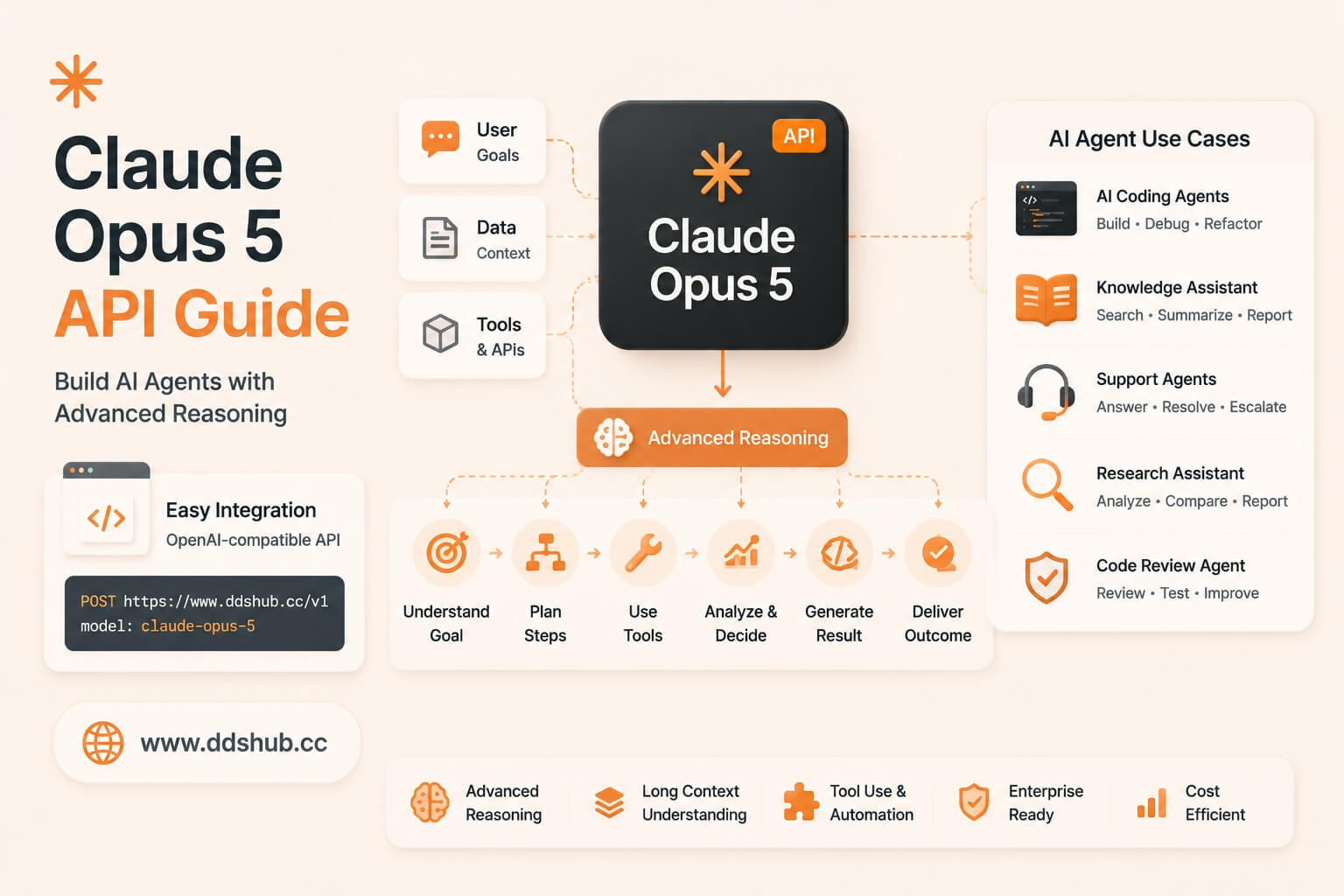
What Is Claude Opus 5 API?
Claude Opus 5 API provides developers with programmatic access to Anthropic's advanced language model capabilities.
Instead of interacting with Claude through a chat interface, developers can integrate the model directly into their own applications.
This allows companies and developers to build:
- AI coding assistants
- Customer service agents
- Research assistants
- Data analysis systems
- Enterprise automation tools
The key difference between a normal chatbot and an AI agent is the ability to execute complex tasks.
A chatbot answers questions.
An AI agent can:
- Understand objectives
- Break tasks into smaller steps
- Use tools
- Analyze information
- Generate solutions
- Complete workflows
Why AI Agents Need Advanced Models
Building AI agents requires more than text generation.
A useful agent needs to maintain context and make reliable decisions throughout a task.
For example, an AI coding agent may need to:
- Understand an existing codebase.
- Identify the source of a problem.
- Design a solution.
- Modify multiple files.
- Test the changes.
- Explain the result.
Each step requires reasoning.
A weaker model may generate technically correct code but fail to understand the broader project context.
Advanced models like Claude Opus 5 are designed for these more complicated workflows.
Claude Opus 5 API Use Cases
1. AI Coding Agents
One of the most popular applications is building AI coding assistants.
Traditional coding tools mainly provide autocomplete suggestions.
AI coding agents go further.
They can help developers:
- Understand unfamiliar repositories
- Generate implementation plans
- Debug complex problems
- Refactor existing systems
- Write automated tests
Example scenario:
A developer connects Claude Opus 5 API to an internal coding assistant.
Instead of asking:
"How do I write this function?"
The developer can ask:
"Analyze this repository, identify performance issues, and suggest improvements."
The AI agent can reason across multiple files and provide a complete engineering solution.
2. Enterprise Knowledge Assistant
Many companies have large amounts of internal knowledge:
- Technical documents
- Product specifications
- Customer records
- Internal guidelines
Traditional search systems can locate information but often cannot understand relationships between documents.
An AI knowledge assistant powered by Claude Opus 5 can:
- Summarize documents
- Answer complex questions
- Connect information across sources
- Generate reports
For example, a company employee could ask:
"Summarize the main risks from our last three product launches."
The AI agent can analyze multiple documents and provide a structured answer.
3. Automated Customer Support Agents
Customer support is another important AI agent scenario.
A modern support agent needs to do more than answer FAQ questions.
It may need to:
- Understand customer problems
- Check account information
- Analyze previous conversations
- Recommend solutions
- Escalate complicated cases
Claude Opus 5 can act as the reasoning layer behind these workflows.
Companies can combine the model with their own databases and business systems to create more intelligent support experiences.
4. AI Research Assistant
Research workflows often involve large amounts of information.
Researchers may need to:
- Analyze papers
- Compare different approaches
- Summarize findings
- Generate reports
An AI research agent can reduce the time spent on repetitive information processing.
For example, a market research agent can analyze industry reports and generate competitive analysis automatically.
5. Software Testing and Code Review Agents
Software quality is another area where AI agents are becoming valuable.
A Claude Opus 5-powered testing agent can analyze:
- Source code
- Test coverage
- Potential security risks
- Code quality issues
Instead of only checking whether code runs, the agent can evaluate whether the implementation follows engineering best practices.
How Claude Opus 5 Agents Work
A typical AI agent architecture contains several components.
The language model acts as the reasoning engine.
The application provides:
- User input
- External tools
- Database access
- APIs
- Execution environment
The agent then decides:
- What information it needs
- Which tools to use
- What actions to perform
This is why API access is important.
Developers can customize the entire workflow instead of being limited to a fixed chat experience.
How to Use Claude Opus 5 API with DDS Hub
Developers can access Claude-compatible API services through DDS Hub.
DDS Hub provides an OpenAI-compatible API format, allowing developers to integrate AI models using familiar development methods.
API Base URL:
https://www.ddshub.cc/v1Example:
from openai import OpenAI

client = OpenAI(
    api_key="YOUR_API_KEY",
    base_url="https://www.ddshub.cc/v1"
)

response = client.chat.completions.create(
    model="claude-opus-5",
    messages=[
        {
            "role": "user",
            "content": "Analyze this project and create an improvement plan."
        }
    ]
)

print(response.choices[0].message.content)
Documentation: https://www.ddshub.cc/docs
Models: https://www.ddshub.cc/models
Building Cost-Efficient AI Agents
One challenge with AI agents is that they often require many model calls.
A single workflow may involve:
- Planning
- Reasoning
- Tool usage
- Verification
- Final response generation
This can increase token consumption.
Developers can improve efficiency in the following ways.
Choosing the Right Model
Not every task requires the most powerful model.
Simple tasks can use lightweight models, while complex reasoning tasks can use advanced models.
Improving Prompts
A clear prompt reduces unnecessary iterations.
A good agent instruction should include:
- Task objective
- Available tools
- Expected output
- Constraints
Using Multi-Model Architecture
Modern AI applications often combine different models.
For example:
- Claude Opus 5 for complex reasoning
- Coding models for programming tasks
- Smaller models for classification and simple requests
This approach improves both performance and cost efficiency.
Why Developers Use DDS Hub for AI Agent Development
Building AI applications often requires flexibility.
Different products may need different models depending on the task.
DDS Hub allows developers to access multiple AI models through a unified API platform.
This makes it easier to:
- Test different models
- Switch models based on workload
- Manage API access
- Optimize AI application costs
For developers experimenting with AI agents, this flexibility is becoming increasingly important.
The Future of Claude Opus 5 and AI Agents
AI agents represent a major shift in software development.
The future generation of applications will not only respond to users but actively complete tasks on their behalf.
Developers will build systems where AI can:
- Write and review code
- Analyze information
- Automate business processes
- Support customers
- Manage workflows
Advanced models such as Claude Opus 5 provide the reasoning foundation for these applications.
However, successful AI products will depend not only on choosing a powerful model, but also on designing efficient workflows, selecting appropriate tools, and controlling operational costs.
Final Thoughts
Claude Opus 5 API gives developers a powerful foundation for building AI agents and intelligent automation systems.
From coding assistants to enterprise workflows, the biggest opportunity is not simply generating better answers, but creating AI systems that can understand goals and complete meaningful tasks.
By combining advanced models with effective agent design and flexible API platforms such as DDS Hub, developers can build more capable and scalable AI applications.