
Claude Max Is Not an API: Why Developers Should Think Twice Before Building Products on Claude Subscriptions
Claude has quickly become one of the most popular AI tools among developers. With the growth of Claude Code, many programmers now rely on Claude for software development tasks, including understanding large codebases, generating new features, debugging problems, and improving existing applications.
For individual developers, Claude Max provides an attractive experience. Instead of managing API keys or tracking every token, users can access advanced Claude models through a monthly subscription and use them directly in their daily workflow.
This naturally leads to an important question:
Can Claude Max replace Claude API for building AI products?
At first glance, the idea seems reasonable. If a developer can access powerful Claude models through a subscription, why pay separately for API usage?
However, Claude Max and Claude API solve two completely different problems.
Claude Max is designed to help people use AI.
Claude API is designed to help developers build products with AI.
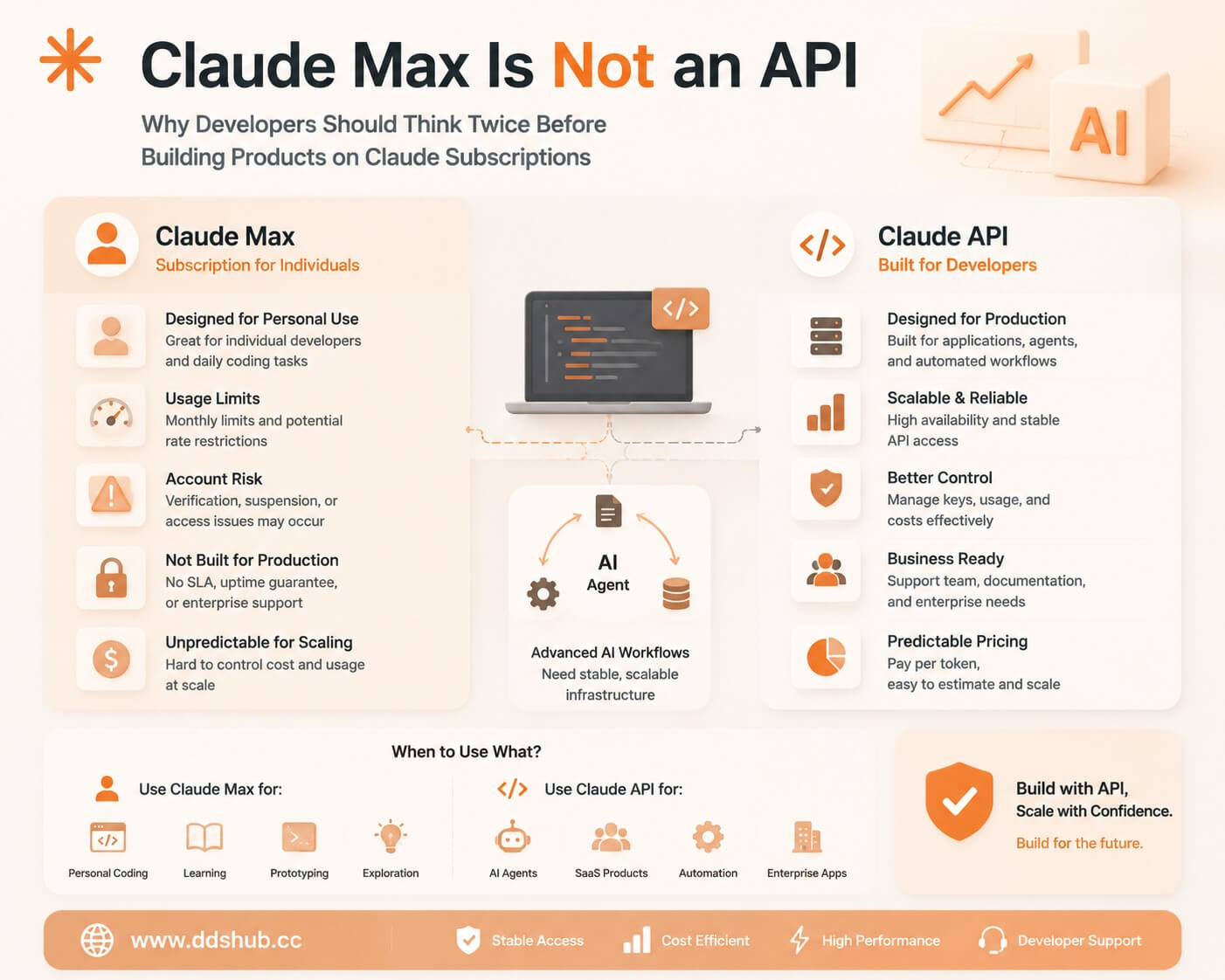
This difference becomes increasingly important when a personal AI workflow grows into a commercial application, an AI agent platform, or a product used by multiple customers.
Claude Max and Claude API Are Built for Different Users
The biggest misunderstanding around AI subscriptions is assuming that a subscription plan is equivalent to API access.
Claude Max is primarily designed for individual users who interact with Claude through the official application and tools such as Claude Code. It provides a convenient experience for developers who want AI assistance during their own work.
A developer working on a personal project may use Claude Max to analyze code, generate functions, review architecture decisions, or troubleshoot bugs. In this scenario, the interaction is controlled by a person, and the usage pattern is naturally limited.
A production application operates differently.
When developers build an AI-powered product, requests no longer come from one person manually typing questions. They come from users, automated workflows, background tasks, and AI agents that may run continuously.
The system needs predictable access, usage monitoring, cost management, and the ability to scale as demand increases.
This is why subscription products and API products exist separately.
Official references: Claude API documentation and Claude API pricing.
Subscription Access Is Not the Same as Production Infrastructure
A personal subscription is optimized around user experience.
An API is optimized around application infrastructure.
This difference is similar to using a personal software account compared with building a service that thousands of users depend on.
With Claude Max, the primary goal is allowing one user to have a better AI experience. The user opens Claude, writes prompts, reviews responses, and completes tasks.
With Claude API, developers control how AI is integrated into their own systems. They decide when requests are sent, which model is used, how context is managed, and how costs are calculated.
For a developer building an AI assistant for personal use, a subscription may be enough.
For a company building an AI coding platform, customer support agent, or automation system, API access becomes necessary because the product itself depends on reliable model availability.
Why Developers Should Be Careful When Using Personal Accounts for Products
One of the biggest risks of building on subscription accounts is that the account was never designed to become a backend service.
A production AI system requires consistency.
Imagine an AI coding platform where users submit tasks and the backend relies on a single personal account. If that account experiences a usage restriction, verification requirement, or temporary availability issue, the entire service may be affected.
For an individual developer, this may only interrupt personal productivity.
For a commercial product, even a short interruption can impact users and revenue.
This is why professional software systems usually separate personal accounts from production infrastructure.
The same principle applies to databases, cloud servers, and payment systems. Developers rarely build a commercial service around personal resources because those resources are not designed for business-level reliability.
AI Coding Agents Make Usage Complexity Even Higher
The rise of AI coding agents has made this distinction more important.
A traditional chatbot interaction is relatively simple. A user asks a question, the model generates an answer, and the conversation ends.
An AI coding agent works through a much longer process.
For example, when a developer asks an agent to modify a project, the system may first need to understand the repository structure, inspect existing files, analyze dependencies, generate code changes, run tests, review errors, and refine the solution.
The final answer is only one part of the process.
Behind that answer, there may be multiple model calls and large amounts of context being processed.
This means AI coding workloads can consume significantly more resources than normal conversations.
A personal subscription may feel inexpensive because a human user only performs a limited number of tasks.
A product built around AI agents behaves differently because the workload grows together with the number of users.
Why a Fixed Subscription Price Does Not Always Mean Lower Cost
One reason developers consider Claude Max is the predictable monthly price.
Compared with API billing, a subscription appears easier to control.
However, production applications require a different way of measuring cost.
The important question is not:
"How much does my AI account cost every month?"
The more important question is:
"How much does it cost to successfully complete one user task?"
An AI agent may need several attempts to complete a complex request. A more capable model with higher token pricing may sometimes be cheaper overall because it completes tasks more accurately and requires fewer retries.
API-based systems provide developers with the visibility needed to answer these questions. They can monitor usage, analyze spending, and optimize the application architecture.
Without this visibility, developers may underestimate the real cost of running AI-powered products.
Claude API Gives Developers More Control
The main advantage of API access is not only technical integration.
It is control.
With Claude API, developers can design their own AI architecture.
They can decide which model handles different workloads, how much context should be included, and how the system balances performance and cost.
For example, a complex software architecture decision may require an advanced reasoning model, while a simple documentation task may be handled by a more cost-efficient model.
This type of model selection strategy is difficult to implement when relying only on a personal subscription.
As AI applications become more advanced, developers increasingly use multiple models and dynamically choose the right model for each task.
The Cost Challenge of Claude API
Although API access provides better scalability, developers still need to consider cost.
Advanced AI models are powerful, but large-scale usage can become expensive.
For applications such as AI coding assistants, autonomous agents, and SaaS products, token consumption can quickly become one of the largest operating expenses.
This is why many developers focus on API optimization.
The goal is not simply finding the cheapest model.
The goal is finding the best balance between capability and cost.
Developers usually optimize costs through better prompt design, context management, model selection, and efficient API infrastructure.
DDS Hub: A Lower-Cost Way to Access Claude API
For developers who need Claude API access but want better cost efficiency, DDS Hub provides an alternative API access solution.
DDS Hub focuses on providing developers with easier access to AI models through an API-based workflow.
Compared with official Claude API pricing, DDS Hub Claude API access is approximately 20% of the official API cost, helping developers reduce model usage expenses while maintaining an API integration approach.
For example:
| Model | Official API Price | DDS Hub Approximate Price |
|---|---|---|
| Claude Fable 5 | $10 / MTok Input, $50 / MTok Output | ~$2 / MTok Input, ~$10 / MTok Output |
| Claude Opus 5 | $5 / MTok Input, $25 / MTok Output | ~$1 / MTok Input, ~$5 / MTok Output |
| Claude Opus 4.8 | $5 / MTok Input, $25 / MTok Output | ~$1 / MTok Input, ~$5 / MTok Output |
| Claude Sonnet 5 | $2 / MTok Input, $10 / MTok Output | ~$0.4 / MTok Input, ~$2 / MTok Output |
For developers building AI applications, reducing API costs can directly improve scalability and product margins.
DDS Hub provides access through standard API integration:
Website: DDS Hub
Models: DDS Hub Models
API endpoint:
https://www.ddshub.cc/v1Claude Max or Claude API: Which One Should Developers Choose?
The choice depends entirely on the purpose.
For personal development, Claude Max remains a convenient option. A single developer who wants AI assistance while coding, researching, or writing can benefit from the simplicity of a subscription.
For software products, automation systems, and AI agents, API access is usually the better foundation because it provides better control, scalability, and monitoring.
The mistake is not choosing Claude Max.
The mistake is assuming that a personal subscription can replace production infrastructure.
A subscription helps people work with AI.
An API helps developers build with AI.
Final Thoughts
Claude Max has made advanced AI coding capabilities accessible to individual developers, and it remains a valuable tool for personal productivity.
However, as developers move from experimenting with AI to building real products, the requirements change.
Production systems need predictable access, cost control, scalability, and reliable integration.
This is why developers should carefully distinguish between AI subscriptions and AI APIs.
Claude Max is designed for using Claude.
Claude API is designed for building applications powered by Claude.
For teams creating AI agents, coding platforms, and commercial AI products, choosing the right API strategy early can prevent future scaling problems and help control long-term infrastructure costs.