
Claude KYC Explained: Why Verification Happens and What Developers Should Know
Claude has become one of the world's most popular AI assistants for developers, researchers and businesses. Its powerful reasoning capabilities, coding performance and long-context understanding have made it a preferred choice for building AI applications.
However, alongside its growing popularity, many users have searched for terms such as:
- Claude KYC
- Claude verification
- Claude account suspended
- Claude account restricted
- Why is Claude asking for verification?
If you've encountered verification requests or account restrictions, you're not alone.
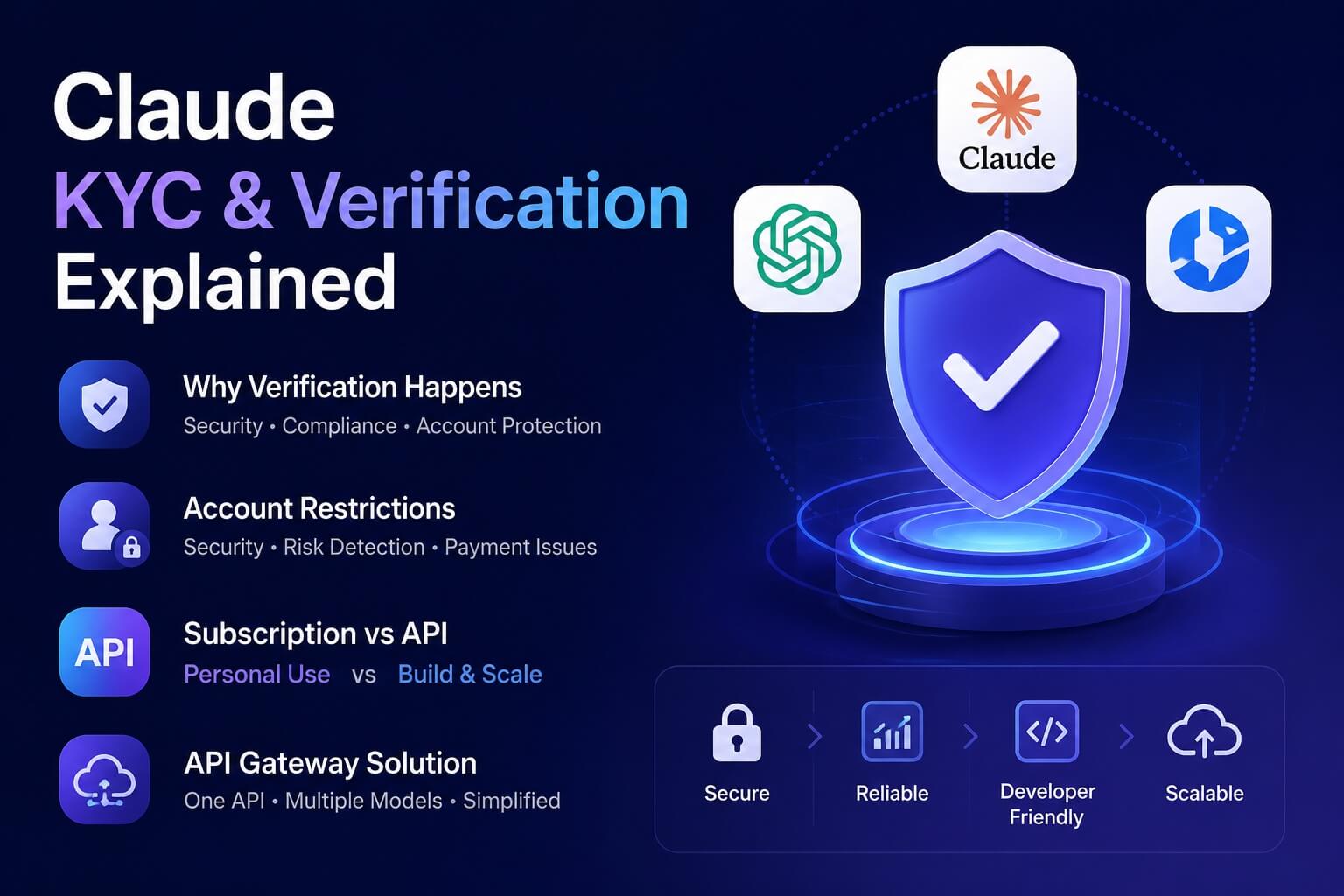
This article explains why these situations occur, how Claude subscriptions differ from API services, and why many developers choose API gateway platforms for production workloads.
What Is Claude KYC?
KYC stands for Know Your Customer, a verification process commonly used by online platforms to help maintain account security and comply with applicable regulations.
Like many cloud-based services, AI providers may use verification mechanisms to:
- Protect user accounts
- Prevent abuse
- Reduce automated fraud
- Improve platform security
- Meet legal and compliance obligations
Verification requirements may vary depending on factors such as account activity, region, payment methods or other risk signals.
For most legitimate users, verification is simply part of the normal account security process.
Why Might Claude Ask for Verification?
There isn't a single reason why verification may appear. Instead, platforms typically evaluate multiple factors designed to protect both users and the service itself.
Examples may include:
- New account activity
- Unusual login patterns
- Payment verification
- Security reviews
- Regional compliance requirements
These checks are common across many online platforms — not only AI services. Receiving a verification request does not necessarily mean that an account has violated any rules.
Why Some Claude Accounts Become Restricted
Occasionally, users report that their Claude accounts become temporarily unavailable or require additional review. While each situation is different, restrictions may occur for reasons such as:
- Security protection
- Unusual account activity
- Payment-related issues
- Automated risk detection
- Compliance reviews
Because account decisions depend on many internal factors, only the platform itself can determine the specific reason in an individual case.
For this reason, developers building production software often avoid relying solely on personal web accounts.
Claude Subscription vs Claude API
One of the most common misunderstandings is assuming that a Claude subscription works the same way as the Claude API. In reality, they are designed for different audiences.
Claude Subscription
Subscription plans are intended primarily for individuals using Claude through the web interface. Typical use cases include:
- Writing
- Brainstorming
- Research
- Personal productivity
- Everyday conversations
Subscriptions are optimized for interactive human use.
Claude API
The API is designed for software development. Developers use the API to build:
- AI products
- Customer support systems
- Internal automation
- Coding assistants
- Enterprise applications
- AI agents
Instead of manually chatting through a browser, applications communicate with Claude programmatically. For production environments, API access generally offers much greater flexibility. If you're just getting started, see our guide on the free Claude Opus 4.8 API key.
Why Developers Prefer API-Based Workflows
As AI products grow, browser subscriptions become difficult to integrate into automated systems. Modern software often requires:
- Backend services
- Automated requests
- Team collaboration
- Scalable infrastructure
- Stable deployment pipelines
This is where APIs become essential. Rather than depending on manual interactions, developers can build applications that communicate directly with language models.
The Challenge of Managing Multiple AI Providers
Today's AI ecosystem is more diverse than ever. Many companies use different models for different tasks. For example:
- Claude for advanced reasoning
- Codex for software engineering
- GLM for multilingual applications
Managing separate accounts, billing systems and API integrations for every provider quickly becomes time-consuming. As teams scale, infrastructure complexity grows alongside operational costs.
Why Many Teams Use API Gateway Platforms
Instead of maintaining multiple independent integrations, many startups and engineering teams adopt unified API platforms. An API gateway provides a single endpoint that connects to multiple AI models.
This approach allows developers to:
- Switch between models more easily
- Simplify infrastructure
- Centralize billing
- Reduce integration effort
- Compare model performance
Rather than rebuilding an application whenever a different model is needed, developers can often update configuration while keeping the same API workflow.
A Practical Alternative for Claude API Access
For teams building production applications, flexibility is often just as important as model quality.
DDS Hub provides unified access to several leading AI models, including:
- Claude
- Codex
- GLM
Instead of maintaining multiple provider accounts, developers can register once, obtain an API key, and choose the model that best fits each workload. New users can create an API key free of charge. API usage is activated after topping up the account balance.
Compared with managing separate providers, DDS Hub offers several advantages:
- Unified API format
- Multiple model groups
- Flexible pricing options
- Lower pricing than standard official API rates for supported groups
- Easier testing across different AI models
For developers who frequently compare Claude, Codex and GLM, this greatly simplifies day-to-day operations. For a full cost breakdown, see DDS Hub vs official API pricing.
You can recharge and activate API access here: Activate API access on DDS Hub. To browse available model groups, visit the DDS Hub models page.
Should You Choose a Subscription or an API?
The answer depends on your goals.
A Claude subscription is ideal if you primarily use AI through a browser for writing, research or everyday productivity.
However, if you're:
- Building SaaS software
- Developing AI agents
- Creating coding assistants
- Automating business workflows
- Integrating AI into applications
then API access is generally the better long-term solution. Many engineering teams even combine multiple models to optimize both performance and cost.
Best Practices for Developers
Before integrating any AI model into production, it's worth considering a few practical recommendations:
- Choose a scalable API provider
- Monitor API usage and costs regularly
- Keep your application compatible with multiple models when possible
- Avoid relying on a single provider for every workload
- Select models based on task requirements rather than popularity alone
A flexible architecture today can significantly reduce migration costs in the future.
Final Thoughts
As Claude continues to gain adoption across the AI industry, searches related to Claude KYC, verification and account restrictions are likely to remain common.
In most cases, verification mechanisms are part of broader security and compliance processes rather than something unique to Claude.
For developers building production systems, the more important decision is choosing the right access method. While browser subscriptions are excellent for personal productivity, API-based workflows provide the flexibility, automation and scalability required by modern AI applications.
Platforms such as DDS Hub make this even easier by offering unified access to Claude, Codex and GLM through a single API, helping developers reduce operational complexity while optimizing infrastructure costs.
FAQ
What is Claude KYC?
KYC ("Know Your Customer") is a standard verification process used by many online platforms to protect accounts, prevent abuse and meet compliance requirements. It isn't unique to Claude.
Why is Claude asking me for verification?
Verification can be triggered by factors like new account activity, unusual login patterns, payment checks or regional compliance. A verification request doesn't necessarily mean you broke any rules.
Why do some Claude accounts get suspended or restricted?
Restrictions may come from security protection, unusual activity, payment issues or automated risk detection. Only the platform can confirm the reason for a specific account, which is why production teams avoid relying on a single personal account.
Is a Claude subscription the same as the Claude API?
No. Subscriptions are for interactive use in the web app; the API is built for developers and production applications, with usage-based billing and far more flexibility.
What's a good alternative for stable Claude API access?
A unified API gateway like DDS Hub gives you Claude, Codex and GLM through one integration, with free key registration, pay-as-you-go top-up, and lower pricing for supported model groups.