
Claude KYC Explained: Identity Verification, Age Verification, and Claude API Access
Claude has become one of the most popular AI models for developers, especially in areas such as AI coding, software engineering, automation, and long-context reasoning.
As Claude adoption grows, many users have recently started searching for questions like:
- What is Claude KYC?
- Why does Claude require identity verification?
- Does Claude need ID verification?
- What is Claude age verification?
- Can developers use Claude without a Claude consumer account?
These questions became more common after Anthropic introduced new identity and age verification processes for certain Claude consumer users.
However, one important concept is often misunderstood:
Claude consumer accounts and Claude API access are two different usage models.
A person using Claude through the Claude.ai website has a different experience from a developer integrating Claude models into applications.
This article explains:
- What Claude KYC means
- Why Anthropic introduced identity verification
- How Claude age verification works
- The difference between Claude subscription accounts and API access
- How developers can use Claude models through API-based workflows with platforms such as DDS Hub
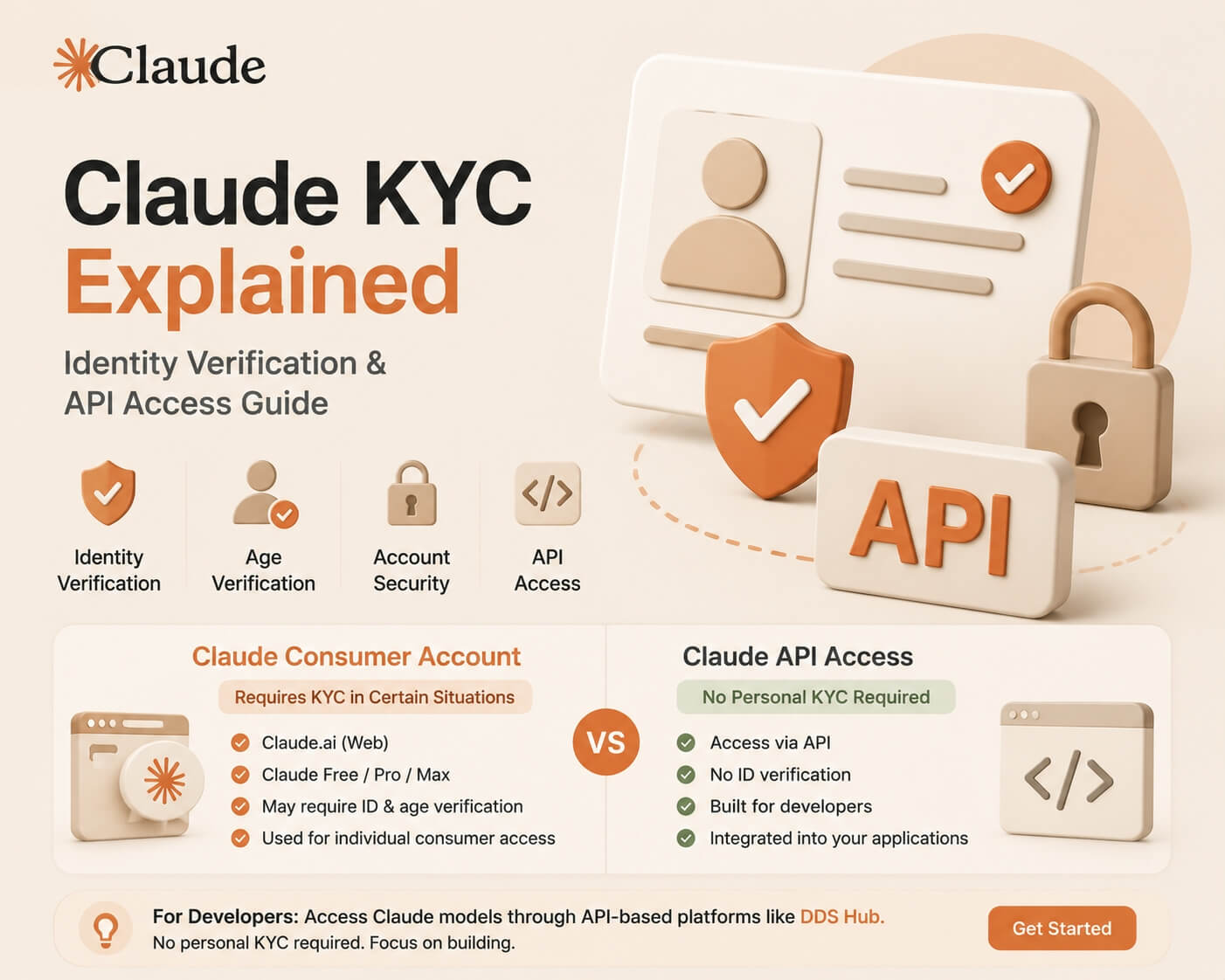
What Is Claude KYC?
KYC stands for Know Your Customer.
Originally used in banking and financial services, KYC refers to processes that verify a customer's identity.
In the AI industry, KYC usually means identity or age verification systems designed to:
- reduce abuse
- prevent fraudulent account usage
- improve platform security
- meet regulatory requirements
According to Anthropic's official Claude identity verification documentation, identity verification helps Anthropic prevent abuse, enforce usage policies, and maintain the security of Claude services.
The verification process may require users to confirm their identity through methods such as:
- government-issued identification
- selfie verification
- third-party identity verification services
Why Does Claude Require Identity Verification?
AI models are becoming increasingly powerful, and companies need stronger systems to maintain platform safety.
Common challenges faced by AI providers include:
- automated account creation
- account sharing
- abuse of free access programs
- unauthorized usage patterns
- compliance requirements
Identity verification is one approach companies use to make sure users are real individuals and reduce misuse.
Anthropic explains in its privacy policy updates that verification information may be collected in certain situations to support security, safety, and compliance requirements.
Importantly, this does not mean every Claude user must complete verification.
Instead, verification may be requested depending on factors such as:
- account activity
- security checks
- product access requirements
- regional requirements
Does Every Claude User Need KYC?
No.
A common misunderstanding is:
"Claude now requires every user to upload an ID."
This is not the official policy.
Anthropic's verification requirements apply mainly to consumer Claude products, including:
- Claude Free
- Claude Pro
- Claude Max
The verification process is designed to apply only in specific situations.
The exact triggers are not publicly disclosed, but users may encounter verification when Anthropic needs additional confirmation for security or compliance purposes.
What Information Does Claude Identity Verification Require?
The verification process depends on the situation.
Possible verification methods include:
| Verification Type | Possible Requirement |
|---|---|
| Identity verification | Government-issued ID |
| Age verification | Proof of age |
| Face verification | Selfie or facial verification |
According to Anthropic's identity verification help center, users may need to provide an accepted government-issued identification document and complete additional verification steps.
Anthropic also explains that verification providers may process certain information during this process.
What Is Claude Age Verification?
Identity verification and age verification are related but different concepts.
Age verification focuses on confirming that users meet minimum age requirements.
Anthropic explains through its Claude age assurance documentation that Claude consumer products require users to meet age requirements.
If Anthropic detects signals suggesting that an account may belong to an underage user, additional age confirmation may be required.
Possible verification methods include:
- age estimation
- identity document checks
- digital identity verification
Claude Consumer Account vs Claude API Access
One of the biggest sources of confusion is the difference between Claude.ai accounts and Claude API access.
Many users assume:
Claude Subscription = Claude API AccessHowever, they are designed for different purposes.
Claude Consumer Account
Claude consumer products are designed for personal usage.
The workflow looks like:
User
  ↓
Claude.ai
  ↓
Free / Pro / Max Subscription
  ↓
Chat Interface
Typical use cases:
- personal productivity
- research
- conversations
- individual assistance
Claude API Access
Claude API access is designed for developers.
The workflow looks like:
Developer Application
  ↓
API Key
  ↓
Claude Model
  ↓
Application Response
Typical use cases:
- AI applications
- SaaS products
- automation systems
- coding tools
Developers generally work with API credentials instead of consumer subscriptions. Anthropic provides API documentation through its developer platform documentation.
Why Developers Prefer Claude API Workflows
For developers, API access provides several advantages compared with consumer subscriptions.
Designed for Applications
API access allows developers to connect Claude models directly into:
- software products
- developer tools
- automation workflows
Instead of manually interacting through a chat interface, applications can send requests programmatically.
Better Usage Control
Developers can manage:
- API keys
- model selection
- application behavior
- usage limits
This makes API access more suitable for engineering projects.
Better Team Collaboration
For teams, API workflows make it easier to separate:
- testing environments
- development environments
- production systems
How DDS Hub Provides Claude API Access
For developers who want to use Claude models in coding workflows and applications, DDS Hub provides a developer-focused API access platform.
Unlike Claude consumer accounts, DDS Hub focuses on API-based model access through dedicated groups.
The workflow is:
Create DDS Hub Account
  ↓
Select Claude Group
  ↓
Create API Key
  ↓
Configure Application
  ↓
Use Claude Models
Developers do not need to create a Claude.ai consumer subscription account to use API-based Claude workflows through DDS Hub.
Understanding DDS Hub Claude Groups
DDS Hub uses a group-based API architecture.
The relationship is:
API Key
  ↓
Selected Group
  ↓
Available Models
Each API key belongs to one specific group. Users choose the group based on their usage scenario.
| DDS Hub Claude Group | Access Method | Recommended Scenario |
|---|---|---|
| Claude Max Pool Group | Claude Code CLI | Personal AI coding workflows |
| Claude Stable Group | API Access | Development and production applications |
| Claude Discount Group | API Access | Cost-sensitive projects and testing |
Which DDS Hub Claude Group Should Developers Choose?
Claude Max Pool Group
Recommended for developers who mainly use:
- Claude Code CLI
- AI coding assistants
- personal development workflows
This group focuses on Claude Code usage, making it a good fit for developers who spend most of their time inside a terminal-based coding assistant.
Claude Stable Group
Recommended for developers who need reliable API access for:
- development environments
- production applications
- long-running integrations
This group prioritizes stability, so it fits teams that are shipping real products and need consistent behavior.
Claude Discount Group
Recommended for developers who want to reduce cost during:
- early experimentation
- testing and prototyping
- high-volume, cost-sensitive workloads
This group focuses on affordability, making it a practical choice for projects where controlling spend matters more than peak performance.
You can compare the available options on the DDS Hub models page.
Claude Consumer Account or Claude API: Which Do You Need?
A simple way to decide:
| Your Goal | Recommended Path |
|---|---|
| Chatting and personal productivity | Claude consumer account (Free / Pro / Max) |
| Building apps, tools, or automation | Claude API access |
| Claude Code CLI coding workflows | API access via a Claude Max Pool group |
| Lowest-cost testing | API access via a Claude Discount group |
If your work is application-focused, API access is usually the better path — and it does not depend on completing consumer identity verification.
Conclusion
Claude KYC, identity verification, and age verification are safety and compliance mechanisms that Anthropic may apply to consumer Claude products in specific situations. They are not a blanket requirement for every user, and they are separate from how developers access Claude through the API.
The key takeaways:
- KYC means "Know Your Customer" — identity or age verification used to reduce abuse and meet compliance requirements.
- Verification applies mainly to consumer products (Free, Pro, Max) and only in specific situations.
- Claude consumer accounts and Claude API access are two different usage models.
- Developers usually work with API keys, not consumer subscriptions.
For developers exploring AI coding, automation, and AI applications, an API-based workflow is often the simplest way to start. When you're ready, activate Claude API access on DDS Hub and create your first group-based key.