
Claude Fable 5 vs Opus 5: Which AI Model Should Developers Choose for Coding and AI Agents?
The development of AI coding tools has changed how developers think about large language models.
In the early days, choosing an AI model was mainly about asking a simple question:
"Which model gives the best answer?"
Today, the question has become much more complicated.
Developers are no longer only using AI for conversations. They are building AI coding assistants, autonomous agents, software automation systems, and applications where models continuously analyze information and complete tasks.
Claude Fable 5 and Claude Opus 5 represent two different approaches to solving these problems.
Both models target advanced AI workloads, but they are optimized for different scenarios.
For developers deciding between them, the right question is not:
"Which model is stronger?"
The better question is:
"Which model is the right fit for my workflow?"
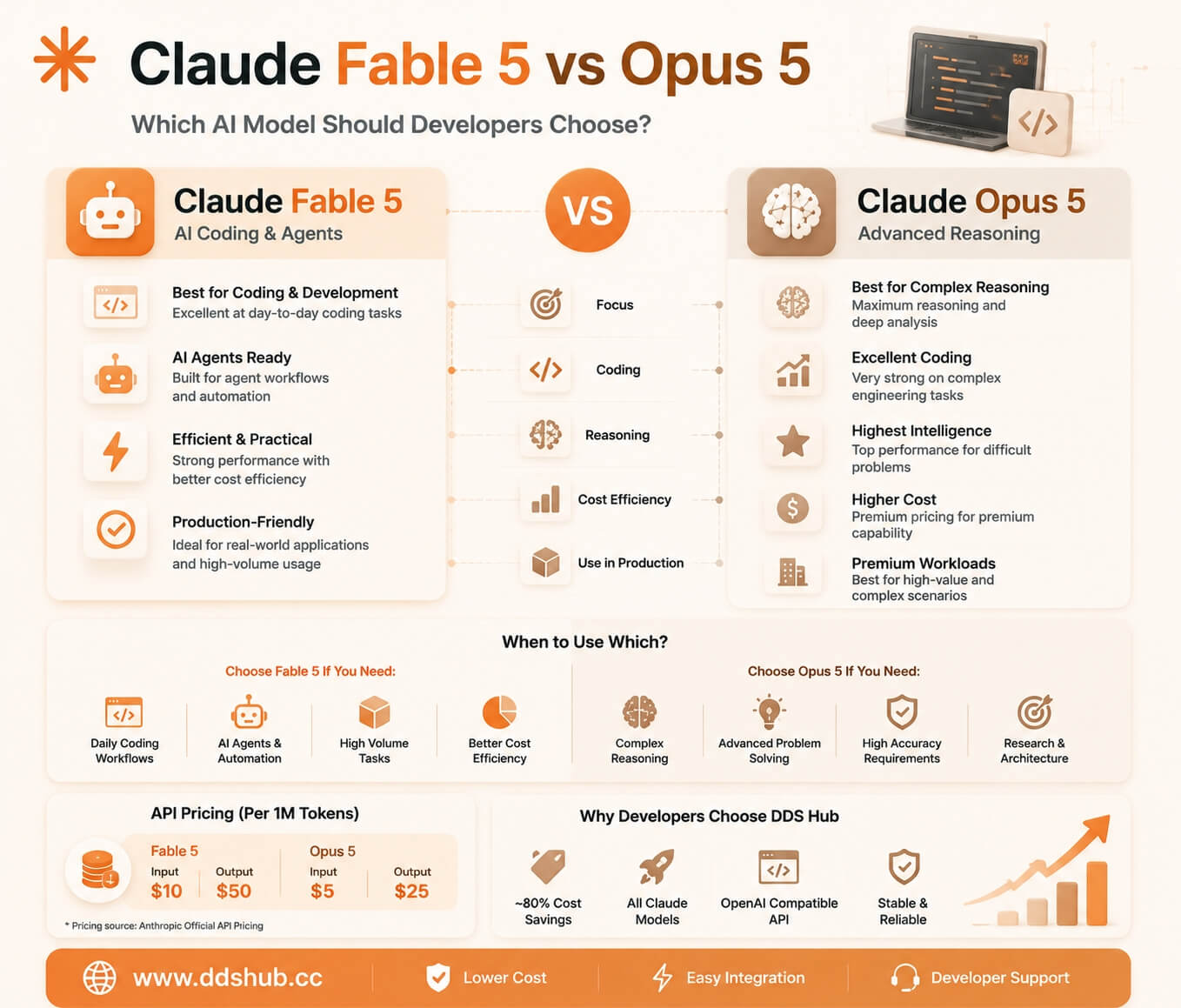
Claude Fable 5 and Opus 5: Different Goals for Different Workloads
Modern AI development requires a balance between intelligence, speed, and cost.
A model that produces the highest-quality answer is not always the best choice for every task.
For example, an autonomous coding agent may need to process hundreds of requests every day. A research assistant may only need a few high-quality responses.
The ideal model depends on the workload.
Claude Opus 5 is positioned as a high-capability reasoning model designed for situations where accuracy, complex analysis, and advanced problem solving are the priority.
Claude Fable 5 focuses more on practical developer workflows, including coding tasks, AI agents, and applications that require strong reasoning combined with efficient execution.
The difference is similar to choosing between a specialized expert and a highly capable engineering assistant.
Claude Fable 5 vs Opus 5: Capability Comparison
| Category | Claude Fable 5 | Claude Opus 5 |
|---|---|---|
| Primary focus | AI coding and agent workflows | Maximum reasoning capability |
| Best for | Software development, automation, AI agents | Complex analysis and advanced reasoning |
| Coding tasks | Excellent | Excellent |
| Long reasoning tasks | Very strong | Stronger |
| Cost efficiency | Higher | Lower |
| Production applications | Very suitable | Suitable for premium workloads |
For most developers building applications, the decision is not simply about choosing the most powerful model.
It is about choosing the model that provides the best balance between capability and operating cost.
Coding Performance: Fable 5 vs Opus 5
Coding is one of the most important use cases for Claude models.
Modern AI coding workflows require more than generating a few lines of code.
A capable coding model needs to understand project structure, maintain consistency across files, reason about dependencies, and modify existing systems without introducing unexpected problems.
Both Fable 5 and Opus 5 perform well in these scenarios.
However, the difference appears when considering workflow design.
For daily development tasks such as writing features, reviewing code, fixing bugs, and improving existing applications, Fable 5 can provide an excellent balance between performance and efficiency.
For extremely complex engineering problems, such as designing large architectures, analyzing difficult algorithms, or solving unfamiliar technical challenges, Opus 5 may provide additional reasoning capability.
In practice, many teams will not use only one model.
They may use Fable 5 for the majority of development tasks and reserve Opus 5 for the most difficult problems.
AI Agents: Why Model Selection Matters More Than Ever
The rise of AI agents has changed model requirements.
A chatbot usually handles one interaction.
An AI agent completes a process.
For example, a software engineering agent may receive a task, inspect a repository, analyze existing code, create a plan, implement changes, test the result, and iterate until the problem is solved.
This workflow requires repeated model calls.
The cost difference between models becomes much more significant when multiplied across thousands of tasks.
This is why many developers are moving toward model routing strategies.
A simple task does not always require the strongest model.
A complex reasoning problem does.
Using Fable 5 for everyday development and Opus 5 for high-value reasoning tasks can create a better balance between performance and cost.
API Pricing: Performance vs Cost
When comparing AI models, capability is only one part of the equation.
For developers building commercial applications, API cost is equally important.
A powerful model that is too expensive may not be practical at scale.
Claude API pricing is based on token consumption, including both input and output tokens.
Official pricing: Claude API pricing.
The approximate pricing structure is:
| Model | Input Cost | Output Cost |
|---|---|---|
| Claude Fable 5 | Higher | Higher |
| Claude Opus 5 | Premium | Premium |
The exact cost depends on the official model pricing and usage volume.
For production applications, developers usually optimize costs by selecting the right model for each task instead of sending every request to the most expensive model.
Why Developers Should Not Use One Model for Everything
One common mistake in AI application development is assuming that the strongest model should handle every request.
This is similar to using a high-end server for every small task.
It works, but it is inefficient.
A better architecture separates workloads.
Simple requests can use faster, lower-cost models.
Complex reasoning tasks can use advanced models.
Coding agents can dynamically select models depending on the difficulty of the task.
This approach improves both performance and cost efficiency.
Accessing Claude Fable 5 and Opus 5 Through DDS Hub
For developers building AI applications, API access provides more flexibility than personal subscriptions.
DDS Hub provides Claude API access through a unified API platform, allowing developers to integrate advanced Claude models into their own applications.
Instead of managing multiple accounts or subscription limitations, developers can use a standard API workflow and select the model that fits their needs.
DDS Hub also focuses on reducing AI infrastructure costs. Claude API access through DDS Hub is approximately 20% of official API pricing, helping developers reduce expenses when running AI agents, coding assistants, and automation systems.
Developers can access models through:
Website: DDS Hub
Models: DDS Hub Models
API Endpoint:
https://www.ddshub.cc/v1Fable 5 or Opus 5: Which Model Should You Choose?
For most developers building AI applications, Fable 5 is likely the more practical choice.
It provides strong coding capability while maintaining better cost efficiency for repeated workflows.
Opus 5 is better suited for situations where maximum reasoning quality matters more than cost, such as complex research, advanced architecture design, or difficult technical analysis.
A simple guideline:
- For daily coding workflows, choose Fable 5.
- For extremely complex reasoning problems, consider Opus 5.
- For a large AI product, combine both through model routing.
Final Thoughts
Claude Fable 5 and Opus 5 represent two different directions in AI development.
Fable 5 focuses on making advanced AI capabilities practical for everyday engineering workflows.
Opus 5 focuses on pushing the limits of reasoning and problem solving.
For developers, the future is unlikely to be about choosing one model forever.
The best AI systems will combine multiple models, selecting the right capability for each task while controlling cost.
With API platforms such as DDS Hub, developers can experiment with different Claude models, optimize their workflows, and build scalable AI applications without being limited by a single access method.