
Claude Fable 5 Explained: Model Routing, Opus 4.8 Fallback and What Changed After Relaunch
The release of Claude Fable 5 represents a new stage in the evolution of AI coding and reasoning models. Instead of simply increasing model size or focusing only on benchmark improvements, the latest generation of AI systems increasingly relies on intelligent routing, specialized capabilities, and adaptive model selection to provide better results across different workloads.
For developers, one of the most important changes is understanding that a modern AI model experience is not always determined by a single underlying model. In many cases, requests may involve different processing paths depending on the task type, safety requirements, performance needs, and availability.
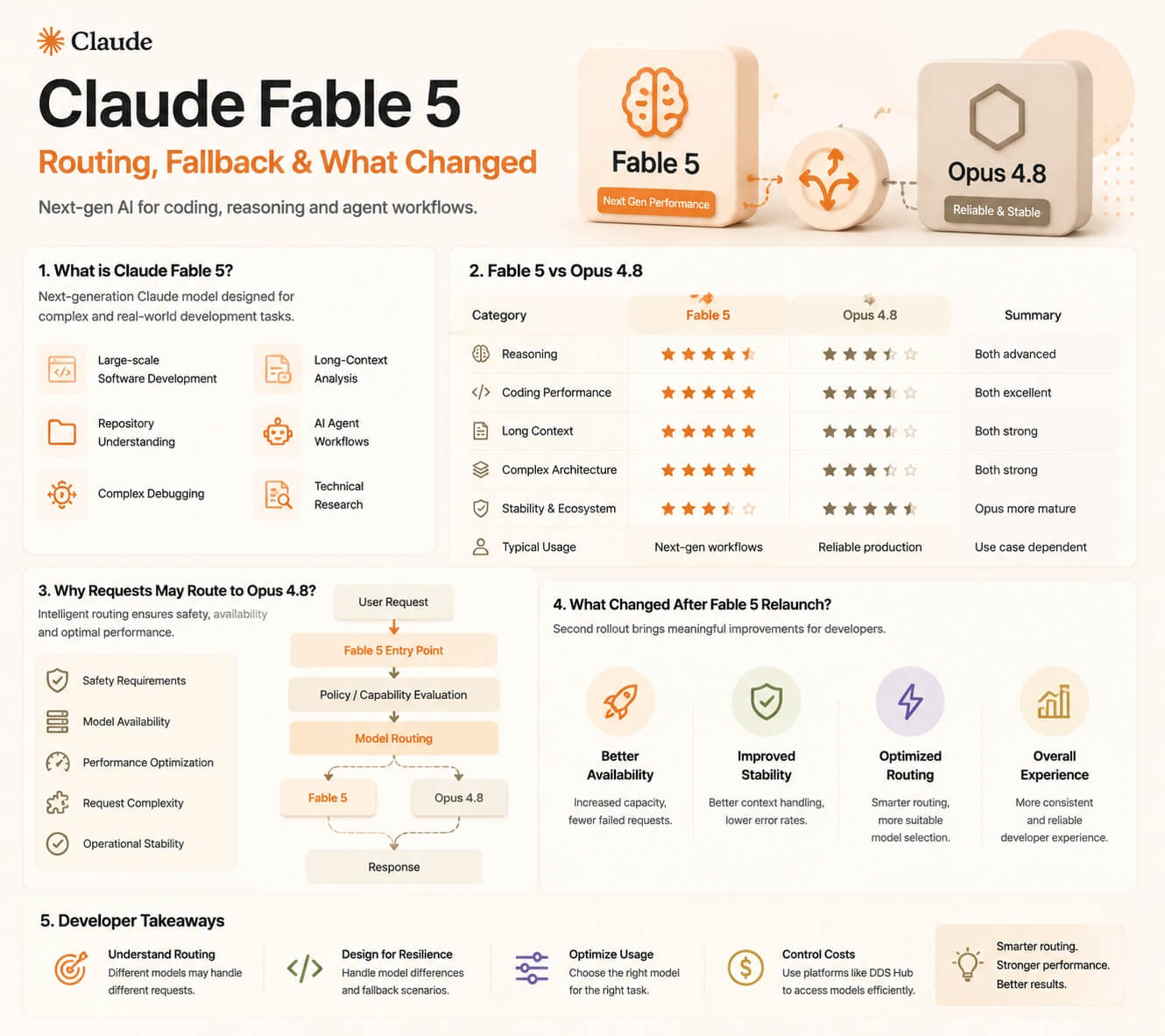
This is why understanding concepts such as model routing, fallback mechanisms, and specialized model behavior has become increasingly important.
This article explains how Claude Fable 5 fits into modern AI workflows, why some requests may be handled by Opus 4.8, what changed after the second Fable 5 rollout, and how developers can optimize their usage through platforms such as DDS Hub.
What Is Claude Fable 5?
Claude Fable 5 is positioned as a next-generation Claude model designed to improve reasoning, coding ability, and complex task execution. Compared with previous Claude generations, Fable 5 focuses on providing stronger performance for advanced workflows such as:
- Large-scale software development
- Repository understanding
- Complex debugging
- Long-context analysis
- AI agent workflows
- Technical research
For developers, the biggest improvement is not only raw intelligence but also better ability to operate inside complex environments.
Modern coding tasks are rarely isolated questions. A developer may ask an AI assistant to analyze thousands of files, understand architecture decisions, modify multiple components, and verify changes through tests.
A stronger reasoning model can reduce the number of iterations required to complete these tasks.
Claude Fable 5 vs Opus 4.8: Different Roles in AI Workflows
Many users compare Fable 5 directly with Opus 4.8, but the relationship between models is often more complicated than a simple replacement.
A practical comparison:
| Category | Claude Fable 5 | Claude Opus 4.8 |
|---|---|---|
| Reasoning Capability | Advanced | Advanced |
| Coding Performance | Excellent | Excellent |
| Long Context Tasks | Strong | Strong |
| Complex Architecture | Strong | Strong |
| Stability | Depends on availability and routing | Mature ecosystem |
| Typical Usage | New generation workflows | Reliable production workloads |
For many development scenarios, both models are capable of handling advanced programming tasks. The choice often depends on availability, pricing, latency, and specific workload requirements.
Why Some Requests May Be Routed to Opus 4.8
One of the most discussed topics after Fable 5 availability changes is model fallback behavior.
In modern AI platforms, the model shown to users does not always represent a single fixed inference path. Providers may use intelligent routing systems to balance:
- Safety requirements
- Model availability
- Performance optimization
- Request complexity
- Operational stability
For certain categories of requests, especially those involving sensitive content policies or specialized evaluation requirements, the system may route the request through another model such as Opus 4.8.
This does not necessarily mean the original model is unavailable. Instead, it represents an adaptive architecture where different models may participate depending on the request context.
A simplified workflow:
User Request
   ↓
Fable 5 Entry Point
   ↓
Policy / Capability Evaluation
   ↓
Model Routing
   ↓
Fable 5 or Opus 4.8 Processing
   ↓
Response
For developers building applications on top of AI models, understanding this behavior is important because the final user experience depends not only on model selection but also on the provider's routing strategy.
What Changed After Claude Fable 5 Relaunch?
After the second rollout, many developers noticed changes in availability, performance consistency, and overall usability.
The main improvements users generally expect from a relaunch include:
Better Availability
Early access periods for large models often experience high demand. A second rollout typically focuses on improving capacity, reducing failed requests, and expanding access.
For developers running production workloads, availability is often as important as benchmark performance.
A slightly less powerful model that is consistently available can outperform a theoretically stronger model with unstable access.
Improved Stability for Coding Workflows
AI coding requires long-running sessions, large context windows, and frequent tool calls.
Improvements in context handling, request reliability, tool execution, and streaming responses can have a major impact on developer productivity.
For Claude Code users, stability improvements are especially valuable because coding sessions may involve hundreds of interactions rather than a single prompt.
More Practical Model Selection
As AI model families become larger, choosing the right model becomes increasingly important.
A practical approach:
| Task | Recommended Choice |
|---|---|
| Complex architecture design | Fable 5 / Opus-class model |
| Large repository analysis | Fable 5 |
| Daily coding | Fable 5 or balanced Claude models |
| Lightweight automation | Smaller Claude models |
| High-volume requests | Cost-efficient models |
Using the strongest model for every request is usually not the most efficient strategy.
Claude Fable 5 Prompt Engineering Tips
Even with advanced models, prompt quality remains one of the biggest factors affecting output quality.
Provide Clear Engineering Context
Instead of:
Fix this code.Provide:
You are a senior software engineer.

Analyze this authentication module.

Identify security risks.

Provide a production-ready solution.
The additional context helps the model understand expectations.
Separate Planning and Implementation
For complex coding tasks, avoid requesting everything at once.
A better workflow:
Step 1: Analyze the current architecture.
Step 2: Create an implementation plan.
Step 3: Generate code changes.
Step 4: Review potential issues.
This reduces mistakes and improves consistency.
Control Context Size
Large context windows are powerful, but unnecessary information can reduce efficiency.
Developers should:
- Remove unused files from analysis
- Keep CLAUDE.md concise
- Use /compact
- Clean unused Skills and plugins
Better context is usually more valuable than more context.
Using Claude Fable 5 Through DDS Hub
For developers who use multiple AI coding models, managing separate providers can become complicated. Different models may require different API configurations, billing systems, and client settings.
DDS Hub provides a developer-focused gateway for accessing different AI model families through dedicated groups.
Unlike a universal API key system, DDS Hub uses separate model groups. Each API key is connected to one specific group, and each group represents a model family.
For example:
| DDS Hub Group | Usage Scenario |
|---|---|
| Claude Stable Group | Stable Claude API usage |
| Claude Discount Group | Lower-cost Claude workloads |
| Claude Max Pool Group | Claude Code CLI workflows |
| Codex Groups | Codex-based coding workflows |
| GLM Groups | OpenAI-compatible integrations |
This architecture allows developers to select the right balance between cost, stability, and workflow compatibility.
Developers can learn more about supported models and configuration through the official DDS Hub resources: the DDS Hub Documentation and the DDS Hub Homepage.
Conclusion
Claude Fable 5 represents the next step toward more adaptive AI systems, where model capability, routing strategy, and infrastructure reliability work together to create better user experiences.
For developers, the most important lesson is that AI performance is no longer determined only by the name of the model. Factors such as routing behavior, context management, prompt engineering, and platform architecture all influence the final result.
Understanding how Fable 5 works alongside models like Opus 4.8 helps developers make better decisions when building AI-powered applications.
By combining effective prompting, efficient context management, and flexible platforms such as DDS Hub, developers can get more value from advanced AI coding models while maintaining control over cost, stability, and workflow design.