
Claude Code vs OpenAI Codex: Which AI Coding Assistant Should Developers Choose in 2026?
AI coding has evolved rapidly over the past year. Instead of asking whether AI can write code, developers are now asking a more practical question: which AI coding assistant fits their workflow best? Two of the strongest contenders are Claude Code from Anthropic and OpenAI Codex. Both are designed for software development, both integrate deeply with the terminal, and both can understand large codebases, but they approach programming from different perspectives.
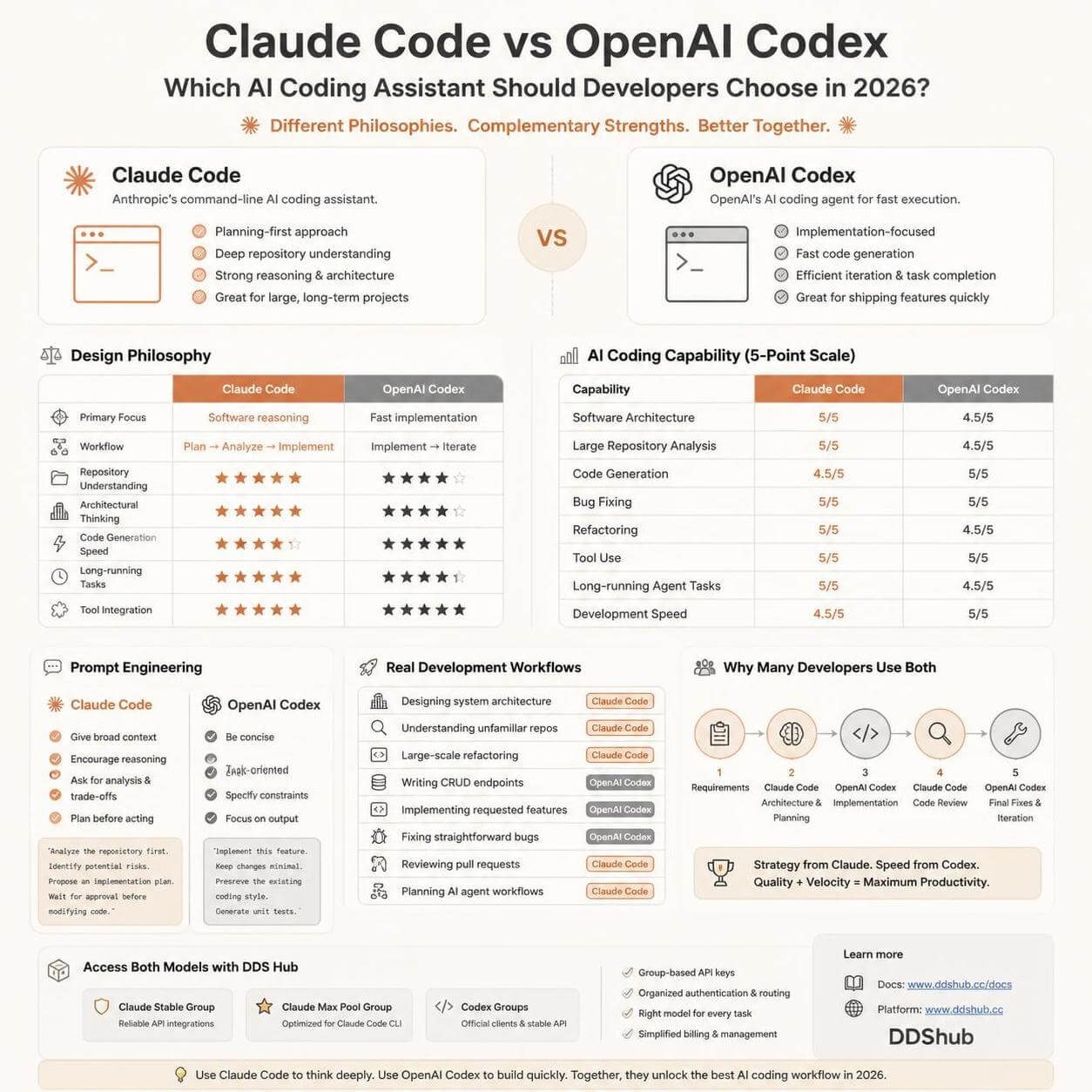
Rather than declaring a single winner, this guide compares Claude Code and OpenAI Codex based on real development scenarios, including software architecture, implementation speed, repository understanding, prompt engineering, and developer productivity. By the end, you'll have a clearer idea of when to use each tool—and why many professional developers choose to use both together.
What Is Claude Code?
Claude Code is Anthropic's command-line AI coding assistant. Instead of acting as a simple code generator, it behaves more like an AI software engineer capable of understanding an entire repository, planning complex changes, refactoring existing systems, writing tests, and coordinating multi-step development tasks.
One of Claude Code's biggest strengths is its reasoning ability. Before modifying code, it typically analyzes project structure, dependencies, and potential side effects, making it particularly effective for large production codebases where architectural consistency matters as much as implementation speed.
This planning-first approach has made Claude Code especially popular among developers working on long-term projects, enterprise software, and AI agent workflows.
Official documentation: https://docs.anthropic.com/en/docs/claude-code
What Is OpenAI Codex?
OpenAI Codex is OpenAI's AI-powered coding agent designed to assist developers directly from the terminal and development environment. While it also understands repositories and project context, its design philosophy emphasizes rapid execution, task completion, and iterative development.
Codex performs particularly well when developers already know what they want to build and need an assistant that can quickly generate code, implement features, write unit tests, fix bugs, or perform repetitive programming tasks with minimal prompting.
Rather than spending additional time planning, Codex often focuses on efficiently transforming instructions into working code.
Official documentation: https://developers.openai.com/codex
Design Philosophy
Although both products target software developers, their design philosophies are noticeably different.
| Category | Claude Code | OpenAI Codex |
|---|---|---|
| Primary Focus | Software reasoning | Fast implementation |
| Workflow | Plan → Analyze → Implement | Implement → Iterate |
| Repository Understanding | Excellent | Excellent |
| Architectural Thinking | Excellent | Very Good |
| Code Generation Speed | Very Good | Excellent |
| Long-running Tasks | Excellent | Very Good |
| Tool Integration | Excellent | Excellent |
Neither philosophy is inherently better. Instead, each reflects different stages of the software development lifecycle.
AI Coding Capability Breakdown
Using a five-point scale, the overall experience can be summarized as follows.
| Capability | Claude Code | OpenAI Codex |
|---|---|---|
| Software Architecture | 5/5 | 4.5/5 |
| Large Repository Analysis | 5/5 | 4.5/5 |
| Code Generation | 4.5/5 | 5/5 |
| Bug Fixing | 5/5 | 5/5 |
| Refactoring | 5/5 | 4.5/5 |
| Tool Use | 5/5 | 5/5 |
| Long-running Agent Tasks | 5/5 | 4.5/5 |
| Development Speed | 4.5/5 | 5/5 |
Claude Code generally excels at understanding systems before making changes, while Codex often delivers faster implementation once the objective is clear.
Prompt Engineering: Different Models Prefer Different Instructions
An overlooked difference between these assistants is how they respond to prompts.
Claude Code generally performs best when given broader context and encouraged to reason before acting. Prompts that ask it to analyze a repository, explain trade-offs, and propose an implementation plan often produce more maintainable results.
For example:
- Analyze the repository first.
- Identify potential risks.
- Propose an implementation plan.
- Wait for approval before modifying code.
OpenAI Codex, on the other hand, usually benefits from concise and task-oriented instructions.
For example:
- Implement this feature.
- Keep changes minimal.
- Preserve the existing coding style.
- Generate unit tests.
Neither prompting style is universally better; they simply align with different model behaviors.
Real Development Workflows
In day-to-day development, the choice often depends on the task rather than the model.
| Development Scenario | Recommended Assistant |
|---|---|
| Designing system architecture | Claude Code |
| Understanding unfamiliar repositories | Claude Code |
| Large-scale refactoring | Claude Code |
| Writing CRUD endpoints | OpenAI Codex |
| Implementing requested features | OpenAI Codex |
| Fixing straightforward bugs | OpenAI Codex |
| Reviewing pull requests | Claude Code |
| Planning AI agent workflows | Claude Code |
This pattern reflects a broader trend: developers increasingly select tools based on workflow stage instead of expecting one assistant to handle every task equally well.
Why Many Developers Use Both
Perhaps the most interesting development in 2026 is that experienced engineers rarely choose between Claude Code and Codex. Instead, they combine them into a complementary workflow.
A common pattern looks like this:
Requirements
      ↓
Claude Code — Architecture & Planning
      ↓
OpenAI Codex — Implementation
      ↓
Claude Code — Code Review
      ↓
OpenAI Codex — Final Fixes & Iteration
      ↓
Deployment
Claude Code provides strategic guidance, architectural analysis, and high-level reasoning, while Codex accelerates implementation and repetitive engineering work. Together, they create a workflow that balances quality with speed.
Accessing Both Models Through DDS Hub
Managing multiple AI providers can quickly become complicated, especially for teams using different coding assistants throughout the development lifecycle. DDS Hub simplifies this by providing dedicated model groups for Claude, Codex, and GLM. Rather than using a single universal API key, each API key is associated with a specific model group, allowing developers to keep authentication, routing, and billing organized while selecting the right model family for each task.
For example, the Claude Stable Group is designed for reliable API integrations, the Claude Max Pool Group is optimized for Claude Code CLI usage, and dedicated Codex groups support both official clients and stable API access. This group-based approach makes it straightforward to switch between reasoning-heavy workflows and implementation-focused workflows without managing multiple platforms.
Learn more:
Documentation: https://www.ddshub.cc/docs
Platform: https://www.ddshub.cc
Final Thoughts
Claude Code and OpenAI Codex represent two different philosophies of AI-assisted software development. Claude Code emphasizes planning, reasoning, architectural consistency, and long-running engineering tasks, making it particularly effective for understanding complex systems and guiding large projects. OpenAI Codex prioritizes fast execution, efficient implementation, and rapid iteration, allowing developers to convert ideas into working code with minimal friction.
For most professional teams, the choice is no longer about selecting one assistant over the other. Instead, the most productive workflow often combines both: using Claude Code to analyze and design software, then relying on Codex to accelerate implementation and repetitive coding tasks before returning to Claude for review and refinement. As AI-assisted development continues to mature, understanding when to use each tool may become more valuable than deciding which tool is better.