
Claude API Pricing Explained: Claude Subscription vs API Costs and How Developers Save 80%
Claude has become one of the most popular AI platforms among developers, especially for AI coding, autonomous agents, and enterprise automation.
However, as more developers start integrating Claude into real applications, one question appears frequently:
How much does Claude API actually cost, and is a Claude subscription enough for development?
Although Claude subscription and Claude API provide access to the same AI ecosystem, they are designed for completely different scenarios.
A subscription is mainly built for individual users who interact with Claude through the official application. API access, on the other hand, is designed for developers who want to integrate Claude into software products, AI agents, and automated workflows.
Choosing the wrong option can lead to unnecessary expenses, usage limitations, or difficulties when scaling an AI application.
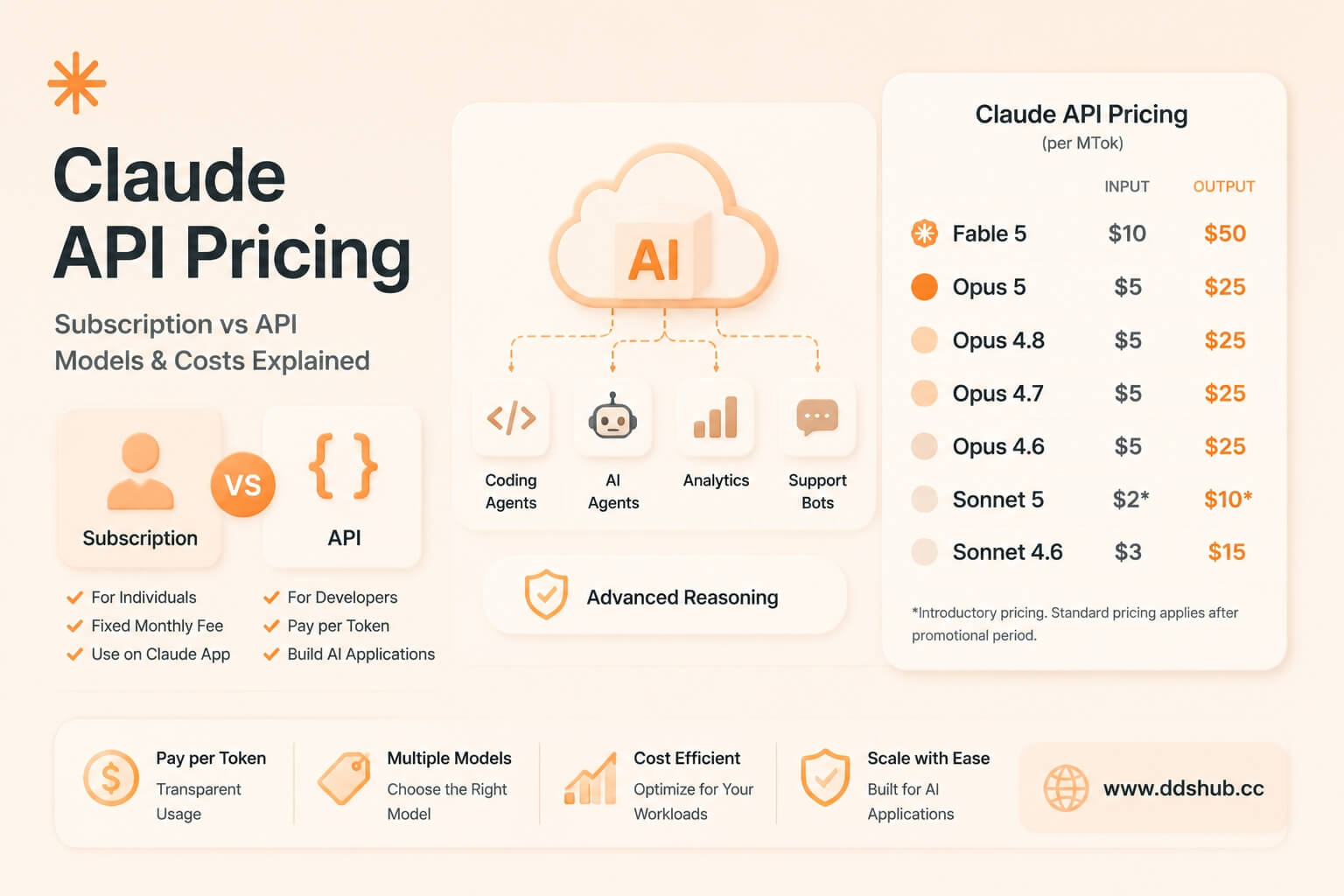
This guide explains Claude pricing structure, compares subscription and API usage, analyzes common access challenges, and introduces how developers can use DDS Hub to access Claude models with lower API costs.
Official references: Claude API pricing and Claude subscription pricing.
Understanding Claude Pricing: Subscription and API Are Different Products
The first thing developers need to understand is that Claude subscription and Claude API are not interchangeable.
Claude subscription is designed for human users.
A user pays a fixed monthly fee and interacts with Claude through the Claude application. This model is suitable for personal productivity, writing, research, and individual coding assistance.
For example, a developer who occasionally uses Claude Code for personal projects may find Claude Pro or Claude Max convenient because the monthly cost is predictable.
However, subscription plans are not designed to support production applications.
A company building an AI coding platform, customer support system, or AI agent cannot simply use a personal Claude subscription as the backend. Production applications require API keys, usage tracking, scalable infrastructure, and predictable request management.
Claude API follows a different pricing model.
Instead of paying a fixed monthly fee, developers pay based on actual usage. The cost depends on:
- Input tokens
- Output tokens
- Model selection
- Application architecture
- Number of requests
For developers building AI products, API access provides much greater flexibility.
Claude Subscription Plans Explained
Claude subscription plans are designed around user experience rather than application infrastructure.
According to Claude's official pricing page, current subscription options include Free, Pro, Max, Team, and Enterprise plans.
Claude Pro is designed for individual users who need more access than the free plan. It provides higher usage limits and access to additional Claude features, including Claude Code.
Claude Max targets heavy users who need significantly more Claude usage for demanding workflows.
For personal developers, researchers, and AI enthusiasts, subscriptions provide a simple experience:
You pay monthly, open Claude, and start working.
The limitation is that subscription usage is still tied to a user account rather than an application.
When usage becomes automated or high-volume, API access becomes the more suitable solution.
Claude API Pricing Explained
Claude API uses token-based billing.
Anthropic calculates API costs based on the number of tokens processed by the model. Pricing is measured using MTok, which means one million tokens.
Different Claude models have different prices because they target different levels of reasoning capability.
Higher-performance models provide stronger reasoning and are usually used for complex coding, AI agents, and enterprise workflows.
Claude Model API Price Comparison
The following table shows commonly used Claude models and their official API prices.
| Model | Input Price | Output Price | Typical Usage |
|---|---|---|---|
| Claude Fable 5 | $10 / MTok | $50 / MTok | Advanced AI agents and complex enterprise workflows |
| Claude Opus 5 | $5 / MTok | $25 / MTok | Advanced coding agents and reasoning tasks |
| Claude Opus 4.8 | $5 / MTok | $25 / MTok | Complex software engineering |
| Claude Opus 4.7 | $5 / MTok | $25 / MTok | High-level reasoning workloads |
| Claude Opus 4.6 | $5 / MTok | $25 / MTok | Coding and analysis tasks |
| Claude Sonnet 5 | $3 / MTok | $15 / MTok | High-performance general development |
| Claude Sonnet 4.6 | $3 / MTok | $15 / MTok | Balanced AI applications |
Anthropic runs an introductory promotion on Claude Sonnet 5 at $2 / MTok input and $10 / MTok output through August 31, 2026. Official pricing may change over time, so developers should always confirm the latest numbers through the official documentation.
Why Claude Models Have Different Prices
Claude model pricing reflects different capability levels.
Opus-class models are designed for difficult reasoning tasks where accuracy matters more than cost. They are commonly used in AI coding agents, complex research workflows, and enterprise automation.
Sonnet models focus on balancing intelligence and efficiency. For many developers, Sonnet provides enough capability for daily coding tasks while keeping API expenses lower.
Frontier-level models such as Fable 5 are designed for the most demanding AI agent scenarios. They are suitable when the AI system needs to perform long reasoning chains, use tools, and complete complicated workflows.
However, using the most powerful model for every request is not always the most economical strategy.
A well-designed AI application usually combines different models depending on the task.
Claude Subscription vs API: Advantages and Disadvantages
For individual users, subscription plans have an obvious advantage: simplicity.
Users do not need to manage API keys, monitor token usage, or maintain billing infrastructure.
This makes subscriptions ideal for:
- Learning AI tools
- Personal coding
- Writing assistance
- Research
However, subscription plans have limitations for developers.
Because subscriptions are designed around human interaction, they are not optimized for automated applications.
Developers may encounter:
- Usage limits
- Account-based restrictions
- Difficulty integrating into products
- Lack of programmatic control
An AI agent running continuously in the background consumes resources very differently from a person asking occasional questions.
Why Developers Choose Claude API
Claude API provides much more flexibility for software development.
With API access, developers can build:
AI coding assistants that understand repositories and help modify software.
Customer support agents that analyze conversations and provide automated responses.
Enterprise assistants that search documents, summarize information, and automate workflows.
Research agents that analyze large amounts of information and generate reports.
The API model allows developers to control how Claude is used inside their own products.
Challenges When Using Official Claude API
Although official API access provides direct integration, some developers experience practical difficulties during setup.
One common issue is payment accessibility.
Anthropic requires supported payment methods and billing information. According to Anthropic support documentation, card payments may fail due to reasons such as bank rejection, verification issues, or billing information mismatch.
For some international developers, especially users without suitable international payment methods, setting up and maintaining API access can become inconvenient.
Other developers also report concerns around:
- Payment stability
- Account verification
- Regional availability
- Managing multiple AI providers
For production systems, stable access and predictable costs are important factors.
DDS Hub Claude API Pricing: Access Claude at 20% of Official API Cost
For developers who need frequent Claude API usage, controlling cost becomes a major consideration.
DDS Hub provides Claude API access at approximately 20% of official API pricing, allowing developers to reduce Claude API costs by around 80% compared with direct official pricing.
The following comparison shows the difference.
| Model | Official API Price | DDS Hub Approximate Price |
|---|---|---|
| Claude Fable 5 | $10 Input / $50 Output per MTok | ~$2 Input / ~$10 Output per MTok |
| Claude Opus 5 | $5 Input / $25 Output per MTok | ~$1 Input / ~$5 Output per MTok |
| Claude Opus 4.8 | $5 Input / $25 Output per MTok | ~$1 Input / ~$5 Output per MTok |
| Claude Opus 4.7 | $5 Input / $25 Output per MTok | ~$1 Input / ~$5 Output per MTok |
| Claude Opus 4.6 | $5 Input / $25 Output per MTok | ~$1 Input / ~$5 Output per MTok |
| Claude Sonnet 5 | $3 Input / $15 Output per MTok | ~$0.6 Input / ~$3 Output per MTok |
| Claude Sonnet 4.6 | $3 Input / $15 Output per MTok | ~$0.6 Input / ~$3 Output per MTok |
For developers running AI agents or coding platforms, this difference can significantly impact operating costs.
A system consuming millions of tokens every month can save substantial infrastructure expenses by optimizing API access.
How Developers Use DDS Hub Claude API
DDS Hub provides developers with a unified API access platform.
Instead of managing multiple AI provider accounts separately, developers can integrate through a familiar API format.
API Base URL:
https://www.ddshub.cc/v1Full documentation is available in the DDS Hub Documentation, and supported models are listed on the DDS Hub Models page.
The platform is designed for developers who need:
- Flexible API access
- Lower AI model costs
- Multiple model options
- Easier usage management
How to Reduce Claude API Costs
Reducing AI cost is not only about finding cheaper API access.
Application architecture also plays an important role.
A common mistake is using the strongest model for every request.
For example, a simple text classification task does not require an Opus-level model.
A better approach is:
Use advanced models for complex reasoning.
Use balanced models for regular coding tasks.
Use lightweight models for simple operations.
Prompt optimization is another important factor.
Poor prompts often create unnecessary conversations, longer responses, and additional token usage.
Developers can reduce costs by writing clearer instructions, limiting unnecessary context, and designing structured outputs.
Anthropic also provides prompt caching features that reduce repeated input costs for workloads involving large system prompts, documentation, and repository context.
Final Thoughts
Claude pricing reflects the changing way developers use AI.
Subscriptions are designed for people who want to interact with Claude directly.
API access is designed for developers building products powered by Claude.
For personal usage, Claude Pro and Max provide a simple experience.
For software development, AI agents, and commercial applications, API access provides the flexibility required for scaling.
However, developers also need to consider practical factors such as payment availability, account stability, and long-term operating costs.
By combining the right model selection strategy with cost-efficient API access platforms like DDS Hub, developers can build more powerful AI applications while maintaining better control over expenses.
As AI agents become increasingly common, managing model costs will become just as important as choosing the right model.