
Cheap Coding API: How Developers Reduce AI Coding Costs Without Sacrificing Quality
AI-assisted software development has rapidly evolved from simple code completion into a core component of modern engineering workflows. Today, developers use large language models to review pull requests, understand unfamiliar repositories, generate documentation, debug production issues, and even coordinate autonomous AI coding agents.
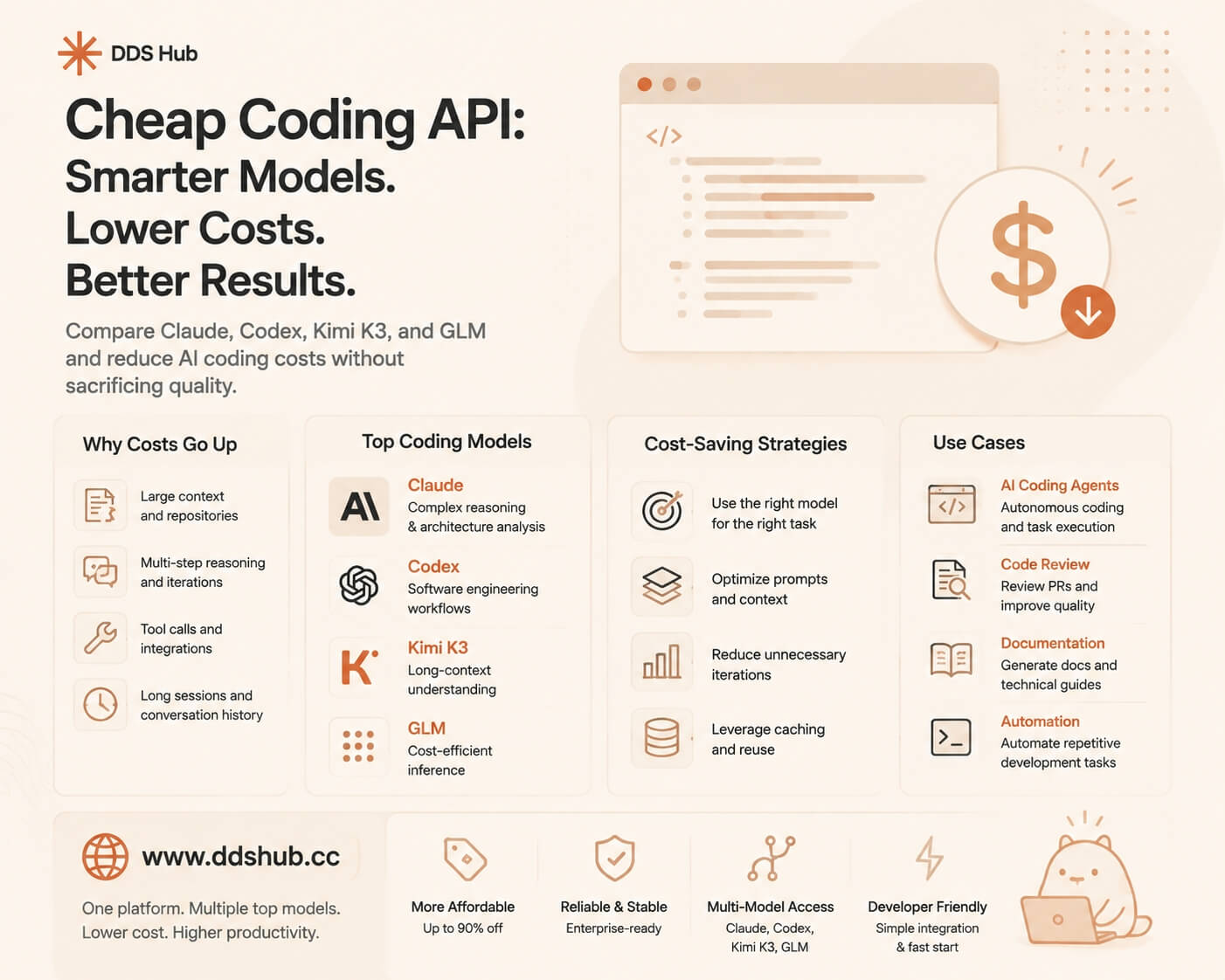
As adoption grows, however, another question becomes increasingly important:
How can developers reduce AI coding costs without sacrificing model quality?
The answer is rarely as simple as choosing the cheapest API. Modern engineering teams are discovering that controlling infrastructure costs requires selecting the right model for each task, optimizing workflows, and using platforms that simplify access to multiple AI models. Instead of relying on a single provider, many organizations now combine Claude, Codex, Kimi K3, and GLM to balance capability, latency, and cost.
This guide explores how developers evaluate AI coding APIs, compares the strengths of today's leading coding models, and explains practical strategies for lowering AI development costs.
Why AI Coding Costs Are Increasing
The cost of AI coding applications is determined by much more than the price per million tokens.
Modern coding assistants continuously analyze repositories, retrieve documentation, maintain conversation history, call external tools, and generate multiple iterations of code before producing a final answer. These workflows often consume significantly more tokens than ordinary chatbot conversations.
For example, asking an AI to generate a small Python function may require only a few thousand tokens. Asking the same model to understand an entire enterprise repository, review architectural decisions, and implement changes across multiple files can require hundreds of thousands of tokens during a single session.
As AI coding becomes more sophisticated, infrastructure design has become just as important as model selection.
Comparing Today's Leading AI Coding APIs
Different models excel at different aspects of software development. Rather than searching for one universally "best" coding model, experienced engineering teams evaluate each model according to its strengths.
| Model | Primary Strength | Typical Coding Scenario |
|---|---|---|
| Claude | Complex reasoning and architecture analysis | Code reviews, debugging, planning |
| Codex | Software engineering workflows | Code generation, implementation |
| Kimi K3 | Long-context understanding | Large repositories, documentation analysis |
| GLM | Cost-efficient inference | High-volume automation and repetitive coding tasks |
Claude has become a popular choice for complex engineering problems because of its reasoning capability and ability to analyze software architecture. Codex focuses heavily on implementation and programming workflows, while Kimi K3 performs particularly well when large repositories or extensive technical documentation must be processed within a single context window. GLM offers an attractive balance for applications where cost efficiency is more important than maximum reasoning performance.
Each model therefore occupies a different position within a modern AI development workflow.
The Cheapest Model Is Not Always the Cheapest Solution
A common misconception is that selecting the lowest-priced model automatically minimizes infrastructure costs.
In practice, model quality directly affects how many API calls are required to complete a task. A weaker model may require additional prompts, repeated corrections, or multiple reasoning cycles before producing acceptable output.
Conversely, a more capable model can sometimes complete complex work in fewer requests, reducing the total number of tokens consumed throughout an entire workflow.
For this reason, engineering teams increasingly evaluate total task cost rather than token price alone.
Multi-Model Routing Has Become the Industry Standard
One of the most important trends in AI infrastructure is model routing.
Instead of processing every coding request with the same language model, applications dynamically select different models depending on the complexity of the task.
A repository analysis workflow may begin with Kimi K3 to understand thousands of files, continue with Claude to reason about software architecture, and finally delegate implementation to Codex. High-volume automation tasks that do not require advanced reasoning can then be processed by GLM at a significantly lower cost.
| Development Task | Recommended Model |
|---|---|
| Repository understanding | Kimi K3 |
| Architecture review | Claude |
| Code implementation | Codex |
| Batch automation | GLM |
This approach improves overall application quality while reducing unnecessary spending on premium reasoning models.
Beyond Model Selection: Optimizing Coding API Costs
Successful AI engineering teams optimize far more than model choice.
Prompt engineering reduces redundant instructions and unnecessary context, allowing models to generate accurate responses with fewer tokens. Prompt caching lowers costs by avoiding repeated processing of identical repository information or system prompts. Retrieval-based architectures ensure that only relevant files are included in each request instead of entire projects, dramatically reducing input token consumption.
These architectural improvements often deliver larger long-term savings than switching to a cheaper model.
Choosing the Right API Platform
As organizations adopt multiple AI models, infrastructure management becomes increasingly complex.
Maintaining separate accounts, API keys, payment methods, and usage monitoring for several providers introduces operational overhead that grows alongside the application.
Many development teams therefore choose unified API platforms capable of exposing multiple models through a single endpoint. This approach simplifies billing, reduces integration work, and makes it much easier to experiment with model routing strategies.
DDShub: A Unified Coding API Platform
DDShub provides developers with access to several leading AI coding models through a unified API platform, including Claude, Codex, Kimi K3, and GLM.
Rather than maintaining multiple integrations, developers can switch between models using the same API workflow while selecting the most appropriate model for each workload.
Compared with managing separate providers individually, this approach offers several practical advantages. Development teams can centralize billing, simplify API management, and reduce engineering effort while continuing to optimize model selection as their applications evolve.
DDShub also provides discounted pricing for supported model groups. Claude APIs are available from approximately 20% of the official API price, while Kimi K3 APIs are available at approximately 80% of the official pricing, allowing teams to significantly lower AI infrastructure costs without changing application logic.
- Website: https://www.ddshub.cc
- Models: https://www.ddshub.cc/models
- Documentation: https://www.ddshub.cc/docs
Official APIs vs Unified Coding API Platforms
| Feature | Official Provider | DDShub |
|---|---|---|
| Claude API | Yes | Yes |
| Codex API | Yes | Yes |
| Kimi K3 API | Yes | Yes |
| GLM API | Yes | Yes |
| Multiple models through one endpoint | No | Yes |
| Unified billing | No | Yes |
| Flexible model routing | Limited | Yes |
| Lower pricing for supported model groups | No | Yes |
For organizations building AI-powered development tools, the greatest benefit often comes from operational simplicity rather than pricing alone. Having one API endpoint capable of supporting multiple coding models makes experimentation, scaling, and long-term maintenance substantially easier.
Final Thoughts
Searching for a cheap coding API is ultimately about building sustainable AI products rather than simply reducing token prices.
The most successful engineering teams rarely depend on a single language model. Instead, they combine Claude for reasoning, Codex for implementation, Kimi K3 for long-context understanding, and GLM for high-volume workloads. By pairing these models with prompt optimization, efficient context management, and unified API infrastructure, they achieve significantly lower operating costs while maintaining excellent coding performance.
As AI-assisted software development continues to evolve, choosing the right API platform will become just as important as choosing the right coding model. Teams that invest in flexible, multi-model architectures today will be better positioned to scale tomorrow's AI applications efficiently and economically.