
Cheap Claude API: 7 Ways Developers Reduce Claude API Costs
As Claude has become one of the most widely adopted large language models for software engineering, AI agents, enterprise automation, and coding assistants, one question appears repeatedly across developer communities:
How can I get a cheap Claude API without sacrificing performance?
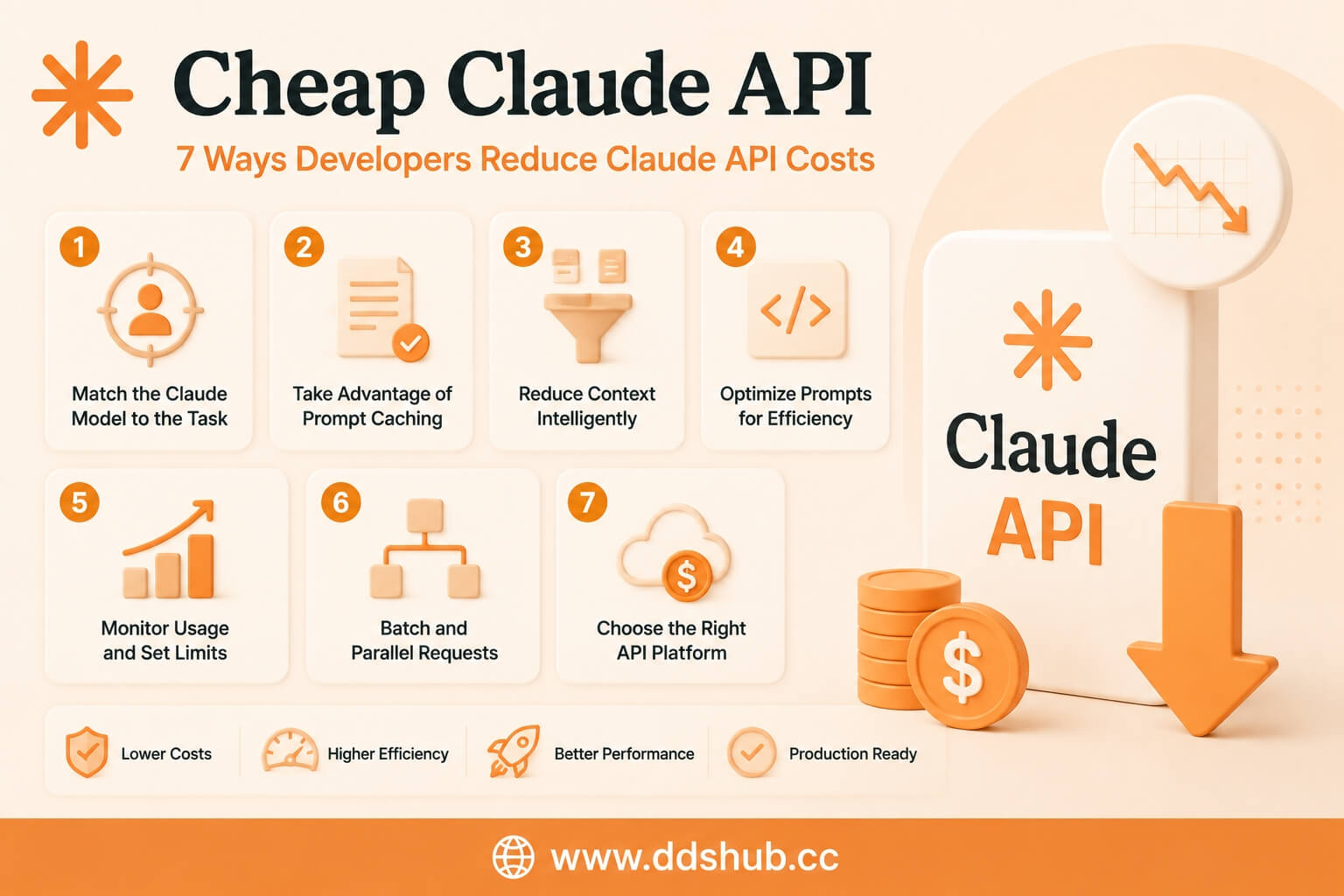
It is a reasonable question. Claude is recognized for its strong reasoning ability, high-quality code generation, and excellent long-context performance, but these advantages also make API usage one of the largest infrastructure expenses for companies building production AI applications.
Finding a cheaper Claude API is not simply about paying less per request. Experienced engineering teams usually focus on improving how Claude is used, selecting the appropriate model for each workload, optimizing prompts, and choosing an API platform that simplifies both cost management and deployment. Together, these strategies can significantly reduce operational expenses while maintaining the quality that makes Claude valuable in the first place.
This guide explores seven practical approaches that developers use today, supported by official Claude documentation and real-world production practices.
Understanding Claude API Pricing
Before discussing cost optimization, it is important to understand how Claude API pricing works.
Unlike Claude Pro or Claude Max subscriptions, which are designed for interactive use through the Claude web application, the Claude API follows a pay-as-you-go pricing model. Every request is billed according to the number of input and output tokens processed, while prompt caching allows repeated context to be reused at substantially lower input costs.
Anthropic currently offers multiple API models, including Claude Fable 5, Claude Opus 5, Claude Sonnet 5, and earlier Opus and Sonnet releases. Each model has its own token pricing and performance characteristics, allowing developers to balance capability against cost depending on the application.
Official Claude API pricing: https://platform.claude.com/docs/en/about-claude/pricing
Rather than asking which Claude model is the cheapest, developers should ask which model provides the best value for a particular workload.
1. Match the Claude Model to the Task
One of the easiest ways to reduce Claude API costs is to avoid sending every request to the most capable model.
Many applications perform a mixture of simple and complex tasks. Customer support requests, document classification, summarization, and routine code generation often require far less reasoning than architecture reviews, advanced debugging, or multi-step planning.
Production AI systems increasingly route requests dynamically, using lighter Claude models for routine workloads while reserving flagship models such as Claude Opus 5 or Claude Fable 5 for tasks that genuinely require advanced reasoning. This approach reduces average API costs without noticeably affecting user experience.
2. Take Advantage of Prompt Caching
Prompt caching is one of the most effective features available for lowering Claude API costs, yet many applications fail to use it efficiently.
Large coding assistants, enterprise knowledge systems, and AI agents frequently send identical system prompts, documentation, repository information, or company policies with every request. Without caching, all of those input tokens are billed repeatedly.
Anthropic's prompt caching mechanism allows reusable context to be stored and referenced across requests, dramatically lowering the cost of repeated input tokens. Applications that work with large repositories or extensive documentation often see substantial savings simply by restructuring prompts to maximize cache reuse.
Anthropic documentation: https://platform.claude.com/docs
3. Reduce Context Instead of Model Quality
Claude's long-context capability is one of its greatest strengths, but it can also become one of the largest contributors to API costs if used inefficiently.
Many developers initially send complete conversation histories or entire repositories with every request. As applications grow, this approach becomes increasingly expensive.
Instead, production AI systems usually summarize previous conversations, retrieve only the documents relevant to the current request, or maintain long-term memory outside the model. These architectural improvements reduce token consumption while preserving the information that actually matters.
In many cases, optimizing context management produces larger cost reductions than switching to a less capable model.
4. Build a Multi-Model Architecture
Leading AI products rarely rely on a single model.
Instead, different models are assigned to different workloads according to their strengths. Claude may handle architectural reasoning and complex planning, Codex can generate production code, Kimi K3 can process large technical documents, while GLM handles cost-sensitive automation at scale.
| Task | Recommended Model |
|---|---|
| Complex reasoning | Claude |
| Software implementation | Codex |
| Long-context document analysis | Kimi K3 |
| Cost-efficient automation | GLM |
Using multiple models allows development teams to reserve Claude for high-value reasoning tasks while reducing infrastructure costs across the rest of the application.
5. Improve Prompt Engineering
Prompt engineering is often discussed from the perspective of model quality, but it also has a direct impact on API costs.
Long prompts containing duplicated instructions, unnecessary examples, or repeated context increase token consumption without necessarily improving output quality. Engineering teams therefore invest time in designing concise system prompts, reusable templates, and standardized instruction formats.
Anthropic's own prompt engineering documentation recommends providing clear objectives, structured instructions, and well-defined output requirements instead of relying on excessively verbose prompts.
Official Prompt Engineering Guide: https://platform.claude.com/docs/en/build-with-claude/prompt-engineering
Better prompts generally improve response consistency while simultaneously lowering token usage.
6. Compare API Providers Instead of Only Comparing Models
Many developers compare AI models but spend far less time evaluating the API platforms that deliver them.
Official APIs remain the preferred choice for many applications, but developers also evaluate API providers based on regional availability, payment methods, operational simplicity, pricing, unified billing, and support for multiple AI models.
For teams building production applications, infrastructure considerations often become just as important as benchmark performance. A platform that simplifies account management, supports several leading AI models, and provides competitive pricing can reduce operational overhead far beyond the difference in token costs alone.
7. Use a Multi-Model API Platform
As AI applications become more sophisticated, maintaining separate accounts for Claude, GPT, Codex, Kimi, and GLM quickly becomes difficult.
Multi-model API platforms solve this problem by providing a unified API endpoint that supports multiple leading models through a single account.
DDShub follows this approach by providing access to Claude, Codex, Kimi, GLM, and other popular models within one platform. Instead of maintaining multiple API integrations, developers can build flexible routing strategies while managing billing through a single interface.
For supported Claude model groups, DDShub currently offers pricing starting from approximately 20% of the official Claude API price, allowing teams to significantly reduce infrastructure costs while continuing to build production applications with Claude.
- DDShub: https://www.ddshub.cc
- Models: https://www.ddshub.cc/models
- Documentation: https://www.ddshub.cc/docs
Official Claude API vs Multi-Model API Platform
| Feature | Official Claude API | Multi-Model API Platform |
|---|---|---|
| Direct Claude API access | Yes | Yes |
| Multiple AI models | No | Yes |
| Unified billing | No | Yes |
| Single API endpoint | No | Yes |
| Flexible model routing | Limited | Yes |
| Cost optimization opportunities | Usage dependent | Platform pricing + routing strategies |
For many development teams, the greatest benefit is not simply obtaining a lower API price, but reducing engineering complexity while making it easier to select the right model for each task.
Final Thoughts
Developers searching for a cheap Claude API are often trying to solve a broader problem than reducing token prices. The real objective is building AI applications that remain affordable as usage grows.
Successful engineering teams rarely depend on a single optimization strategy. Instead, they combine model routing, prompt caching, efficient context management, prompt engineering, and multi-model architectures to control infrastructure costs while preserving application quality.
As AI systems become more capable and more complex, choosing the right API platform becomes just as important as choosing the right language model. Platforms that simplify access to multiple leading models while providing competitive pricing allow developers to spend less time managing infrastructure and more time building products.
For teams planning to deploy Claude alongside Codex, Kimi, GLM, or other leading AI models, adopting a unified API platform can be one of the most effective long-term strategies for reducing operational costs without compromising capability.