
AI Coding Prompt Engineering: Better Prompts for Claude, Codex, and GLM
AI coding assistants have fundamentally changed the way developers build software. Instead of writing every function from scratch, developers can now use models like Claude, Codex, and GLM to generate code, review pull requests, explain unfamiliar repositories, and even automate repetitive development tasks.
However, the quality of AI-generated code depends on more than just choosing the "best" model. In many cases, the biggest factor is the quality of the prompt itself. A vague request encourages the model to guess, while a well-structured prompt provides enough context for the model to reason like an experienced engineer.
This is why prompt engineering has become an essential skill for modern developers. By understanding how coding models interpret instructions, you can generate more reliable code, reduce unnecessary revisions, and make AI a more effective part of your development workflow.
Why Prompt Engineering Matters
Unlike a general chatbot, a coding model must understand technical context before it can produce useful results. Asking an AI assistant to "build a login system" leaves many important questions unanswered, including the framework, authentication method, project structure, and coding standards.
A better prompt reduces ambiguity and helps the model make decisions based on facts instead of assumptions.
| General Chat Prompt | AI Coding Prompt |
|---|---|
| Open-ended conversation | Task-oriented request |
| Minimal context | Repository or project context |
| Flexible response | Predictable engineering output |
| Creative discussion | Clear technical requirements |
Whether you're using Claude, Codex, or GLM, the same principle applies: clear requirements produce better code.
A Simple Prompt Structure That Works
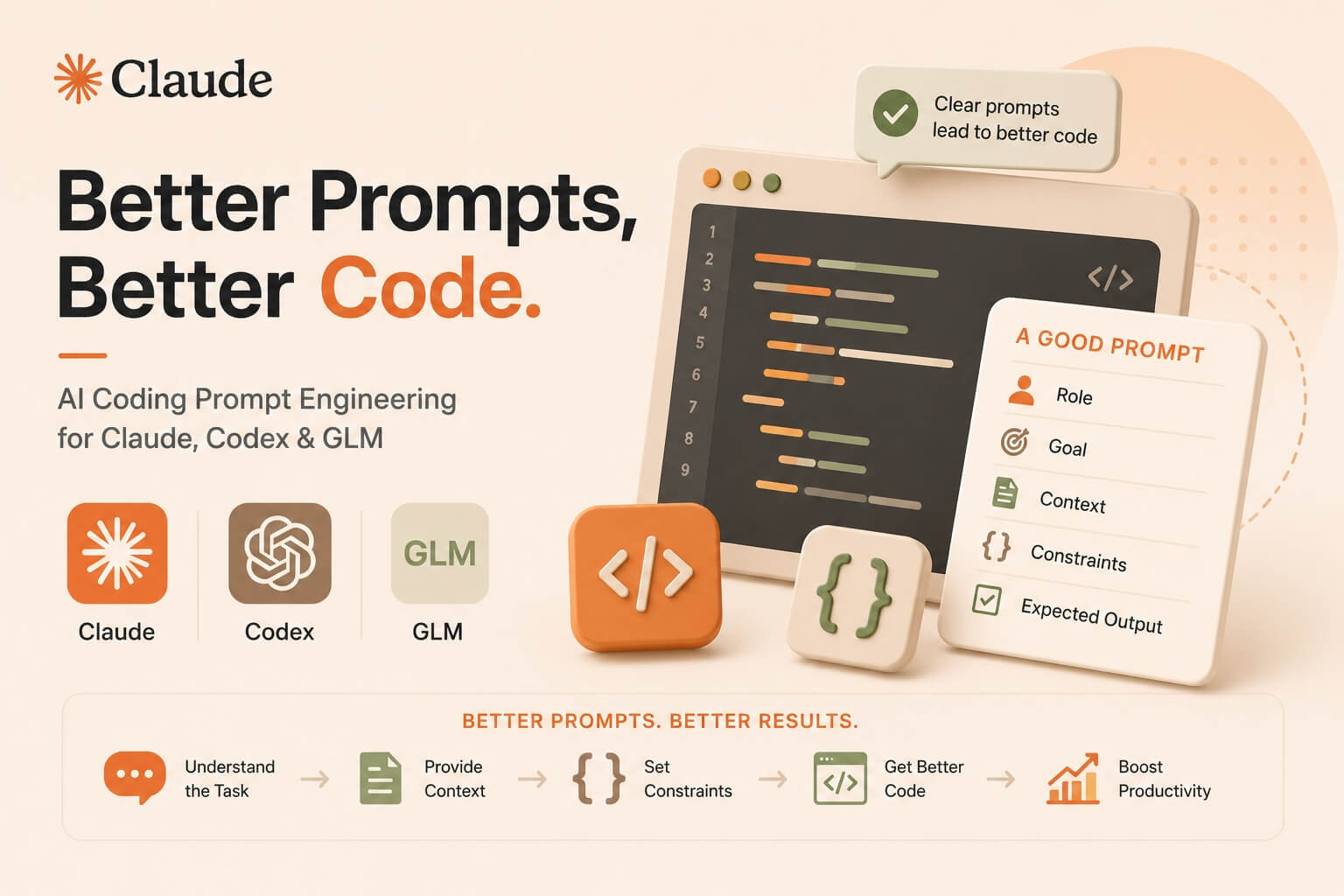
A good coding prompt doesn't need to be long — it just needs to be structured. A simple framework that works well across most coding models is:
- Role
- Goal
- Project Context
- Constraints
- Expected Output
For example, instead of writing:
Build a REST API.
Try something like this:
Role You are a senior backend engineer.
Goal Build a JWT authentication API.
Project Context Existing FastAPI project with PostgreSQL.
Constraints Keep the current architecture. Do not introduce unnecessary dependencies.
Expected Output Return a Git diff and explain each change.
This format gives the model enough information to generate code that fits naturally into an existing project instead of producing a generic example.
Prompt Tips for Claude
Claude is particularly strong at understanding large codebases and complex project structures. Rather than immediately asking it to generate code, it's often more effective to ask Claude to analyze the problem first.
For example:
- Review the existing architecture first.
- Identify potential risks.
- Recommend the best implementation approach before modifying any files.
Claude also performs well when you ask it to preserve the current architecture and explain the reasoning behind its changes. For larger projects, requesting a Git diff instead of a complete file rewrite makes the output easier to review and integrate.
Anthropic also recommends providing sufficient context and clear instructions in its official Prompt Engineering documentation.
Prompt Tips for Codex
Codex works best when prompts resemble development tasks or engineering tickets. Instead of broad requests, define the objective, constraints, and expected outcome.
A typical Codex prompt might look like this:
Goal Implement Google OAuth login.
Requirements Keep existing authentication methods.
Acceptance Criteria Existing tests continue to pass. Generate unit tests for new functionality.
Breaking work into clear tasks helps Codex focus on implementation rather than guessing your intent. This approach is particularly effective for iterative development and AI coding agent workflows.
Learn more about Codex from OpenAI.
Prompt Tips for GLM
GLM responds well to prompts with clearly defined output formats, making it a practical choice for structured engineering tasks and enterprise development.
For example:
Role Senior Java Engineer
Task Review this Spring Boot controller.
Output
- Problems
- Suggested Improvements
- Optimized Code
- Explanation
Separating analysis from implementation encourages the model to reason before writing code, which often leads to more maintainable solutions.
Official documentation is available from Zhipu AI.
Build a Smarter AI Coding Workflow
Many development teams now combine different coding models instead of relying on just one. Claude is commonly used for architecture reviews and repository analysis, Codex excels at implementation and iterative coding tasks, while GLM provides an excellent balance between performance and cost for many development scenarios.
Managing multiple providers separately can quickly become complicated, especially when each platform has its own authentication, billing, and API format.
Platforms such as DDS Hub simplify this process by providing dedicated model groups for Claude, Codex, and GLM. Instead of maintaining multiple integrations, developers simply create an API key for the model group they need. Each API key belongs to a specific model group — for example, a Claude group key accesses Claude models, while a Codex group key is dedicated to the Codex family. This approach keeps projects organized while allowing teams to choose the right model for each task.
Learn more at www.ddshub.cc.
Conclusion
Prompt engineering isn't about writing longer prompts — it's about writing clearer ones. By defining your goal, providing project context, setting technical constraints, and specifying the expected output, you help AI coding models produce more reliable and maintainable code.
Whether you prefer Claude for architectural reasoning, Codex for implementation, or GLM for cost-effective development, the same principle remains true: better prompts lead to better software. As AI becomes a standard part of modern development, mastering prompt engineering will be just as valuable as learning a new programming language or framework.