
AI API Pricing 2026: GPT-5.6 vs Claude Fable 5 vs Opus 5, Which Model Gives Developers the Best Value?
As AI applications move from simple chatbots to autonomous agents, coding assistants, and enterprise automation systems, API pricing has become one of the most important factors developers need to consider.
In the early stage of AI development, many teams focused primarily on model capability. The question was often simple: which model gives the best answers?
However, as AI applications become more complex, the cost structure behind each request becomes equally important. A single interaction with a modern AI agent may involve multiple reasoning steps, tool calls, context retrieval, and verification cycles. The final cost is no longer determined only by the price of one response, but by the entire workflow behind that response.
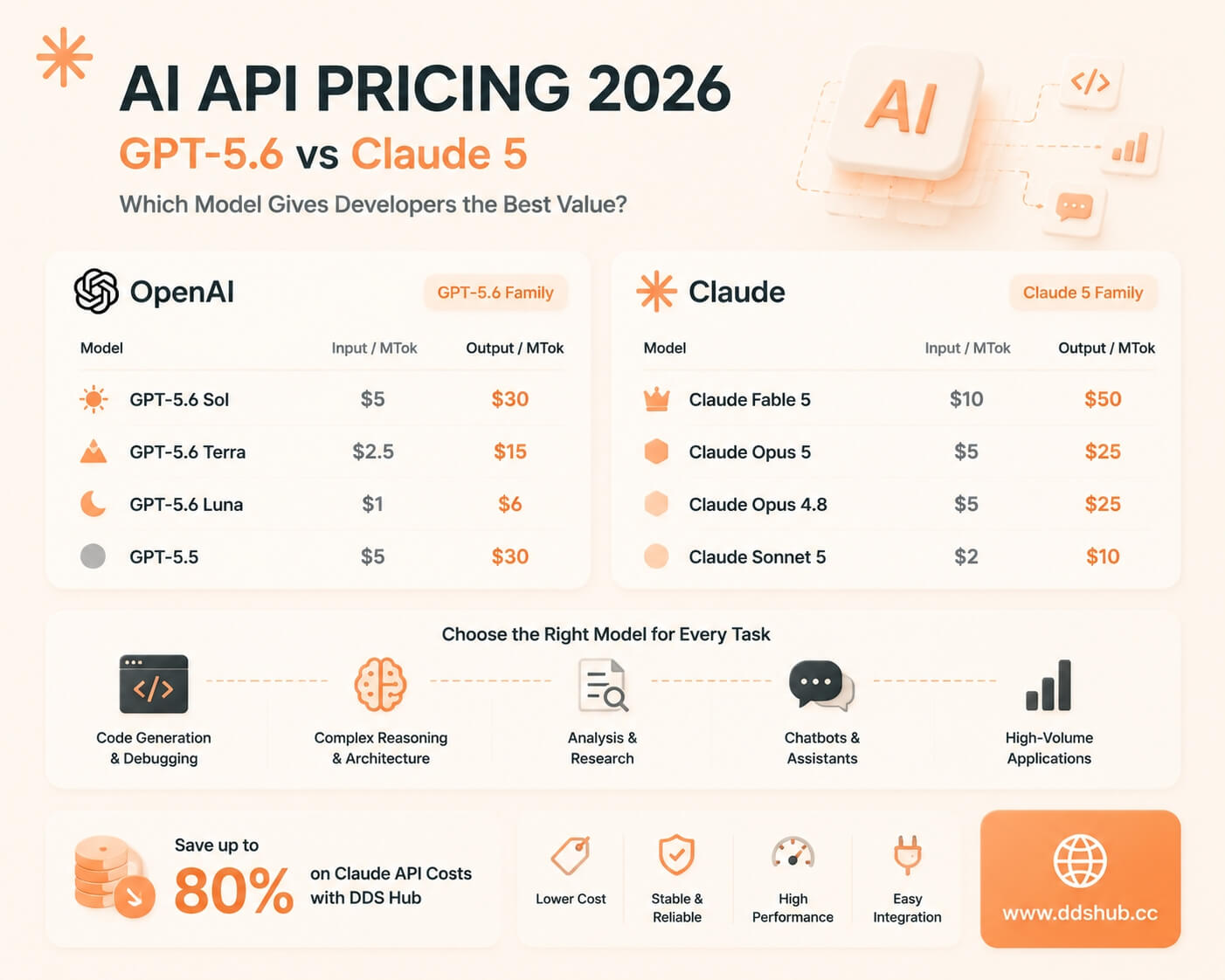
Currently, OpenAI's GPT-5.6 series and Anthropic's Claude 5 series represent some of the most advanced commercial AI models available. Both companies offer different model tiers designed for different workloads, from high-performance reasoning to cost-efficient large-scale applications.
For developers building AI products, the key question is not simply which model is the most powerful. The more practical question is:
Which model provides the best balance between intelligence, reliability, and API cost?
This article compares GPT-5.6, GPT-5.5, Claude Fable 5, Claude Opus 5, Claude Opus 4.8, and Claude Sonnet 5 pricing, explains their different use cases, and explores how developers can reduce AI infrastructure costs with solutions such as DDS Hub.
Official pricing references: OpenAI API Pricing and Anthropic Claude API Pricing.
Understanding AI API Pricing: Why Token Cost Matters
Most commercial AI APIs use token-based pricing.
Instead of paying a fixed monthly subscription, developers pay according to the amount of information processed by the model. Input tokens represent the information sent to the model, including prompts, documents, and conversation history. Output tokens represent the generated responses.
For simple applications, token consumption may be relatively small. A chatbot answering short questions may only use a few thousand tokens per interaction.
However, modern AI agents work differently. A coding agent may need to understand an entire repository, analyze dependencies, generate code, test changes, and review the final result. One user request can trigger dozens of internal model calls.
This is why AI API pricing cannot be evaluated only by looking at the input and output price of a single model. Developers need to consider the cost of completing the entire task.
A more expensive model that solves a problem in fewer iterations may sometimes be cheaper than a lower-cost model that requires repeated corrections.
GPT-5.6 Pricing: Sol, Terra, and Luna Create a Flexible Model Strategy
OpenAI introduced the GPT-5.6 family with different performance levels designed for different application scenarios.
The flagship GPT-5.6 Sol model focuses on maximum reasoning capability. It is designed for complex coding tasks, advanced reasoning workflows, and applications where accuracy is more important than minimum cost. Its API price is $5 per million input tokens and $30 per million output tokens.
GPT-5.6 Terra takes a middle position between performance and cost. With pricing of $2.5 per million input tokens and $15 per million output tokens, Terra is designed for developers who need strong intelligence but also need to control operating expenses.
GPT-5.6 Luna focuses on cost efficiency. Its pricing is $1 per million input tokens and $6 per million output tokens, making it suitable for higher-volume applications where developers need to process many requests while maintaining reasonable model capability.
| Model | Input Price | Output Price | Positioning |
|---|---|---|---|
| GPT-5.6 Sol | $5 / MTok | $30 / MTok | Flagship reasoning and advanced agents |
| GPT-5.6 Terra | $2.5 / MTok | $15 / MTok | Balanced intelligence and cost |
| GPT-5.6 Luna | $1 / MTok | $6 / MTok | High-volume AI applications |
| GPT-5.5 | $5 / MTok | $30 / MTok | Professional coding and reasoning |
The advantage of this tiered approach is that developers do not need to use the most expensive model for every request. A production AI system can assign different tasks to different models depending on complexity.
For example, a software engineering agent may use GPT-5.6 Sol for architecture decisions while using GPT-5.6 Luna for simple code explanations or documentation generation.
Claude Pricing: Fable 5, Opus 5, and Sonnet 5 Explained
Anthropic follows a different model strategy with its Claude family.
Rather than creating several price tiers under the same generation, Claude models are usually divided by capability level.
Claude Fable 5 represents the highest-performance tier. It is designed for advanced AI agents, complex reasoning tasks, and enterprise workflows where maximum capability is the priority.
The official pricing position places Fable 5 at approximately $10 per million input tokens and $50 per million output tokens, making it one of the most expensive models in the Claude ecosystem.
Claude Opus 5 provides a different balance. It focuses on advanced reasoning and coding capability while maintaining a lower price level compared with Fable 5. Opus 5 is priced at approximately $5 per million input tokens and $25 per million output tokens.
Claude Opus models are commonly selected for applications involving:
- Complex software engineering
- Large codebase analysis
- AI agents
- Long-context reasoning
Claude Sonnet 5 targets developers who need strong capability with better cost efficiency. Its standard pricing is approximately $3 per million input tokens and $15 per million output tokens.
For many production applications, Sonnet-class models provide an attractive balance because they can handle most daily AI workloads without the higher cost associated with frontier reasoning models.
| Model | Input Price | Output Price | Typical Usage |
|---|---|---|---|
| Claude Fable 5 | $10 / MTok | $50 / MTok | Advanced autonomous agents |
| Claude Opus 5 | $5 / MTok | $25 / MTok | Enterprise reasoning and coding |
| Claude Opus 4.8 | $5 / MTok | $25 / MTok | Complex development workflows |
| Claude Sonnet 5 | $3 / MTok | $15 / MTok | General AI applications |
Anthropic runs an introductory promotion on Claude Sonnet 5 at $2 per million input tokens and $10 per million output tokens through August 31, 2026. Official pricing may change over time, so always confirm the latest numbers on the Claude pricing page.
GPT-5.6 vs Claude 5: Which Model Is Cheaper?
Looking only at token prices, GPT-5.6 Luna and Claude Sonnet 5 are among the most cost-efficient flagship-level models.
However, comparing AI models purely by price can be misleading.
Different models have different strengths.
Claude models are widely used for coding workflows, long-context tasks, and complex reasoning. Many developers choose Opus-level models when accuracy and reliability are more important than minimizing every request cost.
OpenAI models provide a broad developer ecosystem, strong tool integration, and multiple model options for different workloads.
For example, an AI coding platform may choose Claude Opus 5 for complex repository analysis but use GPT-5.6 Luna for high-volume assistant interactions.
The most cost-efficient architecture is often not choosing one model. It is combining different models based on task requirements.
How AI Agents Change API Cost Calculations
Traditional chat applications usually have a simple cost structure.
A user sends a message, the model generates a response, and the interaction ends.
AI agents are different.
An agent may internally perform multiple steps before producing the final answer. It may analyze a problem, call external tools, retrieve information, generate intermediate reasoning, and verify results.
This means the actual cost depends on the workflow design.
For example, an AI coding agent may spend more tokens analyzing a repository than generating the final code itself.
Developers building AI agents therefore need to optimize both model selection and system architecture.
Using a frontier model for every internal step can create unnecessary costs. A more efficient approach is to reserve powerful models for difficult decisions while using cheaper models for routine operations.
DDS Hub API Pricing: Reducing Claude API Costs
For developers building AI products, API cost directly affects business scalability.
DDS Hub provides Claude API access with pricing approximately 20% of official Claude API pricing, allowing developers to reduce Claude API expenses by around 80%.
The comparison below shows the approximate difference.
| Model | Official API Price | DDS Hub Approximate Price |
|---|---|---|
| Claude Fable 5 | $10 / $50 MTok | ~$2 / $10 MTok |
| Claude Opus 5 | $5 / $25 MTok | ~$1 / $5 MTok |
| Claude Opus 4.8 | $5 / $25 MTok | ~$1 / $5 MTok |
| Claude Sonnet 5 | $3 / $15 MTok | ~$0.6 / $3 MTok |
For teams operating AI coding assistants, automation systems, or AI SaaS products, reducing token cost can significantly improve operating margins.
DDS Hub provides developers with API access through a familiar integration method.
API Endpoint:
https://www.ddshub.cc/v1Visit DDS Hub to get started, and see the DDS Hub Models page for the full list of supported models.
How Developers Reduce AI API Costs
Reducing AI expenses requires more than selecting the cheapest model.
The first step is choosing the correct model for each task.
A complex software architecture problem may justify using GPT-5.6 Sol or Claude Opus 5. However, a simple document summary or classification task does not require the same level of intelligence.
The second step is optimizing prompts.
Large unnecessary instructions, repeated context, and inefficient conversations increase token usage. Better prompt design can reduce costs without sacrificing output quality.
The third step is improving application architecture.
Developers can use techniques such as prompt caching, context management, and model routing to reduce unnecessary API calls.
A mature AI application usually does not depend on one model. It dynamically chooses the most appropriate model based on task complexity.
Final Thoughts
The competition between GPT-5.6 and Claude 5 is not only about model capability. It is also about cost efficiency.
GPT-5.6 provides developers with multiple options through Sol, Terra, and Luna, allowing teams to balance performance and price.
Claude provides a similar strategy through Fable 5, Opus 5, and Sonnet 5, offering different levels of reasoning capability.
The cheapest model is not always the most cost-effective model. The best choice depends on how the model is used, how many tokens the application consumes, and how efficiently the entire workflow is designed.
For developers building AI agents, coding assistants, and commercial AI products, controlling API costs will become increasingly important.
By combining the right model selection strategy, prompt optimization, and cost-efficient API access platforms such as DDS Hub, teams can build powerful AI applications while maintaining sustainable operating costs.